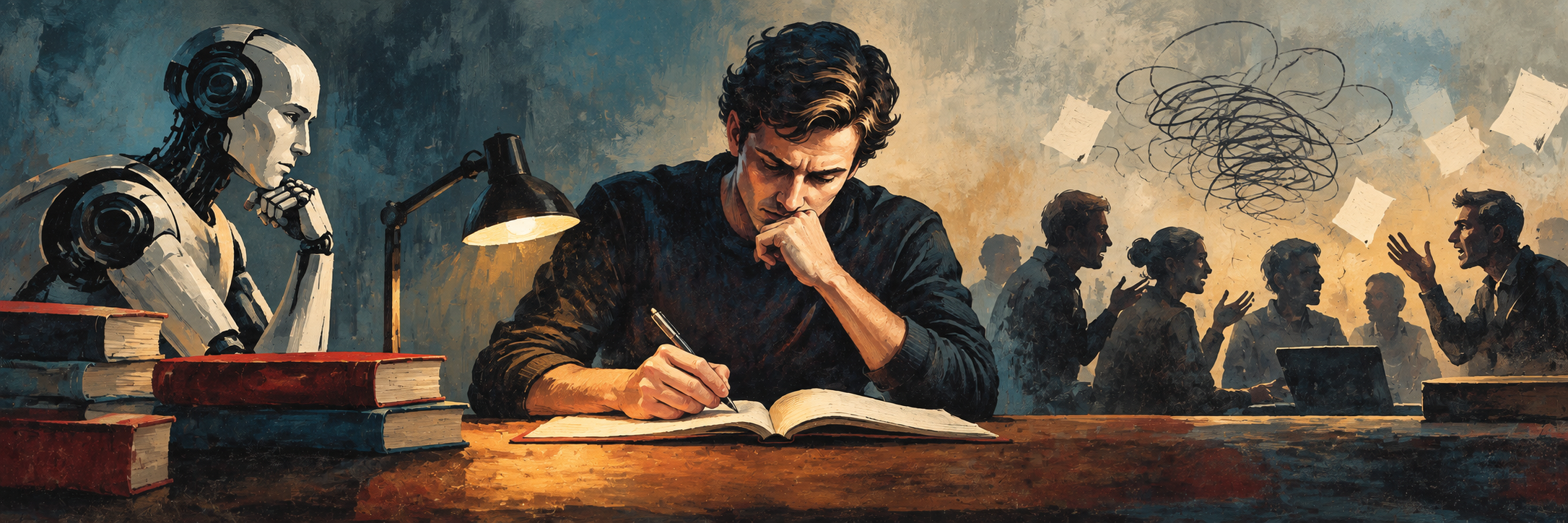
I make my living by writing, for as long as AI allows it, and one might think this article is an exercise in self-serving professional protectionism. It is. But it is also true.
Read more The Spectator P.M Ep. 250: Mamdani Lets Prostitution Run Amok in NYC
More oral communication and less writing. That is the prescription advocated in The New York Times by the chair of the philosophy department and the program in cognitive science at Williams College. It is the sort of article that appeals to journalists and editors simply because it argues the opposite of what everyone else believes. The New York Times seems to have adopted a policy in recent years of constantly publishing provocative pieces that challenge the status quo, provided the views aren’t right-wing. Naturally, the Times isn’t going to publish an article debunking the utility of wind and solar power in halting climate change, or claiming that sex reassignment doesn’t exist, only amputation does. As a journalistic gambit, it is fine, at least for those who regard provocation as a form of thought rather than a waste of time. Regardless of the exercise’s entertainment value, however, the conclusion reached by the author, Joe Cruz, is depressing. (RELATED: Would the Whiff of AI Have Panicked Harold Ross?)
“But what if we are mistaken in treating writing as the highest cultivation of thought?” he asks, though he is stacking the deck: who actually considers writing the great engine of thought? Writing allows us to organize concepts, escape the dizzying pace of oral communication, anchor ideas much more deeply, and calmly find the precise word to deliver a message that is far more refined and sincere than most spoken discourse. Yet no one actually thinks it is the great engine of thought. I find it embarrassing to have to explain something like this to a distinguished academic. (RELATED: Disembodied Autonomy)
To write is to think twice. To speak is to think and go public on the fly.
Writing compels us to organize our ideas before blurting them out haphazardly. It allows for a second look at what we intend to say. And, generally speaking, it enables the construction of longer, more precise arguments. To write is to think twice. To speak is to think and go public on the fly. In fact, when we think through and memorize a script for a speech, we are already doing something very similar to writing it out.
Cruz points out that we could make better use of oral communication and develop our mental faculties through “attention, memory, and interaction with others.” He dislikes the idea of continuing to use written exams. He proposes alternatives, such as thinking aloud together. If you have ever attended a work meeting, you know there are two types of people: those who have written down what they wanted to say beforehand and contribute something useful and concrete, and those who improvise and think aloud, often the very people responsible for meetings lasting three times as long and for the debate of the most idiotic proposals.
Read more Sarah Sanders Steps In It Just Before the Midterms
I have always been a staunch defender of written exams. There are many students for whom oral exams are a source of torment. They interfere with their cognitive processes and sensibilities to such an extent that the results fail to reflect their actual knowledge. I am not sure whether oral exams should be used or not, but eliminating writing from university assessments would be a colossal blunder, just one more in an educational system that is currently in a slump across the West.
This is not the only article I have read recently arguing against writing in the context of finding solutions to the challenges AI will bring to education. I dislike being cynical, yet my job requires a certain degree of skepticism. I get the impression that the campaign against writing is cut from the same cloth as the campaign against the humanities and philosophy. Diminishing the importance of writing — and reading — in schools would have an immediate impact on students: a reduced capacity for critical and reflective thought. The same applies to the marginalization of the humanities and philosophy.
Besides, many writers have, of course, written about the act of writing itself. P.J. O’Rourke, who wrote wonderful things, used to say he was in favor of recycling: “One of the problems with being a writer is that all of your idiocies are still in print somewhere. I strongly support paper recycling.” And Paulo Coelho ought to be, too, after having penned such awful things as “Tears are words that need to be written.”
Writing is essential. It is often only through writing that we realize an idea which sounded good in our heads, once put down on paper and brought into the real world, is utter nonsense. We are in the 21st century: the world does not need more stupid ideas, but fewer. Come to think of it, perhaps Coelho dictates his works into a recorder. That would explain everything.
Read more Democrats Lust for Violence
READ MORE from Itxu Díaz:
The High Priests of Performative Goodness
The UN’s Never-Ending Power Grab
Medicine’s Great Unfinished Business: The Common Cold
About the Author