Author’s note: When I wrote this article, I had not yet heard the news of Wendell Berry’s passing. I dedicate this article to his memory.
Read more The Hidden Benefits of the Lindsay Clancy Trial
In 1987, Wendell Berry’s essay “Why I Am Not Going to Buy a Computer” appeared in Harper’s. The personal computer had by then become ubiquitous. Manufacturers of hardware and software were booming, and as in most booms, many jumped on the hype bandwagon.
Berry’s point in his essay remains clear — the progress of machines is not identical with human progress. Replying to the many people who told him that he could improve his writing by using a computer instead of his pencil, pad, and Royal typewriter, he challenged their underlying premise — that emulating machines is the highest good.
He was told that with the computer, he could write faster, easier, and more. In a 1989 follow-up essay, Berry asked himself if that is what he wanted:
No. My standards are not speed, ease, and quantity. I have already left behind too much evidence that, writing with a pencil, I have written too fast, too easily, and too much. I would like to be a better writer, and for that I need help from other humans, not a machine.
Put as a question of aim: Is our human aim best set on emulating machines, or is it better set on emulating that which is most high?
Everyone seems to realize that AI is likely to be more powerful than almost anything we have ever invented.
When I read Berry’s essays back in the late ’80s, I was finishing up work on my doctoral dissertation. When I had written my master’s thesis, it was on a typewriter, and footnoting and editing were time-consuming and complex. I was very happy that my little Mac together equipped with Word allowed me to edit and footnote with ease, and I wouldn’t have to retype and renumber the pages and footnotes, as the computer did all the work.
About forty years later, I am writing this article on a computer as well. So, Berry did not persuade me to toss my computer out. But his caution has helped keep me away from believing that my work is better simply because I have electronics at my disposal. The questions in the end to ask are: what makes us and our work better? And am I aiming for the highest?
The moral message I took from Berry’s essays was to focus on the work. The tools I use must not distract me from my aim and distort what I produce. They must serve my highest aim and if they cannot serve, I must not lower my aim and serve the machine. I understand him in the light of an old slogan of a conservation organization: “Not blind opposition to progress, but opposition to blind progress.” Or as my father-in-law of blessed memory, a professor of rabbinic literature, taught: “The most important thing is not whether something is new or old, but whether it is bad or good.”
Technology has been a part of our human life since the dawn of history. Our biblical heritage warns us of our human tendency to think our technological cleverness allows us to displace God. The story of the Tower of Babel is one of technical advance and of a society that defined itself by that advance. Their aim seems to be to displace God, with their mighty tower evidence to themselves that they could now ascend endlessly. But the result of the project was instead the implosion of human coherence. Language itself dissolved into babble (the English accurately follows the Hebrew play on words). The midrashic literature gives a picture of one instance: “One worker called for bricks; the other brought him mortar. Enraged, he smashed his skull.”
When technology usurps the position of the highest good in human life, it subverts our language. And because language is the key to our humanity, our humanity itself is subverted. And then, our technological prowess goes down along with everything else: “Oh God, pride of man/Broken in the dust again.”
When our aim is no longer on the highest, our technology cannot save us from a descent into the profound isolation. The death of language is the death of humanity, isolating us from each other and our common task.
Had Berry been a simple no-sayer, we could dismiss him more easily. But he does not propose rejection of technology as an ultimate good. Rather, he proposes tests that technology should pass if we are to use it.
Read more The Iran War, the Houthis, and America’s Problem With Winning Wars
The question of the desirability of adopting any technological innovation is a question with two possible answers — not one, as has been commonly assumed.… If one’s motive is love of family, community, country, and God, then one will have to think, and one may have to decide that the proposed innovation is undesirable.
Berry thinks that tech enthusiasts are the ones with predetermined answers. His answer is not a pre-determined “no” but a test against worthy criteria, ones that reflect our proper aim. Much good has resulted from the computer and all that came in its wake; but, for just one example, the power of the social media that the computer enabled damaged or ended far too many lives.
All of this shows that our current wrestle over AI is not something new. It is just the latest instance of a technological leap that, if addressed without engaging our highest standards and deepest insight, can hurt our human cause.
The question, after all, is the one we confronted in the Garden of Eden — that we have the power to do something does mean that that something will be good.
Power is neither self-justifying nor inevitably corrupting.
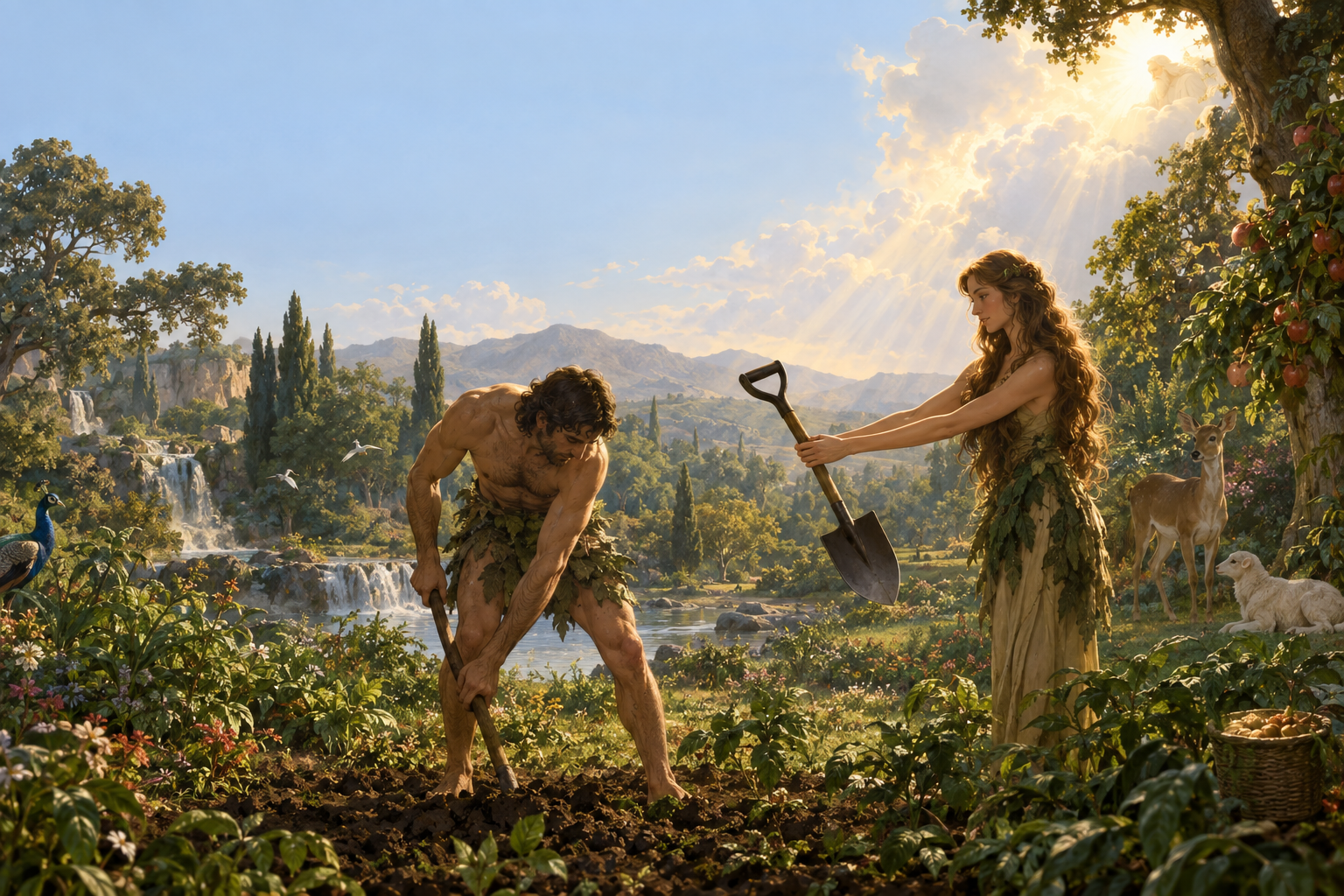
In the Garden, God already endorsed human work. The Genesis text says God placed Adam in the Garden “to work it and to keep it” — the Hebrew for “to keep it” also has the meaning of tending and of guarding. Tools aren’t mentioned; if their use promotes the work and the preservation of its good, then it is implicit that the tools are beneficial.
And like all questions about the good, they require our deepest attention. They are not trivial questions. We need to learn how to ask them.
The issue of technology is taken up in two of the Ten Commandments. The Sabbath requires setting aside the seventh day each week to refrain from creative, which means altering the world to suit our needs — which is what we use technology to do. And what is idolatry but the worship of things we make? It is the most cardinal of sins in our relationship with God; as the prophet Amos said: “We will say no more, ‘Our God,’ to the work of our hands.”
So, the Bible rejects technology? Not at all. The texts above are of one piece with the prayer of Psalm 90, which seeks God’s blessing on our creative work: “May the favor of the Lord our God rest on us; establish the work of our hands for us — yes, establish the work of our hands.”
But it is not insignificant that this approval comes through prayer. We need that deep and heartfelt engagement and self-examination before God: does this serve in achievement of the highest aim that alone informs all my life with meaning?
Technology increases our power. It raises the stakes. The greater the power, the greater the risk of hurt and damage both for using the power recklessly and for failing to realize the good that the technology may enable us to achieve.
We can’t afford to make a mistake in either direction. Everyone seems to realize that AI is likely to be more powerful than almost anything we have ever invented. Let’s hold a discussion that recognizes this and aims for the highest. Nothing less serious, less all-embracing is going to be adequate.
And perhaps we ought to follow Benjamin Franklin’s suggestion to the deadlocked Constitutional Convention and engage in prayer and implore the direction of Providence in our conversations.
Read more Trump’s Greenland Deal Offers a Lesson for the Iran War
READ MORE from Shmuel Klatzkin:
Michigan AG Dana Nessel to Jewish Democrats: Sacrifice Yourself for the Cause
The Questions We Must Ask About Islam
The Truth About ‘It Didn’t Start on October 7’
About the Author