During the course of researching so many books on Ronald Reagan, I’ve thought to myself numerous times: Wow, that would make a great movie.
Read more The Spectacle Ep. 462: Michigan AG Dana Nessel Invokes Queen Esther To Elect Abdul El-Sayed
My colleague Mark Joseph thought the same. One day in 2004, he called about making one of my Reagan books a movie. Twenty years later, the movie became reality, based on my 2006 work, The Crusader: Ronald Reagan and the Fall of Communism, starring Dennis Quaid. That film is a deep dive into the life of Ronald Wilson Reagan, with the thread being his long crusade against atheistic, militant Soviet communism and his plan to peacefully win the Cold War. (READ: “Reagan Gets a Director’s Cut—and Hinckley Shares Some Words.”)
If one were looking for a dramatic flashpoint in that effort, at least regarding Reagan’s direct efforts with Mikhail Gorbachev, it might be captured in one word and place: Reykjavik. That is, the enormously consequential 30-hour engagement between Reagan and Gorbachev in Reykjavik, Iceland, Oct. 11-12, 1986. From the first time I sat in the Reagan Library in Simi Valley in the summer of 2001 reading declassified MemCons (Memoranda of Conversation) between Reagan and Gorbachev at Reykjavik, I thought to myself: Wow, that would make a great movie.
Alas, what were the chances of that happening? Modern movies are saturated with sensationalism, over-hyped bunkum, with shouting and screaming actors, with moronic, mind-numbing action sequences. There were no car chases at Reykjavik. No explosions or people falling from buildings or presidents jumping from airplanes onto the lava rock below. There was no sex or vulgarity. Moreover, Hollywood has little interest in heavy dialogue — even riveting, real dialogue between pivotal leaders whose words literally reduced nuclear stockpiles and changed history.
Plus, of course, Hollywood has been corrupted by politics. Even though everyone back in the day credited both Ronald Reagan and Mikhail Gorbachev with ending the Cold War (Gorbachev himself credited Reagan), Hollywood leftists are so poisoned by ideology that they surely wouldn’t make a movie highlighting the grand historical achievement that was Reykjavik. (READ: “My Response to the Reagan Critics and Haters.”)
Fortunately, we’ve arrived at a long-awaited, blessed moment in which new, independent film companies and technology have made it possible to move beyond Hollywood’s vagaries and to start making movies apart from the toxicity of Tinsel Town and cost-prohibitive budgets. Seizing the moment is a group that has at long last given us a movie about Reykjavik, and it’s superb and well worth your time. (RELATED: Reagan, Gorbachev, and The Brink of War That Changed the World)
A Bipartisan Message
The film is called The Brink of War, produced by SK Global and 2521 Entertainment and distributed by Angel Studios. It’s written by Michael Russell Gunn in his directorial debut. The producer is John Logan Pierson, with Tristan Roche as the co-producer. This group has given the world a story increasingly rare and badly needed today, one in which adversaries and bipartisan diplomats work together to build bridges rather than demonize one another.
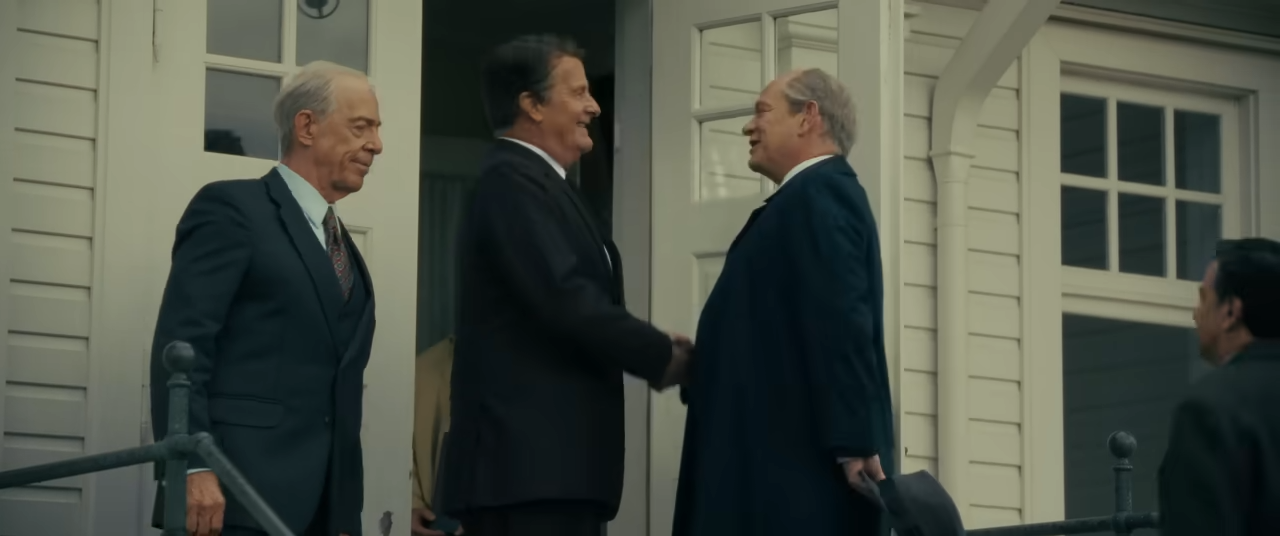
The Reagan and Gorbachev characters are played by Jeff Daniels and Jared Harris, respectively. An English actor, Harris does a fine job with Gorbachev (and a Russian accent). Among other quirks of Gorbachev’s personality, Harris captures the general secretary’s unappreciated angry demeanor. Despite hagiographical portrayals of Gorbachev by Western admirers, the man was a hothead. A minor criticism is that Harris looks older and more tired than Gorbachev, but that’s no big deal. Likewise, Jeff Daniels doesn’t look much like Reagan (he looks more like Reagan’s brother Neil). Nonetheless, he makes you forget about the lack of physical resemblance and draws you into the depth of the affable Reagan character.
Nancy Reagan is played by Hope Davis. She isn’t caricatured as catty and flaky as she is in so many over-the-top portrayals. Well, not totally. In one scene, she has an astrology chart on her desk as she suggests to Ronnie during a phone conversation: “Well, Mars is ascendant, so we have that going for us.” I can’t vouch for whether that exchange truly happened, but it’s plausible.
As for Nancy’s counterpart/rival, Raisa Gorbachev is played by Branka Katic, a pretty actress who makes the atheist-Marxist Soviet “first lady” more appealing than she really was. Katic actually grew up under Raisa’s crappy communist system. The Serbian actress lived in communist Yugoslavia and escaped.
An amusing addition is the cast of four Reagan arms negotiators, whom the president chides as his “four Democrats”: Max Kampelman, Paul Nitze, Richard Perle, and Ken Adelman. (Adelman corrects Reagan, noting that he’s a Republican. Indeed he was, though never very conservative. Adelman endorsed Kamala Harris in 2024 and urged voters to support her as the heir to Reagan.)
Particularly central to the film is U.S. Secretary of State George Shultz, who is played splendidly by J.K. Simmons. Shultz’s eyewitness testimony carries the narrative, from the opening scene where Reagan fears he has failed, lamenting to Shultz as the summit finishes, “It’s over.” The movie sequence then jumps back to their arrival at Reykjavik. Shultz repeatedly bucks up Reagan with lines like, “It was your military buildup — you got us here, sir — you got them to the table.”
Shultz is so central that the film credits close with a dedication to him. That isn’t undue, given his role as Reagan’s right-hand man at Reykjavik. His notes have long been the dominant voice of record on Reykjavik, all the way until his death on Feb. 6, 2021 (Reagan’s birthday) at the age of 100.
Impressively, the filming was done on-site in Reykjavik at the now-historic Höfði House where the president and general secretary locked horns in four long face-to-face meetings. The shots of the surrounding landscape and raging seawater are visually alluring. Kudos to the cinematographer, Magdalena Gorka, for her lovely work. Gorka, too, experienced life behind the Iron Curtain — growing up in Poland.
Ending Nukes and Debating Religion
As for the historical backdrop and film focus, it was at Reykjavik, the second summit between Reagan and Gorbachev following Geneva the previous year, that the two leaders took extraordinary strides aimed not at limiting the growth of tens of thousands of nuclear weapons (as previous negotiators had sought), but at actually reducing their number. In an incredible series of steps that stunned the world, the president and general secretary pursued a deal to abolish all of the two superpowers’ nukes — every single one of them, at every level, on the ground, in silos, on subs, long range, short range, intermediate, you name it.
Within the context of these intense negotiations was Gorbachev’s obsession with the Strategic Defense Initiative and desire to limit, if not banish it completely, as well as Reagan’s commitment to keeping SDI. At one point, remarkably, Reagan went so far as to offer to share the anti-nuke missile shield with the Soviets. Such a shield would allow both sides, the United States and the USSR, to protect their countries from incoming missiles from future rogue regimes. Also dominant within the negotiations was Ronald Reagan’s passion for protecting human rights for Soviet refuseniks, Russian Jews, Pentecostals, Soviet-born cellist Mstislav Rostropovich, and more. For Reagan, nothing was more important than these basic human rights, a fact that annoyed Soviet officials who never gave a damn about morality in their genuinely evil empire. Theirs was a system that, as Reagan put it in the film, “subjugates every citizen, denying them not just basic rights, but their God-given free will.”
Throughout the two-hour film, the pair take the gloves off. Reagan is shown for what he was during these finest of hours: calm, composed, confident, witty, in command, and profoundly dedicated to the abolition of not just an evil empire but nuclear weapons.
The dialogue is the heart and soul of the film, as it should be. Unfortunately, the dialogue isn’t a direct cut-and-paste from the official notetakers and was subject to the scriptwriter’s embellishment. Of course, that’s expected of a movie, and I don’t object to it, so long as the thrust of the dialogue is consistent with reality. To that end, a particularly lively exchange occurs during the afternoon session on day one of the summit. Reagan and Gorbachev go toe to toe and blow for blow, with George Shultz and Foreign Minister Eduard Shevardnadze accompanying them.
Read more John Cornyn Is Owed No Revenge at the Expense of His Own Party
As the two leaders start rolling with major breakthroughs, Gorbachev lights up, smiles, and cheers: “Good. We are making progress!” Reagan responds with a colloquialism, “Seems like Christmas has come early.” Shultz agrees and laughs, though Gorbachev and Shevardnadze are confused by the expression and assume it’s a theological statement by the Christian president. Gorby’s frown returns as he grimly objects in classic commie-atheist fashion: “What does your religious holiday have to do with this?” A genial Reagan calmly responds, “Nothing, sorry, I forget you’re all atheists,” but then adds, “Although it seems to me the Party is about the same as a church. You’re true believers in the Party, right?” Gorbachev and Shevardnadze look at one another, offended. Gorby barks from across the table: “What exactly do you mean?” Reagan explains what the Soviet general secretary knows about the official Party-Marxist line on religion: “I mean you deny religion, as hokum, bunk, nonsense. There can’t be an Almighty Party if there’s an Almighty God above it. So your people can’t worship. They have to worship the Party.”
Confronting this undeniable truth makes Gorbachev fume: “To paraphrase the words of our theology: religion is a false prophet to the people, promising them things that they themselves must achieve.” Reagan’s rejoinder: “And yet you make them wait in line for bread and shoes and milk. And then deny them the hereafter that would suggest that their suffering is temporary. They’ve got nothing to look forward to, this life or the next. No wonder they’re so pissed off.” (For the record, Reagan rarely swore, even with a mild word like “pissed off.”) Here, Shevardnadze interjected: “The Soviet people are not ‘pissed off,’” prompting Reagan to reply with a rather good observation: “Then why do they want to leave? Why do you have to keep them locked up behind walls — like the one in Berlin? Why not tear it down?”
The diplomatic Shultz tries to intervene to tone down an increasingly heated exchange over communism, capitalism, commercialism, immigration, media, and even cinema, but no luck. Reagan cracks an insulting joke about Soviet bread lines. The tit-for-tat ends with these fireworks:
Gorbachev: And you believe you are the only one with public relations problems, Mr. President… you see: we both answer to the people.
Reagan (with a cool smile): Yes, but my people — if they criticize me publicly — don’t get sent to the gulag.
Gorbachev (insulted and angry): And my people can’t shoot me.
Ouch. Now that was a gut punch to Reagan. Of course, Gorbachev’s people had no right to bear arms — itself a problem in a totalitarian dictatorship. Reagan’s people — John Hinckley included — have that right, and oftentimes to the detriment of public safety, even the safety of the president of the United States.
That exchange certainly hits Reagan in the film. It hit me as intriguing but not something I remembered from the MemCons or anywhere else. And truth be told, it never happened. Gorbachev never said that to Reagan. That line — that powerful punch from the general secretary — was made up.
Relatedly, I’m fairly certain that there was writer’s embellishment in the repeated moments in the film when Reagan is shown shaking in his sleep and tormented by nightmares of being shot on March 30, 1981. The film opens with Reagan haunted by that memory as he stands in a dark suit staring out at the crashing waves of the sea. He’s lost in the memory of gunshots ringing outside the Washington Hilton, “pop, pop, pop.”
Traumatic as that moment had been for Reagan, I’m not aware of it haunting him like this at Reykjavik or anywhere. The film nonetheless accentuates that theme. At one point, he’s shown changing his shirt, and we see the bullet scar under his left armpit.
Nonetheless, even when embellished, this theme serves to properly underscore the very real reality that Ronald Reagan felt that God spared his life that moment in March 1981 precisely for the purpose of engaging the Soviets and seeking to peacefully end the Cold War. Reagan alludes to that in one exchange with Gorbachev.
That overwhelming sense of a deeper, divine purpose affected and drove Reagan throughout his presidency. It was a crucial factor in why he was at Reykjavik and everything he did with Gorbachev to end the Cold War.
The Beginning of the End
Though Ronald Reagan and Mikhail Gorbachev left Iceland without a deal, they initiated what turned out to be the beginning of the end of the Cold War. For that crucial rest-of-the-story assessment on what would ultimately happen, George Shultz is given the last word. In a moving soliloquy as the film closes, the Shultz character faces the audience and explains: “The press thought it was a failure at the time. Even I had my doubts. But a year later Reagan and Gorbachev signed the first arms reduction agreement in human history. Since then, nuclear weapons have been reduced to less than 10 percent of their Cold War peak.”
Here, the film flashes to newsreel footage of Reagan and Gorbachev signing the INF Treaty at the White House in December 1987. The agreement reduced intermediate-range nukes to zero on both sides. Shultz continued: “Two years later, the war was over and just as Reagan foresaw… the Soviet Union ended.” Here again, newsreel footage of young people sledgehammering the Berlin Wall and Rostropovich amidst the rubble.
And then, the money line of the whole film and summit, as Shultz wraps up: “A few years after that, when Gorbachev visited me out at Stanford, I said: ‘When we met, the Cold War was at its most dangerous point and then three years later it was over… What was the beginning of the end?’ He replied with one word: ‘Reykjavik.’”
Personally, that really struck me, given that when I visited George Shultz in his office at Stanford in July 2003, I asked him that same question. His answer: he told me what Gorbachev told him at that office: Reykjavik.
I smiled in appreciation. I wouldn’t be surprised if I said something like, “Wow, that would make a great movie.”
Read more The Pro-Life Revival May Already Be Underway
Well, finally, thanks to this group of filmmakers, it is.
READ MORE from Paul Kengor:
Reagan Gets a Director’s Cut — and Hinckley Shares Some Words
Whatever Happened to the Spare Tire?
Toy Story 5 and the Vanishing America of Toy Stores and Churches
About the Author