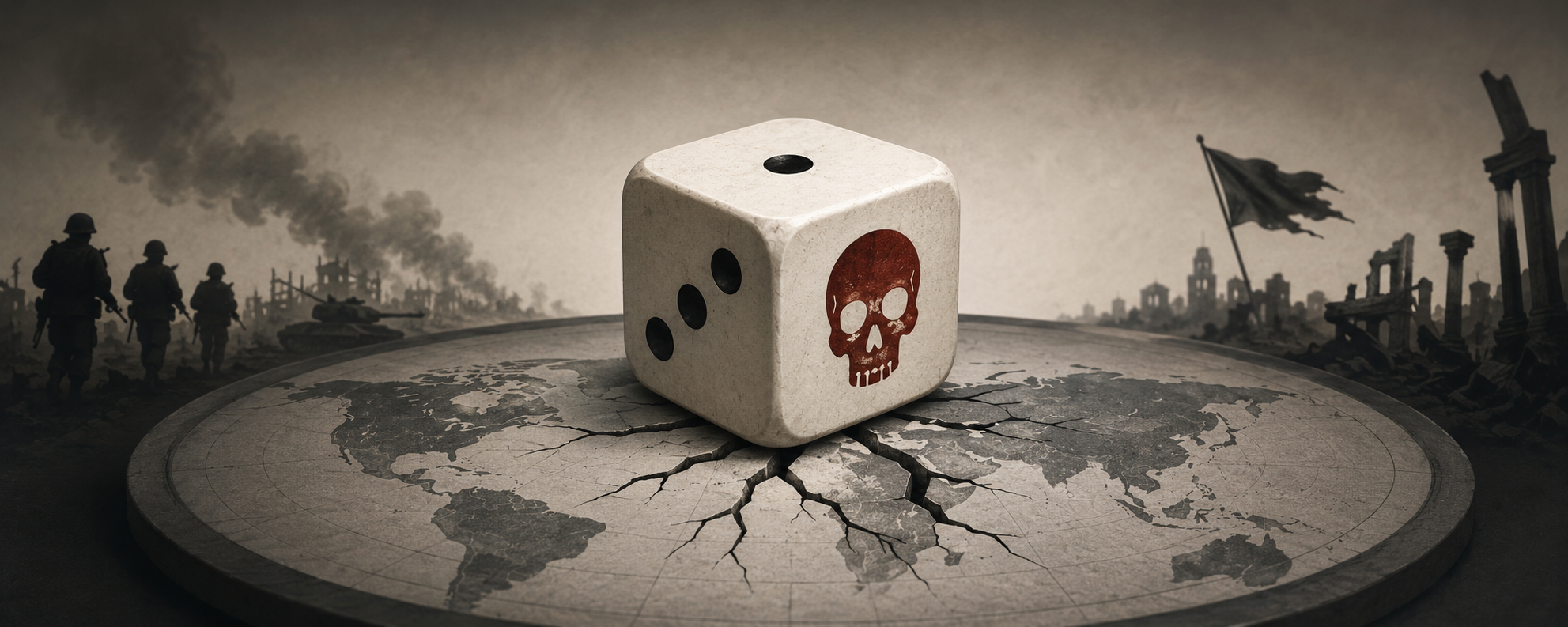
I understand that President Trump is not averse to making an occasional wager, and I am assuming that when he does so, he considers the odds. I would have liked to have had a chance to brief him on the results of a study I did a number of years ago before the Iran War started. At the time, I was teaching a class on military theory, and I did an analysis of the success rate of the states that started conventional wars of the 20th Century. I’d like to think that the results would have sobered Mr. Trump.
Read more The Worst Job of the Century
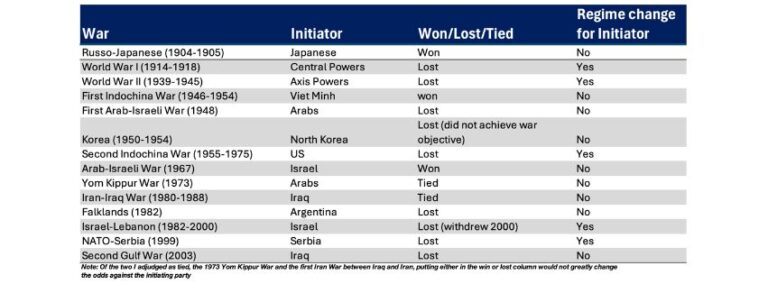
Of the 15 conflicts I examined, the side that started the war lost 10 of them. Three were won (I adjudged two to be ties); my choices can be debated, but in any case, the odds for the initiator are very poor. Discounting the ties, the odds for success by the initiating actor are alarmingly low at 23.08 percent. (RELATED: The Iran War: Trump Must Choose Between Victory and Defeat)
Worse still, of the 10 wars lost by the party/parties that initiated the conflicts, 50 percent resulted in regime change among those that started the war. These are terrible odds for governance survival. This raises the question of why governments continue to start wars? Other than the fact that no one has ever published such a study before this — I never published mine — the real answer lies in the simple fact that wars tend to mutate beyond the control of those who start them, and those mutations seem to pile up the longer a conflict lasts. The chart below details the results of the study.
The example of the Central Powers in World War I was a good illustration. The Austrians declared war over the assassination of their crown prince, and their ally Germany began the war by invading neutral Belgium to get at France. Atrocities against Belgian civilians by the Germans helped to bring the British into the war, and unrestricted submarine warfare later brought in the United States. Soon, the Central Powers were engaged in a seemingly endless war against most of the rest of the world. Eventually, their starving populations demanded change. Those mutations doomed them.
The Johnson administration came to a similar end in Vietnam. It entered what it perceived to be a guerrilla war and believed it could quickly overpower the Vietnamese insurgents with overwhelming conventional might. It did not take the crafty leaders in Hanoi long to figure out how self-limiting the Americans were. Like the current Iranians, Hanoi’s leaders calculated how much pain they could sustain from the Americans and settled in for a long war. Seeing no end in sight, and with young Americans turned against the war in droves, the mutation drove Johnson from office long before the war was finally lost.
Sometimes, overwhelming force caused by bad conduct and atrocities causes the intended victim to gain so many powerful allies that the actors who initiated the war stumble into a situation where the victors demand not just total surrender, but total regime change upon the initiating powers. The cruelty and barbarism of Nazi Germany and Imperial Japan in World War II in Europe and the Pacific – and I count these as separate conflicts- made any chance for negotiated settlements unthinkable. The initial short wars that the Germans, Italians, and Japanese envisioned turned into existential conflicts that exterminated the Nazis, Italian Fascists, and Japanese militarists. (RELATED: Iran, Hitler, and the Lessons of Munich)
Read more The Spectacle Ep. 461: Understanding the Democrats’ Weird Relationship With Islam
With one exception, in none of the conflicts I studied did the initiating actor expect a prolonged war. Only in the 1967 Arab-Israeli War did the initiating actor get the quick and decisive victory it expected. The only exception was the First Indochina War, and that exception proves the rule. The Viet-Minh believed that a long conflict would not be tolerated by the war-weary French population. They were right. In some cases, such as the Falklands War, Desert Storm, and the Kosovo-Serbian conflict, the initiator so badly miscalculated that it was defeated quickly and decisively. Mutation here was caused by miscalculation by the initiator; there is no accounting for incompetence.
Von Moltke was right: no plan survives contact with the enemy. Some combination of miscalculation, time, incompetence, popular morale, perceived atrocities, and sheer bad luck caused mutations in all of the conflicts discussed above. In a very few cases, the mutations favored the initiator, but these were few and far between.
With the exception of the Viet Minh, no one starts a war expecting a long and difficult slog. But few gamblers would call when the odds against them were over 75 percent. Perhaps Peter, Paul, and Mary were right. When will we ever learn?
READ MORE from Gary Anderson:
The Navy’s Morale Problem: Send the Sailors to the Marines
When AI Wants More Than Your Job
Mr. President: Let the Marines Destroy Iran and the Houthis
Gary Anderson taught military theory with the Naval ROTC Unit at Vanderbilt University and the Marine Corps University. For two decades, he lectured on Red Teaming and Wargaming at the George Washington University’s Elliott School of International Affairs
Read more Why Aren’t Our Modern-Day Robber Barons Giving Us Robber-Baron Benefits?
About the Author