Understanding that the First Amendment came from a religious imperative and it was not a mere cover for disbelief offers us a bracing perspective on today’s politics.
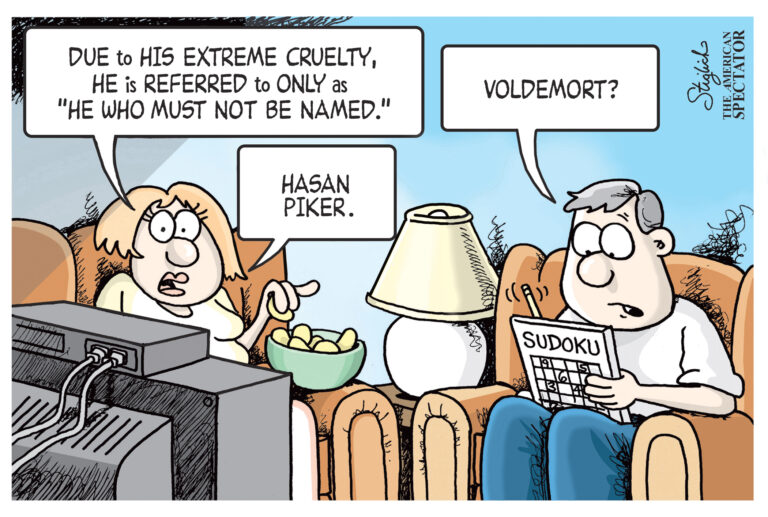
Read more Dear AOC, Hasan Piker Is Not Joe Rogan
This idea that the First Amendment’s religious freedom was established on religious grounds seems shocking to those not acquainted with the Hebrew Republic movement — that’s most Americans. But Harvard’s Eric Nelson brought that movement back into the spotlight about 15 years ago. In his book The Hebrew Republic, he shows how the great political thinkers in Holland and Britain beginning nearly two centuries before the Declaration looked to rabbinic literature — a literature that had not been seriously studied in Christian Europe before then.
And we Americans would not accept our Constitution without religious freedom in the first place. It is a religious imperative.
It was there that they found the teaching of the Noahide Covenant, a living and working tradition flowing from the fount of biblical law. Political thinkers of the 1600s, including Petrus Cunaeus, Hugo Grotius (codifier of the open seas doctrine in international law), John Selden, and even Thomas Hobbes, derived from the Noahide Covenant the crucial idea that God’s law is minimalist in statutes but maximalist in offering a legitimate framework in which all nations and their faiths can find a place.
Looking from this authentic perspective, today’s great political issues are bathed in a clarifying light. Increasingly, today’s battles reveal themselves as essentially religious.
In his account of England’s 17th Century constitutional revolution in his History of the English-Speaking Peoples, Winston Churchill notes that most people will not risk very much for mere political abstractions. He described what happened in the 1600s before the great issues of the day gripped the whole nation, not just politicians:
The Parliamentary party knew that upon the constitutional issue alone they could not succeed.
The King and his Archbishop were seeking centralized authority in both religion and politics. Charles’ Archbishop of Canterbury, William Laud, liked that mix. He started to enforce old royal edicts that punished absence from Church of England worship, edicts that had long gathered dust:
The King’s religious ideas marched in step with his politics and resentments multiplied… [The practice of enforced attendance] had fallen into widespread disuse. Some did not trouble to go; to others it was abhorrent. Now all over England men and women found themselves haled before the justices for not attending church… Here indeed was something ordinary men and women could understand.
And so, the slope towards war pointed more steeply downwards. When the war came, it featured in its various phases: the army of the King and the episcopate of his church; the Presbyterian army of the Scots who had rejected the King’s bid to have them conform in worship; and Cromwell’s Puritan army, who proved the victor.
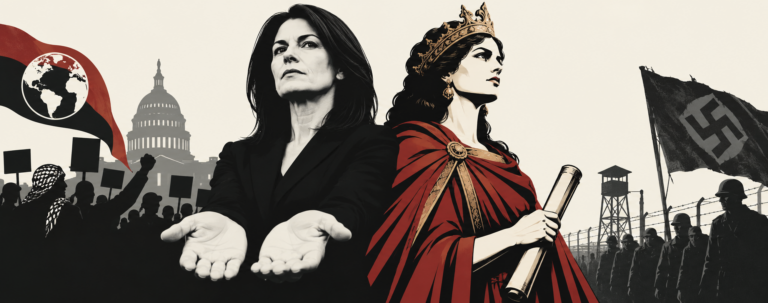
Our current political standoff is at core a religious standoff as well. The current collapse of the old liberal Democrat Party in a gravitational doom spiral into the DSA black hole is a direct result of that liberalism’s belief that America’s freedoms, the chief of which is the freedom of religion, was in fact a decisive turn away from religion, a la Spinoza. FDR might join Churchill in singing hymns with gusto in Christian prayer on the deck of the Navy ship off Newfoundland in 1941, and the photo of that moment is an icon of that time. But after the wreckage of the Warren Court’s comprehensive assault, even the devout Jimmy Carter could not respond effectively, and left a muddle there as in other places.
Muddle is not particularly inspiring. The Dems attempt to frame Reagan’s comfort with old values as bozo-ish and cowboy-like was mirrored in successive elections until it reached full maturity with Obama’s disparaging of those he called bitter clingers to religion and (non-government) guns among other things, people who then found themselves in Hillary’s basket of deplorables and Old Joe’s garbage. This disparagement hasn’t worked very well, and one very strong reason is that none of those candidates made clear their own religious beliefs — for since none of us know all things, and all of us must act nonetheless, we all have a faith that serves as the map by which we negotiate the uncountable number of things clamoring for our attention and response.
Read more Is Your Home Really ‘Stolen Land’? The Case for Property Rights
The old liberals figured it was all obvious enough that there is a vacuum at the center of things and those who don’t agree are just stupid/bitter/deplorable garbage.
But now they are grasping the issue at hand — people know when there is a vacuum. And people with aggressive faiths, who agree that religious freedom and religion are incompatible — they see an opportunity.
The religious warriors of the DSA are cutting through the old guard agnostics like the blade of a plastic surgeon performing a lipectomy. They believe in something and their missionary religious fervor is gaining them converts among the many raised in our culture with a God-sized hole in their hearts.
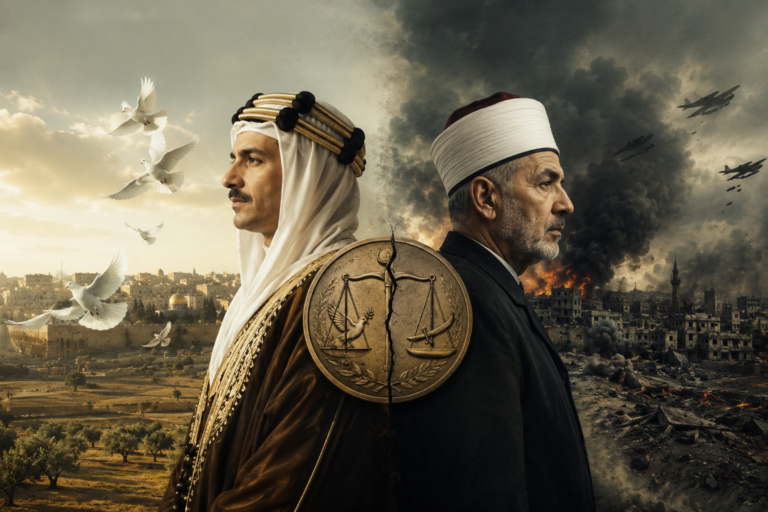
The DSA coup finds in radical Islamism a natural ally — though the alliance is, like that of Hitler and Stalin in 1939, only a marriage of convenience that can expect only a similarly short shelf life. They both are faith based and belief that their faith must have the power to compel uniformity — a uniformity demanded first in coerced actions but which will not be satisfied until it will control as well written and spoken words and ultimately inner thoughts — “He loved Big Brother.”
The methodology of the both the Green and the Red in this alliance is the same as well. It is characterized by the Arabic name hudna — the dissembling and even outright lying permitted in the war to conquer and convert. Groucho, of course, knew this tactic, and reflected on it: “The secret of life is honesty and fair dealing. If you can fake that, you’ve got it made.” Enough to make me a Marxist. It certainly helps to understand the difference between how Hamas and the PA talk among themselves and when they have a Western audience; or AOC and Mamdani admitting that Woke 1.0 is a bust as they work on a more throughgoing 2.0; or the suddenly reasonable words of DSA types who won their primaries in purple states as they seek the language that will take them past the point that the voters have a say.
In 17th century Britain, Cromwell enforced religious practice as much as the King had done; so did Puritans in Massachusetts Bay. But in the end, the Brits found their way through to Selden’s idea, ending the centuries-old expulsion of Jews, and admitting eventually even religious dissidents into Parliament and full political rights.
And we Americans would not accept our Constitution without religious freedom in the first place.
It is a religious imperative. It is a religious imperative that has united Christians and Jews, and it welcomes anyone else who accepts its very few precepts.
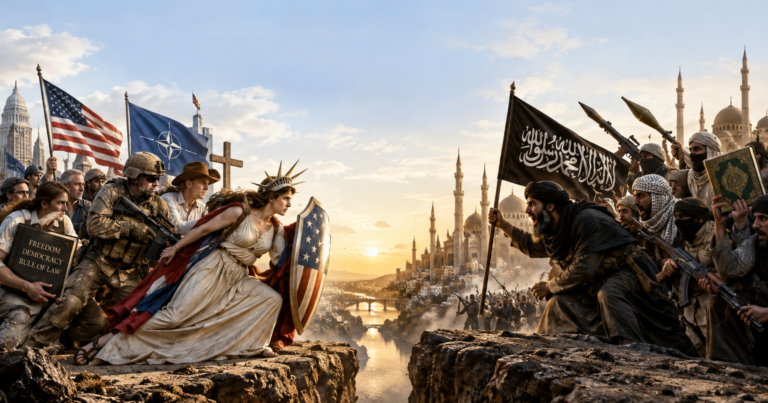
We are fighting those who are intolerant of what is in fact religious difference. Whether it is a religion construed from the worst elements of Islam or a religion that seeks to become a new incarnation of a state answerable to no one on earth or in Heaven, with exclusive control over politics and property, our opponents find the freedom to disagree with their faith existentially threatening.
And as to love is to do unto others as they would do unto us, it is a loving obligation — not only to ourselves and to our future, but also to our opponents — to fight them, not as a matter of abstractions interesting to just a few, but as an existential religious imperative.
Read more Conservatives Should Begin Eating Woke Culture for Breakfast
That is something that matters to everyone.
READ MORE from Shmuel Klatzkin:
Did Religion Create Religious Freedom? Rethinking the Origins of Western Liberty
Does Biden’s Pardon Mean Anthony Fauci Must Testify?
The Story That Refuses to Die
About the Author