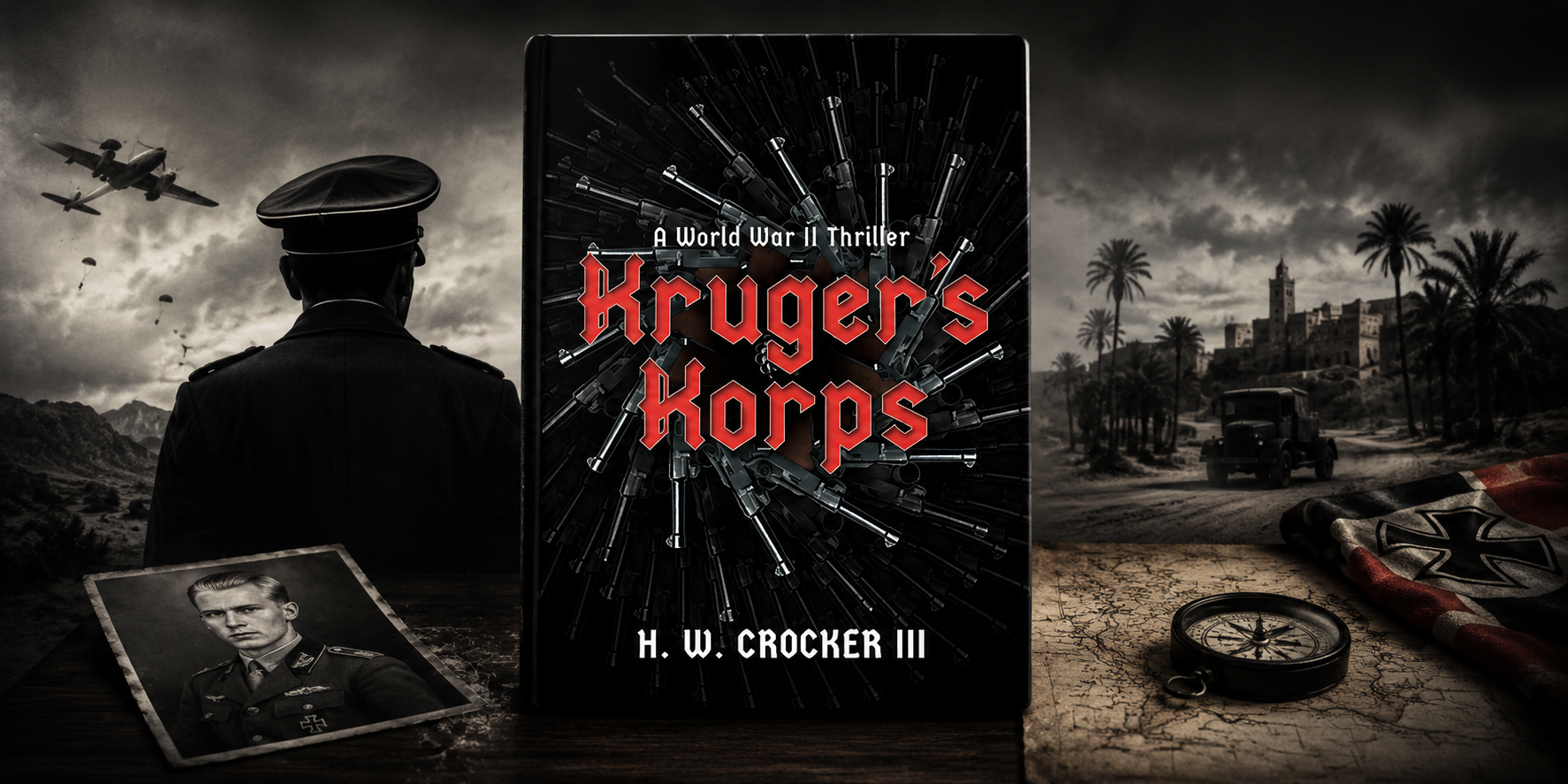
Krugers-Korps/H-W-Crocker/9798895654675″>Kruger’s Korps
By H.W. Crocker III
Simon & Schuster, 224 pages, $28.99
Read more Reclaiming the Middle: Chautauqua’s Slow Push Toward Balance
CIA founding father “Wild” Bill Donovan propels W. H. Crocker III’s historical novel Kruger’s Korps by handing a glossy photograph to titular character Rolf Kruger.
“It was a picture of a young German officer with a passing resemblance to me — fair-haired, square chin, light eyes,” Kruger observes. “But a decade of cultural conditioning had made me more of an Aryan Californian than an Aryan German, and he looked aristocratic, which my folks weren’t.”
“I don’t know what I’m supposed to notice, sir, except that he’s a German lieutenant in a Panzer division.”
Donovan explains, “He’s your spitting image, lieutenant.”
A spymaster, a doppelganger, and a world war — one can almost predict what happens next and indeed this scene sets up the rest of Kruger’s Korps.
Kruger, fortunately for the mission, speaks German and boasts several on-screen roles on his CV. He was made for this part.
The secret to success for a conservative novelist involves more novel, less conservative.
“You’re in the army now — the German Army,” Donovan informs the U.S. Navy ensign. “You are to become Lieutenant Wolf von Ravenhorst, the young man in the photograph. We’re going to drop you into North Africa and deliver you to the enemy. You leave tonight.”
In Africa, it gets wilder than Wild Bill Donovan. Well-fed Italian deserters (desserters?), violent pygmies, and Indochinese opium addicts splash vibrant colors on Crocker’s canvas. An aviator priest, a French beauty, and various characters of indeterminate loyalties add to the Star Wars bar scene feel of it all.
Throughout, one question permeates the story: Will the real Nazis please stand up?
Read more Cartoonists At Work
“Being exposed as a spy, I knew, wasn’t my only danger,” Kruger realizes. “Because of the uniform I wore, Allied soldiers could kill me in action without a second thought. We might have a murderer within our ranks. The French beauty sleeping in the seat beside me might be a spy — but for whom I did not know.”
Periodic anonymous poems, alluding to the subtraction of various members of the mission through murder, deepen the mystery.
Kruger finds one such note: “Thirteen little Nazis, all in a row. Two now dead, eleven to go.”
And, of course, because Kruger plays one of those 11 Nazis, the prospect of his going next — as a result of Nazis discovering his true identity or Allied spies not discovering it — looms large.
“God, I realized, was my sole trustworthy companion.”
The pace sprints rather than jogs. The story lapel-grabs the reader and does not let go. Throughout, Crocker’s tics, to include Catholic themes, old-timey ethnic nicknames and stereotypes (krauts and frogs abound), and projection of a chivalric ethos upon the fighters of the most brutal war in history, endear or annoy depending upon the reader’s tics.
Crocker, reputationally known as an editor (full disclosure: he edited my fifth book, The War on Football), heretofore occasionally switched places with authors. On the nonfiction side, his history of the Catholic Church, Triumph, received rave reviews. But his novels showcase his greatest talents. He is now a novelist who also edits. His initial foray into fiction, The Old Limey, came a quarter-century ago and remains one of the most entertaining novels of the new millennium. Kruger’s Korps, less comedic and more cinematic, similarly allows the reader to pass the time more pleasantly without the obligatory sermons so many authors regard as more important than story. One feels compelled to follow this story and see where it leads.
The secret to success for a conservative novelist involves more novel, less conservative. Crocker accomplishes this. Nobody devotes days of their life to read a book of fiction out of ideological solidarity. They want some enrichment in the form of enlightenment or entertainment. Flattering the ideological prejudices of the reader only goes so far.
Kruger’s captain tells him, “It’s going to be an adventure.” The word sums up the next 200 pages. Kruger’s Korps leads not to enlightenment but adventure. That seems like a good escape whether on a beach blanket or the couch on a rainy day.
Read more AOC Freezes Her Eggs: A Political Calculation or Cultural Symptom?
READ MORE from Daniel J. Flynn:
Is ‘Cancel Thanksgiving’ Really a Winning Message for Democrats?
Fauci Pleads the Fifth Before Congress
Help! I Got Trapped in a Citywide World Cup Party in Málaga, Spain
About the Author