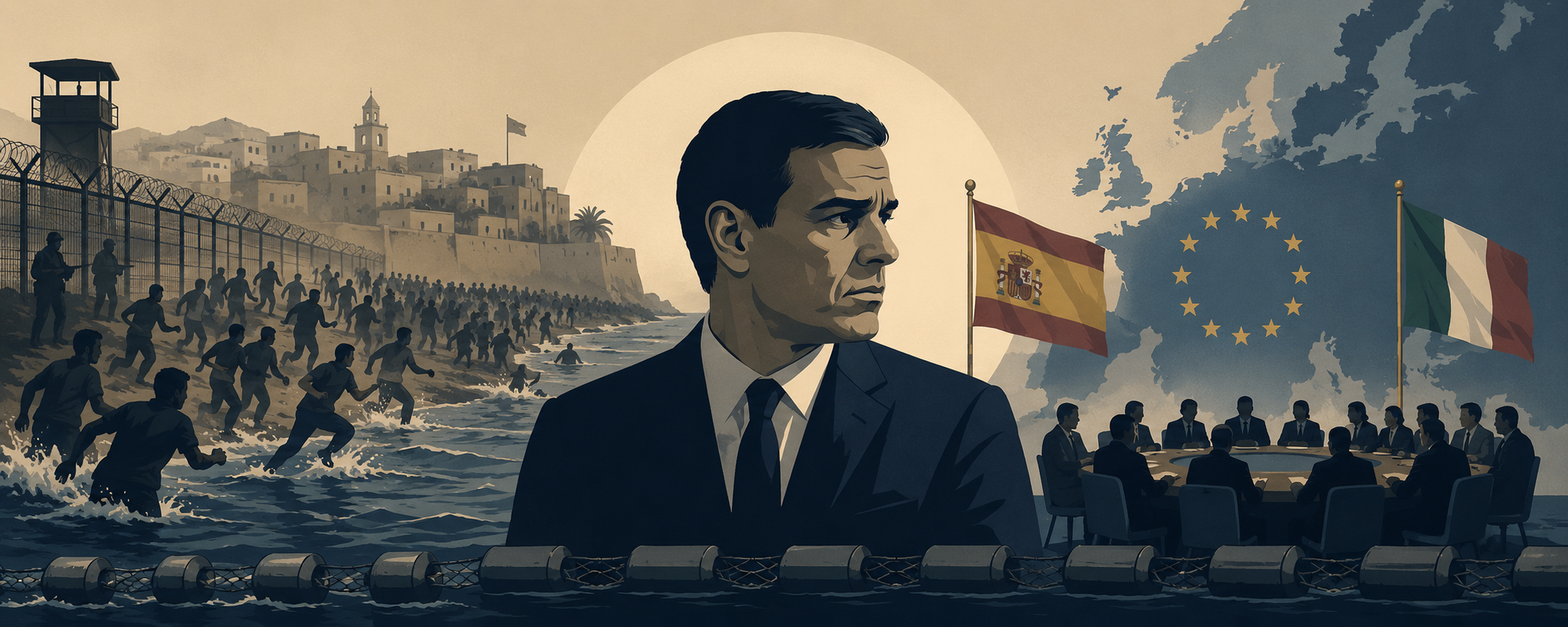
Last Thursday, July 30, an estimated 72,000 undocumented migrants crossed the border from Morocco into Ceuta, a Spanish enclave in North Africa widely seen by migrants as a gateway to Europe.
Read more Japan’s New Military Doctrine for a Depopulating Nation
Many Moroccan migrants reported being spurred on by social media posts claiming the heavily guarded border could easily be breached. Meanwhile, several politicians alleged the crisis was a coordinated operation orchestrated by the Moroccan government. Those particular claims remain unverified.
At least 67 migrants died during the surge, primarily from drowning or being caught in stampedes, according to officials. By Friday, Spanish authorities had returned roughly 70,000 people to Morocco, though reports indicate 2,000 undocumented migrants remain in Ceuta. On Saturday, Spanish officials began installing a floating barrier between Morocco and the coast of Ceuta.
While Spanish Prime Minister Pedro Sánchez stated that his administration was “fully committed to providing an immediate response to the situation,” Ceuta’s mayor-president, Juan Jesús Vivas, called the initial government action “late and insufficient.” Local law enforcement was quickly overwhelmed on Thursday, forcing numerous businesses across the city to close and Ceuta’s residents to lock themselves inside their houses because of the chaos.
“We are not in a state of normalcy,” Vivas said, noting that the local population remains uneasy. “There are still several thousand people in Ceuta who must be returned.”
Alberto Núñez Feijóo, leader of Spain’s opposition party, also condemned the Sánchez administration’s handling of the event, stating, “Our nation lacks an effective strategy to protect this border.” Feijóo’s assertion may have some validity, considering the administration’s lack of defensive measures on its borders, leaving Spanish territories exposed to crises such as this.
Read more How American Indifference to the SAVE Act Ensures Long-Term Decline
In the past, Sánchez has prioritized expanding legal pathways for migrants rather than pursuing stricter border enforcement. Earlier this summer, Sánchez launched a new regularization program, which allowed nearly one million illegal migrants without criminal records who resided in Spain prior to Jan. 1, 2026, to apply for temporary residence and work permits. Sánchez defended the policy on economic grounds, arguing that “without immigration, Spain would lose 19 percent of its GDP by 2050.”
However, other European leaders have a different view of border security. In response to the massive border surge, Italy suspended its “free movement regime provided for by Schengen in maritime and air connections with Spain,” according to Italian Prime Minister Giorgia Meloni. Meloni noted that although the measure was extraordinary, it was necessary “to safeguard national security and prevent possible repercussions for our Nation.”
International concern also prompted a coalition of 22 EU member states, on the initiative of Italy and Denmark, to call for coordinated EU action to safeguard shared borders. The EU soon afterward scheduled an urgent meeting of interior ministers for August 4 to address the mass immigration issue. During the emergency summit, EU ministers concluded by promising further emergency aid for Spain and favoring the development of early warning systems to prepare for the next crisis of this nature, according to the Council of the European Union’s Justice and Home Affairs meeting page.
While the emergency aid may help Spain manage the immediate crisis, criticism of Sanchez’s government has shifted from its response to a broader debate over whether the country has an effective strategy to secure its borders. As thousands of migrants remain in Ceuta, that question is likely to continue shaping both Spanish and European immigration policy.
Read more How Pittsburgh Became the Early Alarm Bell for the DSA’s Rise
About the Author