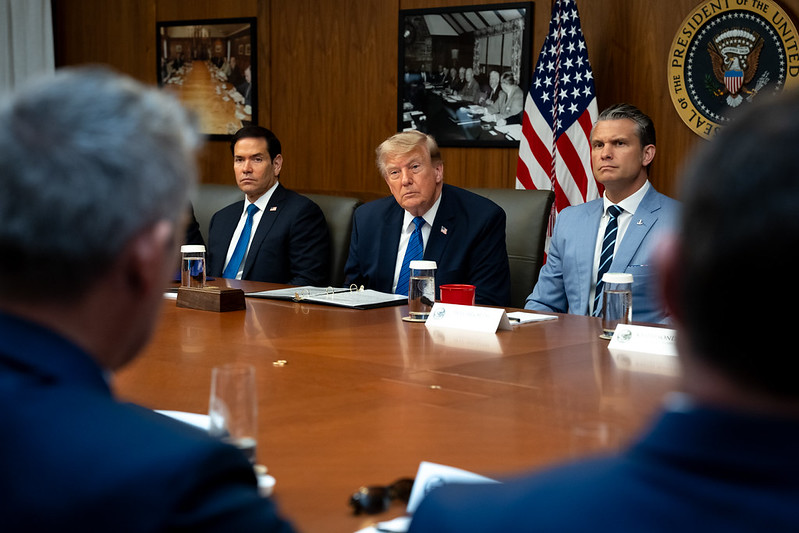
The United States is confronting tough choices over Iran, with an array of unattractive options to address Iran’s tactics and strategy. Iran lacks sufficient incentive to negotiate — the current Iranian negotiators appear to accept the degradation of its military-industrial complex, destruction of its conventional navy and air force, decapitation of echelons of leadership, strangulation of its economy, and the world’s opprobrium over the murder of tens of thousands of its own citizens. Not even an offer of $300 billion for economic development, plus releasing $100 billion of blocked funds worldwide are inducement to talk seriously.
Read more El Cid ’s Ghost Haunts Spain’s Migrant Crisis
All of this notwithstanding, they refuse to meet directly with our negotiators, make demands, and continue to attack our bases and those of our allies. (RELATED: Peace Process, Meet Reality)
The principal tactic of the Islamic Revolutionary Guard Corps is to string out tit for tat what has been called a twilight zone. Neither all-out combat nor peace, neither an open Strait nor closed, neither victory nor defeat — the IRGC will favor this until the November midterm elections, hoping that President Trump will lose the House of Representatives and become a political weakling. Moreover, a Senate that goes blue would be a game changer. (RELATED: The Iran War: Fasten Seat Belts)
In strategic terms, moreover, the IRGC wants to force the U.S. out of the Middle East by showing our allies what the cost of allegiance to the U.S. means — destruction of their oil and gas installations and desalination plants, and acceptance of Iran as the hegemon of the Middle East. (RELATED: Iran Is the Key to Trump’s Gaza Challenge)
Exiting and declaring victory, letting other nations clean up the Gulf, is not an option.
Exiting and declaring victory, letting other nations clean up the Gulf, is not an option. It would be worse than the humiliation suffered in Vietnam and Afghanistan, which were localized conflicts. This would also be an invitation to President Vladimir Putin and President Xi Jinping to intensify the pressure against Europe and Taiwan, knowing that the U.S. has limited will to oppose them. (RELATED: Breaking Iran’s Chokepoint Strategy)
Massive bombardment by the U.S. and Israel has not and will not likely bring Iran to the negotiating table. Further strikes aimed at dual-use infrastructure such as bridges and power generation plants may turn the Iranian population against the West, with the media focusing on what they will characterize as a humanitarian catastrophe. History has shown that with the exception of Hiroshima and Nagasaki, bombing does not end wars.
A tighter blockade of the Gulf most likely offers the best means to cut off Iran’s oil and gas revenue, inhibiting its war machine by permitting zero traffic through lanes now designated for Iranian approval. However, the economic effects will take time, and thus far European and Arab navies have not been supportive of a maritime coalition to assist the U.S.
Read more China Makes Panama Pay for Saying No
The International Monetary Fund is projecting a 6.1 percent decline in Iran’s GDP in 2026, while the global economy is on track for 3.0 percent growth. While the implication is that the Iranian economy will crack before the U.S. or world economy, we have witnessed wild swings in equity markets, and the 10-year U.S. Treasury is up at least 70 basis points since the start of the war. A market crash is nonetheless a risk of a protracted conflict, with further drawdown of world energy reserves.
Only the Iranians can take charge of their country and integrate it into the mainstream of trade, investment, and diplomacy. Regime change will take time for the forces of dissent to be identified, mobilized, the population to be armed, and an alternative government to be developed that has credibility. The danger of assassination of new leadership and civil war is real, in a leadership that appears divided about whether to negotiate with or fight against the West. Further, there can be no guarantee that a successor government will be friendly toward the U.S. and Israel after the punishment that has been inflicted.
There is no way that the United States can tolerate Iran controlling the Strait of Hormuz, where 20 percent of the world’s oil and liquefied natural gas have transited daily, about 20 million barrels per day, or resuming its quest for a nuclear weapon.
President Trump can be masterful at staging. The world needs to see a diplomatic agreement that clears the Strait and ceases Houthi hostilities in the Red Sea, where an estimated 6.2 million barrels of oil per day have also been shipped, mainly from Saudi Arabia. In the absence of open international waterways and restoration of energy flows, deployment of ground troops and special forces will be likely. Assistance from some 200,000 well-armed American-trained Kurds who helped the U.S. in Syria has been contemplated, but thus far there are no signs that the U.S. wishes to engage them, given consideration of a wider ground war, a negative Turkish reaction, and future territorial demands by the Kurds and ethnic unrest. (RELATED: Trump’s Syrian Gamble)
Doubtless there will be a robust blame game about equating Iran with Venezuela, a one-trick pony with a smattering of Cuban security forces; underestimating Iran’s asymmetric warfare capability and ideological fanaticism; commencing a war without enough interceptor munitions; and discounting Iran’s ability to close or manipulate the Strait.
As November approaches, the pressure on the White House for dramatic action will intensify; however, the deployment of ground troops and special forces before then will be disadvantageous to the Republican Party. Badly wounded, Iran nonetheless wants to emerge as a regional Leviathan that has withstood the kinetic fury of a superpower. Whether the U.S. uses ground warfare, conducts sporadic combat, selectively targets nuclear infrastructure as needed, monitors Iran from overhead platforms, or conducts covert actions, it will be ensnared in Iran for a long time to come.
READ MORE from Frank Schell:
The Iran War: Fasten Seat Belts
The New York Times Declares Victory for Tehran
Iran: Crippled but Still Dangerous
Frank Schell is a former senior vice president of the First National Bank of Chicago and later was a management consultant. He was a lecturer at the Harris School of Public Policy, University of Chicago, and is a contributor of opinion pieces to various journals.
Read more Defending ‘Adequate’ Humans Against AI
About the Author