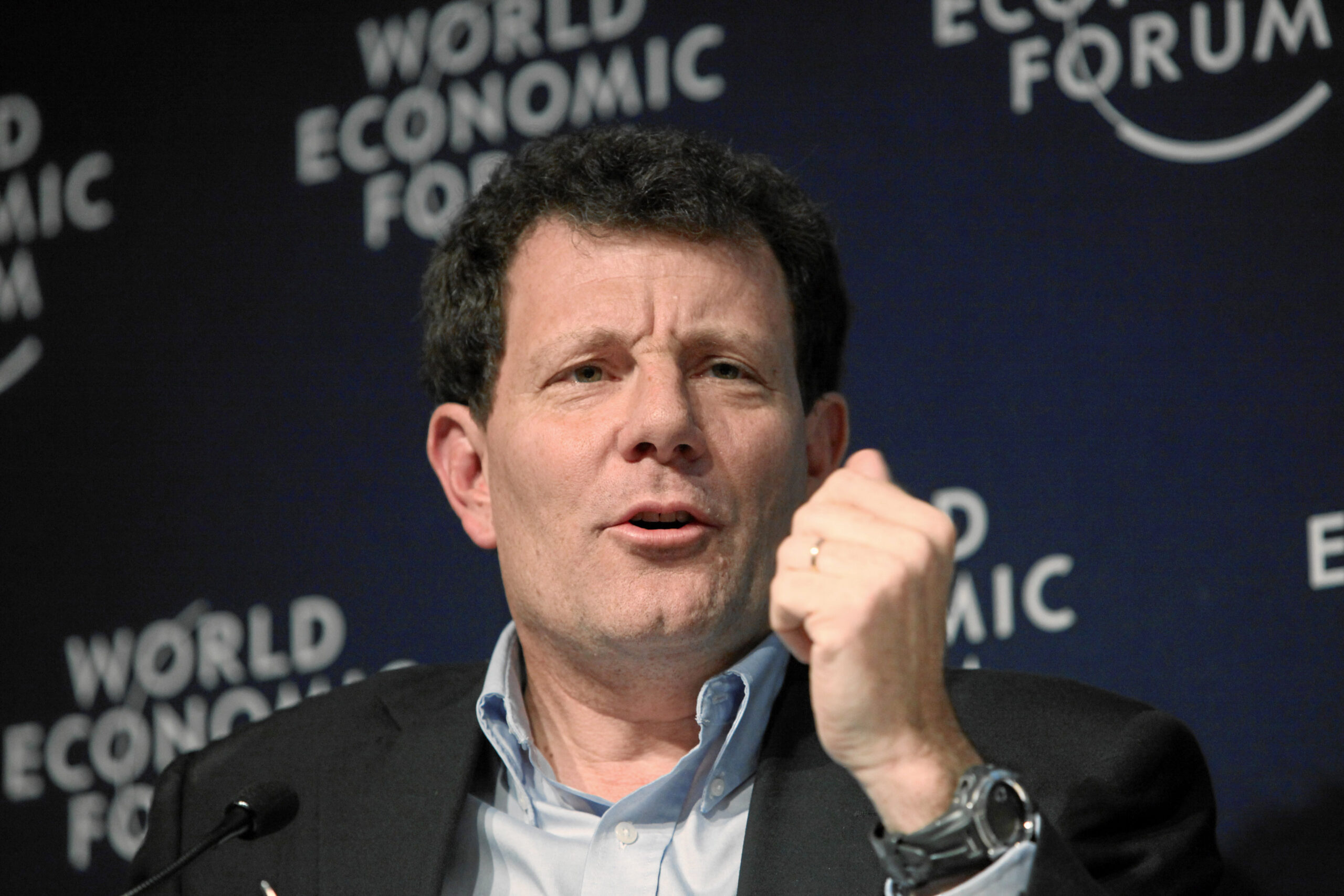
DAVOS/SWITZERLAND, 30JAN10 - Nicholas D. Kristof, Columnist, The New York Times, USA is captured during the session 'Redesign Your Cause' of the Annual Meeting 2010 of the World Economic Forum in Davos, Switzerland, January 30, 2010. Copyright by World Economic Forum swiss-image.ch/Photo by Monika Flueckiger
The anti-Zionist and sometimes overtly anti-Semitic tendency of the New York Times — despite the Jewish ancestry of the paper’s owners — has long been recognized. (See the classic study by Wellesley College historian Jerrold Auerbach, Print to Fit: The “New York Times,” Zionism, and Israel, 1896-2016). Those qualities were on display in an egregious manner in a story published twice in May.
Read more When Words Lose Their Meaning
The story was an extraordinary report by longtime columnist Nichols Kristof, “The Silence that Meets the Rape of Palestinians,” originally published on May 11 but then reprinted, with photos, in a two-page spread in the paper’s Sunday “Opinion” section, six days later. (As a longtime reader, I have never known the paper to engage in such a repetition.)
The column made a series of remarkable, or rather, astounding, charges of abuses that Israelis have supposedly committed since the October 7, 2023 invasion and massacre committed by Hamas against mostly Israeli civilians. The charges include torture, rape, and even the use of dogs who reportedly were trained to rape prisoners. Yet Kristof named only two individuals as sources for this information, explaining that another dozen insisted on remaining anonymous for fear of suffering “reprisals.”
Kristof’s chief source was not the testimony of any professed victim of the torture, but rather a report released in April by the Euro-Med Human rights Monitor, a “Geneva-based advocacy group” that is “often critical of Israel.” Secondarily, he cited a 2025 United Nations report that claimed that sexual violence was one of Israel’s “standard operating procedures” and “a major element in the ill treatment of Palestinians.”
[T]he denial that Jews, alone among the world’s peoples, and despite their unique contribution to the history of civilization — are not entitled to a state of their own — is, of necessity, anti-Semitic.
It is worth noting that the U.N. agency operating supposed “refugee camps” for Palestinians ever since 1948, when Israel first achieved its independence, is the United Nations Refugee and Works Administration, which continues to serve “refugees” from the 1948 war even though rather few Palestinians from that year are alive today. UNRWA continues to operate schools that teach anti-Semitism, hatred of Israel, and a determination to overthrow and destroy the Jewish state. It is also known to have stored weaponry used by Hamas, and actually had employees who took part in the October 7 attacks. (Meanwhile, those non-Jewish inhabitants who remained in Israel rather than fleeing became full citizens of the state, enjoying the right to vote for representatives in the Knesset, 10 of whom are currently members of that body, along with four Druze, out of its 120 members.) In other words, the U.N. is not a disinterested party.
Informed critics, including Federal judge Roy Altman, were quick to point out the many holes in Kristof’s story. As Altman noted in The Free Press, Kristof was accusing individual Israeli guards of using sexual violence against detained Palestinian prisoners and portraying it as a kind of “standard operating procedure.” But, taking his bearings by ordinary Anglo-American judicial rules of due process, Altman notes that Kristof not only tells us very little about the anonymous accusers who he claims were his sources, but fails to identify the offenses themselves: “No locations. No dates. No perpetrators. Israeli prisons, like many of our own, are often videotaped, and those recordings are reviewed not just by prison guards but by prison officials and lawyers.”
Nor, in the case of the one informant Kristof does identify — Sami al-Sai, who for months has publicly accused Israeli guards of sexual assault — does he cite any evidence that al-Sai has suffered retaliation for making those allegations. Al-Sai has repeatedly made these claims in public, including in interviews with major news organizations such as NPR and The New York Times, asserting that he was sexually assaulted while in Israeli detention.
There are serious problems with al-Sai’s claims. For instance, shortly after his detention, he filed a petition with the Israeli Supreme Court demanding his immediate release, complaining about the quality of the food he was served in prison, without including any of the allegations of sexual violence that Kristof now attributes to him. And while Kristof identifies al-Sai as a “freelance journalist,” the Israeli Supreme Court in denying his petition, found credible evidence that he was affiliated with Palestinian terror groups, and thus had been properly detained. (Nonetheless, al-Sai was subsequently freed rather than suffering retribution.)
As Altman notes, advancing his claim that Israel permits or encourages sexual abuse of detainees as a matter of state policy, Kristof fails even to mention that sexual offenses are strictly prohibited under Israel’s penal code. And Israeli military forces are bound by a host of additional directives, which further protect prisoners from state-sponsored violence, including sexual violence. (Some soldiers have been tried and punished for abusing prisoners, though not in ways comparable to Hamas’s horrific acts.)
Read more Is Killing Innocents Christian?
The sorts of charges Kristof makes against Israel’s treatment of its prisoners are hardly new, but have been circulated by anti-Israel propagandists for years, starting well before the Euro-Med report. (That organization’s director has been identified as affiliated with Hamas.) But what is novel about Kristof’s column is its timing. As Altman and others have noted, weeks before Kristof’s column appeared, the independent commission charged with reporting on Hamas’s widespread use of sexual violence during its attack on October 7 — much of which was already known to the public — informed the Times that it would be releasing its report on or around May 12. Altman cites the Israeli foreign ministry as having offered to provide its findings to the Times — only to have its editors deny any interest in the report.
It can hardly be coincidental, then, that the Times ran Kristof’s column just one day before the Israeli report’s release. In effect, the Times was engaging in what Altman calls an attempt at the preemptive co-opting of the real, thoroughly documented story: attempting to divert attention from that story by concocting one of its own, leading readers to conclude that at most, Hamas (in its horrifying rape and torture of the civilians it captured on October 7 — including, for instance, forcing family members to engage in sex with one another, or ordering parents to watch their children’s execution and vice versa ) was acting no differently from the Israelis’ customary practice.
Indeed, so credulous was Kristof that he reported as factual the claim of some of his supposed interlocutors that the Israelis had trained dogs to rape prisoners — a physical impossibility. (Although the Times did subsequently run a shorter story on the Israeli report, it had not, as of this writing, retracted any of Kristof’s farfetched claims, but rather, as I’ve noted, reprinted Kristof’s column in an illustrated two-page spread only six days after its appearance.)
In the Times’s May 21 issue, it did publish a column by Bret Stephens, former editor of the Jerusalem Post and the only regular Times columnist who explicitly acknowledges Israel’s right to exist as a secure Jewish (not “binational”) state, titled “Hatred of Israel and the Degradation of the West.” In it, while acknowledging the right and duty of observers to raise questions about the policies of Israel’s current leadership and, of course, to investigate allegations of prisoner abuse, Stephens urges that we put the latter into context, noting that the U.S. Bureau of Justice Statistics reported 8,628 allegations of staff-committed sexual misconduct in this country in 2020.
But he adds that “good-faith criticism of Israeli leaders and policy has for years been giving way to something darker,” a “hyperbolic and often conspiratorial hatred of the country.” He goes on to list several prominent cases of accusations of atrocities against the Israeli government over the past 25 years that had to be retracted for demonstrated falsity, such as the alleged Jenin massacre of 2002, the 2009 Goldstone Report issued by the U.N. which claimed that Israel “intentionally targeted Palestinian civilians as a matter of policy,” and the allegation that shortly after October 7 Israel fired a missile at a Gaza hospital, killing some 500 people.
Despite the retractions, the memory of the original (false) accusations continued to smirch Israel’s international reputation. These accusations have been launched not only by careless journalists, but by “once-admired organizations like Amnesty International and Human Rights Watch, which in recent decades have turned themselves into factories of anti-Israel invective.” Now, Kristof has joined that group, with unusually strong support (rather than serious investigation of criticisms) from his employer. Indeed, as if to certify his acceptance into the nation’s highest echelons of learning, Kristof’s wife, also a journalist, was just named vice chair of the executive committee of Harvard University’s Board of Overseers, despite the revelations of the bias of her husband’s column.
Despite being a two-time Pulitzer winner, Kristof, as the Washington Free Beacon reports, has a history of botched reporting on such topics as the 2001 anthrax attacks and child sex trafficking (which led to Kristof’s apologizing and correcting himself). But while Kristof has made a career out of investigating reported injustices around the world, there may be a deeper psychological motive underlying his credulous account of Israel’s supposed atrocities. As Ira Stoll reported in the May 14 Free Beacon, Kristof’s father emigrated to the U.S. from Romania following the Second World War as an ostensible “concentration camp survivor.” The truth, as Kristof briefly acknowledged in his 2024 memoir, Chasing Hope, was that following the German invasion of Romania, his father “had actually fought for a year on the same side of the Nazis.” That this service was not simply a result of compulsion is suggested by a letter the father published in the Times in 1989 (quoted by Stoll) in which he defended Nazi collaborator Paul Touvier, the intelligence chief of a militia in Vichy France who was convicted of killing seven Jewish hostages, on the grounds that during the war “it was sometimes difficult indeed to draw a sharp line between friend and enemy, patriot and traitor, moral and immoral acts. To do good, you often had to do evil too. Time and again, people had to quantify their ethics: I am permitted to be this much immoral to achieve that much good; kill so many to save that many.”
No evidence exists to my knowledge that Nicholas Kristof shares his father’s outlook. (In his memoir he reports embarrassment as a schoolboy at having to remain silent about his father’s service while classmates boasted about their fathers’ heroic exploits fighting for America’s, and the world’s, freedom.) But Kristof acknowledges in his memoir that an unexplained “tortuous family history” helped turn him into the sort of reporter he became. One fears to consider the possibility that that history led him to a disposition to single out Israelis and Jews for (poorly researched) denunciation, when as Stoll observes “prison abuse cases are plentiful worldwide.”
In conclusion it must be noted that, contrary to claims that are often made nowadays (including by many self-styled “liberal” Jews), anti-Zionism — that is, the denial that Jews, alone among the world’s peoples, and despite their unique contribution to the history of civilization — are not entitled to a state of their own — is, of necessity, anti-Semitic. If one compares the size of Israel’s territory (enlarged in 1967 as the outcome of another war launched against it by its neighbors) with that of the world’s Muslim nations, there is no reason to think that its existence somehow deprives Muslims of their right to a free and prosperous existence. In fact, the “naqba” — the anniversary of which many Muslims recently commemorated with great lamentation. That is, ostensibly, the founding of Israel — is not really about the production of a class of “refugees,” but rather the very existence of a Jewish state within a predominantly Muslim region. It is an outrage that journalists at prestigious Western publications should encourage this prejudice.
Read more A Party of Weak Men and Strong Women
READ MORE from David Lewis Schaefer:
A False Choice: ‘Wars of Necessity’ v. ‘Wars of Choice’
EPA Overreach Exposed
Representative Democracy and Convoluted Elections
About the Author