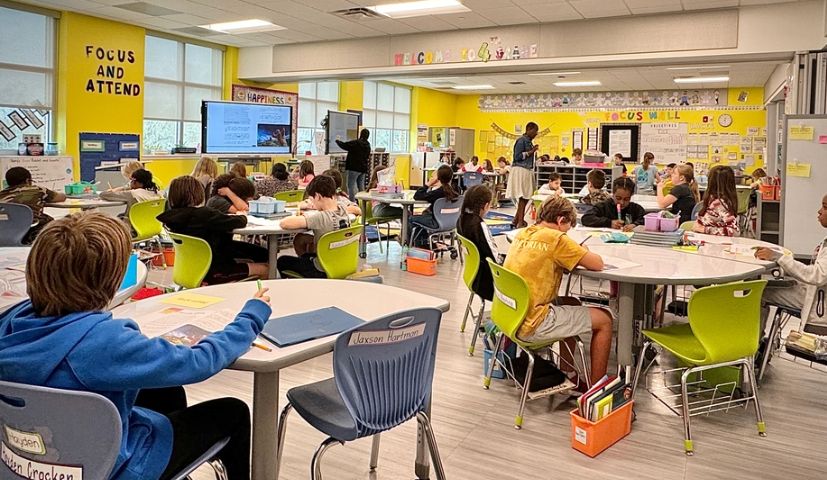
This spring, Illinois became the first state in the country to require universal mental health screenings in public schools. But Illinois isn’t an outlier. At least one-third of school districts nationwide are already using universal mental health screenings in some form — with other states, including Virginia and Montana, considering implementing such policies. When did public schools become mental health clinics?
Read more The Two-State Solution Is Dead — Long Live the Two-State Solution
Schools are increasingly being asked to do something they were never designed to do: screen every child for potential mental health problems.
No one disputes that America’s children are facing a mental health crisis, or that schools are often the first place adults notice a struggling child. Teachers should be equipped to recognize warning signs, and students in genuine distress should be able to get help.
What exactly is the school supposed to be doing? The classroom has a job to do. It is time we let schools focus on teaching.
But recognizing a problem is not the same as diagnosing one — and providing a school with resources to help a troubled student is not the same as turning the school into a mental health clinic. Universal mental health screenings are a poorly supported and potentially counterproductive response to a serious problem. They represent a growing expansion of the school system into territory that belongs to parents, doctors, and mental health professionals.
Carolyn D. Gorman, a fellow at the Manhattan Institute, recently examined the evidence behind universal mental health screening in schools. She found that broad universal screenings do not reduce mental health conditions or improve academic outcomes. Instead, they produce extraordinarily high rates of false positives, potentially leading to overdiagnosis and overtreatment.
In other words, schools can end up identifying large numbers of children as having mental health problems without actually making those children healthier — or better students.
The consequences go beyond wasted resources. Universal screening can create a false impression that schools are preventing mental illness while diverting attention and resources from students who are actually at serious risk of harming themselves or others.
So why are schools doing this in the first place?
As Gorman explains, the trend emerged “somewhat inconspicuously.” The politics surrounding school shootings and the COVID-19 pandemic increased public pressure — and funding — for school-based mental health programs. The logic seemed intuitive: If medical professionals screen adults for diseases before symptoms become severe, why not screen children for mental health conditions before they become crises?
But mental health does not necessarily work like blood pressure or cholesterol.
Gorman argues that the evidence simply does not justify universal screening. “The fact that there’s no evidence doesn’t slow down efforts” to expand these policies, Gorman explained. She has consequently advocated for states to explicitly prohibit universal school mental health screening.
Read more The Witches’ Sabbath on Election Night
The expansion also has roots in a legitimate responsibility of public education. Under the Individuals with Disabilities Education Act, schools must provide children with disabilities a free and appropriate public education when their disabilities affect their ability to benefit from education. That can include related services, such as psychotherapy, when appropriate.
A child whose disability prevents them from accessing an education may need services beyond the traditional classroom. But that narrowly defined obligation has contributed to a much broader conception of what schools are responsible for addressing. A system designed to accommodate students whose disabilities interfere with their education is increasingly being asked to identify mental health problems among the entire student population.
That is mission creep.
There are better ways to help struggling students. Gorman points to ordinary teacher observation and targeted screening when there is an actual concern, with parental consent and transparency about medical credentials and practices. The existing IDEA evaluation process, she argues, is already “the superior mechanism for identifying students.”
Teachers should absolutely be empowered to recognize when something is wrong. Schools can give teachers the training and resources to recognize warning signs and communicate concerns to parents. But at the end of the day, the school has to focus on teaching.
Such a distinction matters, because schools are already struggling to educate children. Large numbers of American students are failing to meet basic academic benchmarks. In Chicago, for example, only 27 percent of 3rd-through-8th grade students are proficient in math.
And while academic performance remains deeply troubling, schools continue to take on responsibilities far beyond the classroom. According to Gorman, “gold-standard research finds that school-based services had no effect on test scores or attendance.”
If these programs aren’t improving academic outcomes, we should be asking a basic question: What exactly is the school supposed to be doing? The classroom has a job to do. It is time we let schools focus on teaching.
READ MORE from Sam Raus:
Don’t Let Democrats Win the Affordability Debate
Chicago’s Tax on Free Social Media Usage Is a Bad Idea
The Line We Must Not Cross
Sam Raus is the David Boaz Resident Writing Fellow at Young Voices. Follow him on X: @SamRaus1.
Read more The Day the Light of the World Went Out
About the Author