For weeks now my emotions have oscillated between anger and sadness, frustration and depression. It scarcely matters which way I turn: from Iran and Ukraine to Lindsay Clancy and Zohran Mamdani, to smirking condescension from all those who seemingly despise our country and who seem no longer hesitant to show their contempt. Like so many others, I wanted to share my reflections on the 25th anniversary of 9/11, but each time I started, my feelings dissolved into an almost incandescent rage at what has become of New York City, indeed, of our entire country, since 9/11. So, each time I stopped writing.
Read more Michigan AG Dana Nessel to Jewish Democrats: Sacrifice Yourself for the Cause
This morning, however, something happened that brought me back, if only for a moment, to the feelings I needed to feel, feelings of hope, feelings of renewed confidence in what we Americans are capable of achieving, above all, feelings of appreciation for our American heroes. There are, of course, many such heroes, and, in the midst of my frustration, it’s been good to read all the many encomiums dedicated to the firefighters, police officers, and private citizen heroes of 9/11, not least the magnificently courageous passengers of Flight 93.
But what opened my heart this morning was a reminder of a different sort, an example of almost sublime heroism from a different time. My inbox this morning contained pictures from France, pictures from ceremonies staged by my French friends to honor the American soldiers who liberated their province in the fall of 1944.
I’ve referenced these battles before. I was raised to admire the heroes he shared a battlefield with all those years ago. This morning, I offer one of these heroes as a source of inspiration. (RELATED: Learn of Heroes at a Young Age)
Dale Brough Rex had just graduated from Brigham Young University in 1943, where he’d been an All-American center on the basketball team. The Army rejected him at first because he was too tall. Dale stood 6’7” in his stocking feet and weighed 240 pounds; some friendly doctors were persuaded to list him at 6’5”, and Dale was accepted.
Eighteen weeks later, in August of 1944, Dale joined Company G of the 11th Infantry Regiment of the 5th Infantry Division, part of Patton’s famed Third Army. As a replacement, he joined a unit that had already been bled heavily, first in the Normandy “breakout,” then while pursuing the fleeing Germans across France.
The race across France ended at the beginning of September when, having raced beyond its supply lines, the Third Army literally ran out of gas. Critically, this enabled the Germans to collect themselves, reconstitute shattered units, and push reserves, including vaunted SS units, forward to stop the Americans. In front of the Third Army, they drew the line at the Moselle River and the city of Metz, territory that had been exchanged repeatedly between France and Germany.
So, when Dale Rex’s Company G and the rest of the 11th Infantry closed up on the banks of the Moselle River at the little town of Dornot, the defending Germans were prepared to fight fiercely, believing that the battle for Germany itself had begun. Moreover, when Germany had controlled the region prior to World War I, the entire area had been heavily fortified against just such an attack. All around the planned crossing site, massive German forts dominated the terrain, protected by massive walls of reinforced concrete, with turreted cannon ready to pound the crossing site. But because the Americans had outrun their intelligence sources — and even their available tactical maps — the attackers were effectively clueless about what lay ahead.
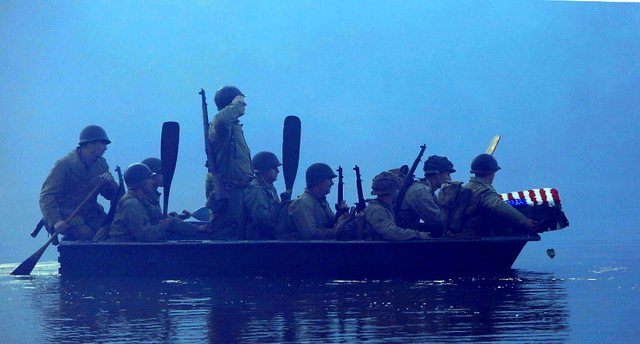
The plan was for Dale’s battalion, accompanied by a company from the 7th Armored, to force a crossing in wooden assault boats and seize the high ground opposite the crossing site. From the beginning, this was a trial by fire. Traffic congestion leading to the crossing site meant delays and confusion. The entire area was under observation from the Germans at the forts across the river, and the American soldiers found themselves paddling their little wooden assault boats across a football field’s width of water in broad daylight.
In spite of this, most of the troops made it across and advanced across open terrain almost to the forts themselves, which were only lightly occupied. There the Americans were stymied by barbed wire and steel barricades. As they tried to find a way to overcome these obstacles, disaster struck. Several companies of elite German SS troopers struck the Americans from behind and both sides, catching the American troops in the open. The Americans suffered heavy casualties as they withdrew to a small, wooded area at the river’s edge.
There they were trapped, the river at their backs, the remnants of the attack force squeezed into a space scarcely 100 yards deep and 200 yards wide. There they formed a hasty, horseshoe-shaped defensive line, which gave the ensuing battle its name — the Battle of Horseshoe Woods. For the next 60 hours, the Americans tried to hold out against near-constant counterattacks, fanatical SS troopers, supported by tanks and artillery, doing everything possible to reject the Americans from their toehold on “German” soil.
The generals ordered the survivors to hold the failed bridgehead at all costs, diverting German reinforcements from a second crossing attempt two miles to the south — and hold they did, in spite of overwhelming odds. In this dire moment, multiple heroes emerged, none greater than Dale Rex, caught in the midst of his first real battle. Dale was an assistant machine gunner, his job to make sure that the gunner remained supplied with ammunition, critical since their gun was one of the few holding the left flank of the horseshoe.
Read more Tennis Thrills in Queens
Then Dale’s gunner was blown apart, and Dale took over the gun. In the hours to come, highly exposed and very much a priority German target, Dale manned the gun, pouring round after round into the ranks of the fanatical German attackers. After the battle, other GIs attested to the fact that Dale and a second gunner a few yards away had accounted for an estimated 300 Germans over the course of repeated attacks.
When, finally, the second bridgehead was established, and the order to evacuate was received, Dale traded his killing task for one of lifesaving. In the dark, and still under heavy fire, he first gave his clothing to provide warmth to a wounded soldier, and then swam the cold river four times, helping weaker swimmers, saving one soldier from drowning, and helping to load and unload other boats carrying the wounded.
Only then did he rest, but by then his performance throughout the bridgehead fight had become legendary among his fellow survivors. One of these survivors was an older soldier, Jacob Kurtzberg, better known to the world as the famous comic book artist, Jack Kirby. Kirby had already made a name for himself as an artist, partnering in the creation of the Captain America comic book series.
In 1943, however, Jack Kirby was drafted and a year later found himself serving in Company F of the 11th Infantry Regiment, immersed in the very same bridgehead fight as Dale Rex. Kirby never spoke much about his role in the battle at Horseshoe Woods. Having personally walked the remnants of the foxhole line there, all I can say is that to have been there, under constant bombardment and repeated attacks, could only have been a profoundly life-altering experience.
Several months later, during the Battle of the Bulge, Kirby would experience frostbite so severe that he nearly lost his leg. Kirby returned home and resumed his comic book career, eventually becoming the creative artist at the heart of the Marvel universe. In France, where the fight at Horseshoe Woods is remembered and honored each year, it’s an article of faith that Kirby’s most famous creation, the Incredible Hulk, was inspired by Dale Rex.
The link is, at the very least, suggestive. Dale Rex was a true mountain of a man, and during the 60-hour battle he demonstrated something of the duality that Kirby assigned to the Hulk, at first a ferocious killer — let’s not mince words here — and then a monument of gentleness and self-sacrifice. And Kirby would have known well the story of Dale Rex, since by the time the evacuation was over, Dale Rex had assumed legendary status throughout the entire regiment.
Dale Rex would be promoted to sergeant and would receive the Distinguished Service Cross, our country’s second-highest medal, for his actions in the bridgehead. For those who wonder that he didn’t receive the Medal of Honor, I can only say that the 5th Infantry Division was notably parsimonious in recommending soldiers for the nation’s highest award for valor. Modest that he was, Dale apparently thought the DSC was honor enough.
He would go on to fight further fierce battles before being killed by a sniper, a single shot to the head as he led his men forward. Since 1947, Brigham Young University has honored his memory with the Dale Rex Memorial Award, an award since conferred upon such athletic notables as Danny Ainge, Steve Young, and Lavell Edwards. And Dale’s nephew, Sam Rex, has written a beautiful biography of Dale, one I recommend highly.
I’m grateful to my French friends for their annual tribute to Dale Rex and his comrades, grateful that the anniversary falls in the same week as 9/11, grateful to turn away for a moment from the smirking faces of those who care so little for our country. Perhaps our schools, so neglectful of even such recent history as the true stories — and the true heroes — of 9/11, will learn how to tell these stories as they should be told. Perhaps our grandchildren will find inspiration in these stories as my own generation was inspired by the heroes of World War II — heroes such as Dale Rex.
READ MORE from James H. McGee:
Iryna Zarutska, Lindsay Clancy, and the Politics of Who Gets Mourned
Conservatives Should Begin Eating Woke Culture for Breakfast
Xi Jinping’s Global Strategy: Why China’s Unrestricted Warfare Demands America’s Attention
James H. McGee is a retired nuclear security and counter-terrorism professional. His most recent novel, The Zebras from Minsk, was featured among National Review’s favorite books in 2025. His next novel, The Cathedral of Sorrows, will directly focus on the plight of Africa’s Christians. You can find The Zebras from Minsk and his previous thriller, Letter of Reprisal, in paperback and Kindle editions at Amazon. The Cathedral of Sorrows will appear this fall.
Read more Scott McKay’s The Necessary Men — Episode 10: Consequence
About the Author