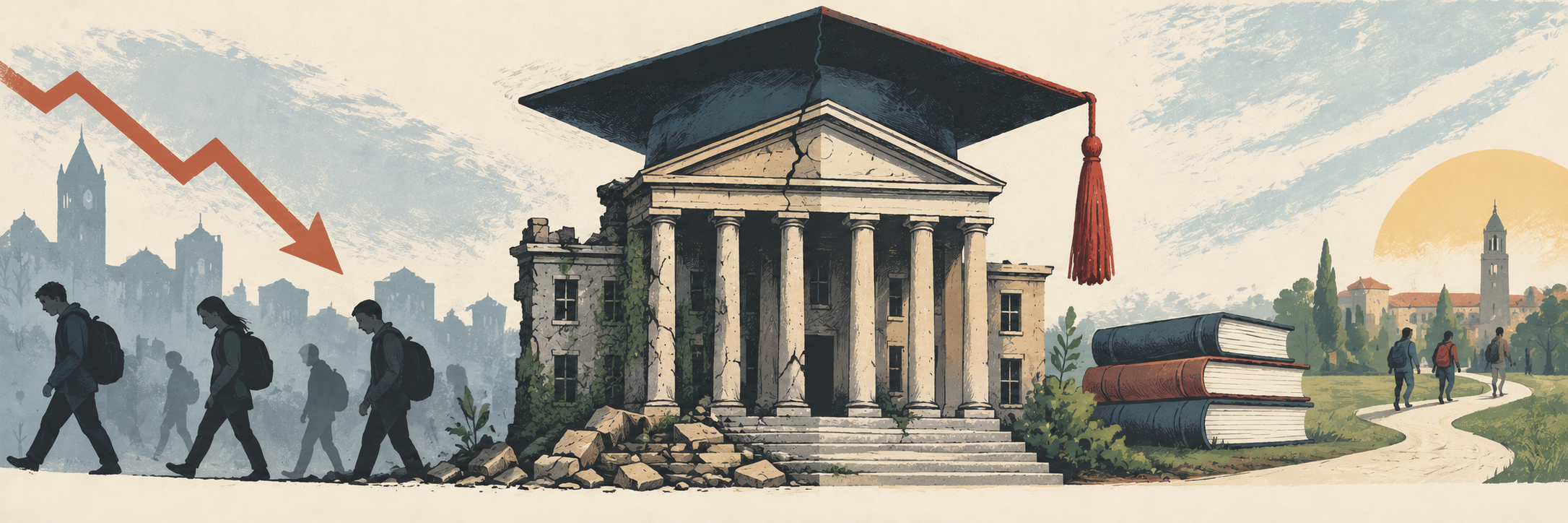
By many indicators, American higher education is having its biggest crisis in the two-thirds of a century in which I have been involved with universities as a student or faculty member. The sector is very dependent on resources provided by its primary customers, students, and by state governments, and also federal government and private sector grants, contracts, and student loans. Yet these funding sources are increasingly disenchanted with colleges, most obviously demonstrated by numerous Trump administration reductions in grants, as well as other moves such as enhanced endowment taxes. Nationwide, enrollment last fall was lower than it was 15 years earlier, and real tuition fees, after decades of explosive growth, have been declining.
Read more Louisiana’s Economic Renaissance: How the Pelican State Became a New Hub for Tech and Industry
The number of campus closings and mergers is up, and financial difficulties have forced staffing reductions at not only poorly endowed and reputationally challenged small private and public colleges and universities, but also at some prominent Ivy League schools, probably a first in modern American history. Public polling has shown plummeting confidence in America’s providers of higher education. (RELATED: Five Quick Things: Rip-off U.)
The problem is enormously aggravated by the fact that third-party (governments, alumni, foundations) donors have largely, but not completely, shielded universities from the discipline imposed by competitive private sector markets. Except for college sports and campus financial investments, it is hard to even clearly measure success: did Oklahoma State University or Princeton have a good year in 2025 — how would we even know? As I write this, Apple Computer stock is up $3.25 a share for the day, but what is happening to the worth of the Universities of Pennsylvania, Nebraska, or California? No one even knows.
This lack of good information and the market discipline which rewards private sector businesses for innovating and cost-reductions have been largely responsible for the crisis in the universities — the expensive and destructive administrative bloat that has diverted colleges from their primary mission, strange employment practices such as academic tenure encouraging mediocrity, and mission creep that has led to the creation of many mediocre but expensive programs such as quasi-professional sporting teams that have utterly nothing to do with learning and expanding the frontiers of knowledge. (RELATED: Gone With the Wins: College Sports Fiscal Insanity)
While the consequences of poor performance have been somewhat muted by third-party subsidies, they are belatedly furiously manifesting themselves in actual or threatened closures. Adding to the collegiate woes, the beginning of the unfavorable demographics of a falling college-age population is upon us. (RELATED: Ignorance Is Not Bliss: The Dumbing Down of America)
Yet I am seeing some early encouraging signs of a revival in collegiate fortunes, perhaps validating a saying that Plato seemed to express in the Republic well over two millennia ago: “necessity is the mother of invention.” New leaders are coming to the fore who are positively challenging academic norms on several fronts.
“Universities face a choice they can no longer avoid: recommit to the principles that once earned the public’s trust or preserve the status quo and watch the crisis of confidence in higher education deepen.”
Let’s start with the Ivy League, the most prominent home of the Wokish Supremacy that provoked national outrage in 2023 from the Congressional testimony of presidents like Harvard’s Claudine Gay or Penn’s Liz Magill and from the intimidation of Jewish students at schools like Columbia. New voices of reason are being heard. In late 2024, in a Wall Street Journal op-ed, Dartmouth College’s new president Sian Beilock strongly supported the principle of institutional neutrality: universities should be locations where participants can voice all sorts of opinions on issues of the day in a civil, non-violent fashion, but the school itself takes no position — it merely provides a platform for informed debate. This spring, a report by 10 senior faculty at Yale startlingly said: “we must admit where we have been wrong,” “A shift in attitude is needed” and we need a renewed focus on the mission: “to create, disseminate and preserve knowledge through research and teaching.” (RELATED: The Collegiate Anti-Woke Counterrevolution)
Read more Penn State’s 2026 Schedule Demands Success
Moving South and West, chancellors at two other distinguished private schools, Vanderbilt (Daniel Diermeier) and Washington University in St. Louis (Andrew Martin), have loudly and aggressively (even an ad in a major newspaper) proclaimed their belief in academic freedom, robust campus debate, but also institutional neutrality. As Diermeier put it in Forbes a few weeks ago, “Universities face a choice they can no longer avoid: recommit to the principles that once earned the public’s trust or preserve the status quo and watch the crisis of confidence in higher education deepen.”
At public universities across the country, new “civic centers” are popping up, centers where the progressive leftish near-monopoly on campus thought is being aggressively challenged, and a renewed emphasis placed on classical philosophy, history and economics. It is too early to do much of an assessment of their accomplishments, but the very challenge of the woke supremacy dominating many campuses is a salutary move, and some, like the Hamilton Center at the University of Florida, have seemed to gain sizable scale and signs of accomplishment.
As elections approach, most legislative action is in hiatus, but that could change after the election. For example, Congress looks like it may get involved in a bipartisan way to try to reduce at least marginally some of the extremely expensive happenings in intercollegiate athletics.
While I have generally applauded the jolt that the Trump administration has given to American higher education, there have been some downsides. For example, foreign student enrollment has plummeted in part because of visa restrictions, while research grants have gotten fewer and smaller. These things imperil a historically strong international reputation of having the planet’s best schools for advanced training and cutting-edge research.
But that is almost certainly going to change somewhat, as lame duck presidents typically see a waning in power in their last years, aggravated likely by increased Democratic power in Congress. That could lead to attempts to reverse some recent reforms, including a revival in DEI-type initiatives in defiance of the Supreme Court ruling in Students for Fair Admission v. Harvard. But market forces, to be sure muted by government and private financial support, are still present, and the declining college-age population pool is a reality. A new generation of leaders, less ideologically oriented and more pragmatically focused in light of the sector’s recent woes, may help lead at least a modest revival in the fortunes of American colleges and universities.
READ MORE from Richard Vedder:
How American Indifference to the SAVE Act Ensures Long-Term Decline
Ignorance Is Not Bliss: The Dumbing Down of America
America’s War on Men
Richard Vedder is a distinguished professor of economics emeritus at Ohio University and senior fellow at the Independent Institute and Unleash Prosperity.
Read more Gritty Play on Court 17: Dane Sweeny Stuns Lorenzo Musetti at US Open
About the Author