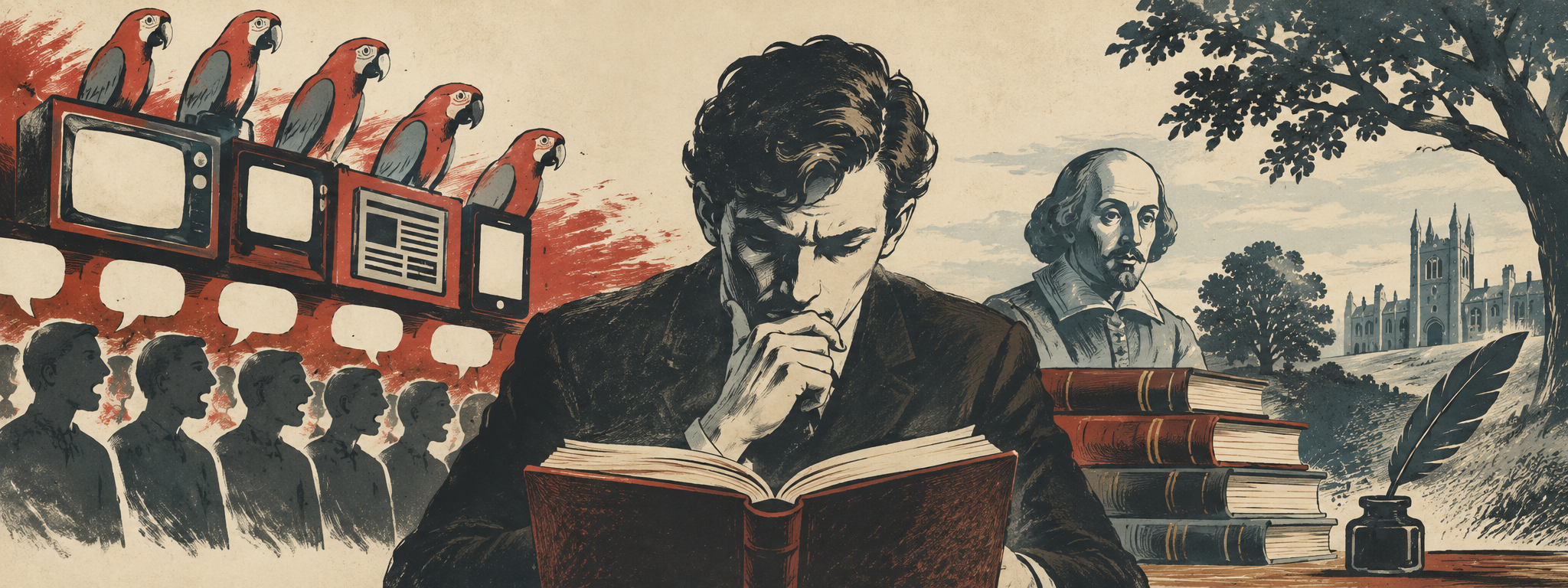
Before the advent of television, and now other and far more intrusive forms of mass media, it was hard for slogans to get any traction. Yes, you might see a bit of parroting going on in newspapers, whose writers, under the pressure of daily deadlines, might naturally reach for whatever handy phrases were in the air. But I have a very large collection of American magazines, in bound volumes of six months each, from about 1870 to 1920, and I am continually struck by the high literary and intellectual quality of the writing. It was the result of genuine thought, not reaction and repetition. It is enlightening and deeply refreshing to read, for example, the comic actor Joseph Jefferson’s autobiography serialized in The Century Magazine, to relish his anecdotes, and to be instructed, with a gentle hand, by his evaluation of other artists in his own field, what they did best and why. If Joe Jefferson ever met a platitude or a cliché, he must have shrugged and walked past it, having better things in mind. The same goes for the Italian actor Tommaso Salvini, whose reflections on Shakespeare I have also read in The Century. I do not agree with all of his romantic interpretations, but they are well worth considering. After all, you have to respect a man who dared to perform Shakespeare in Italian translation, before English-speaking audiences and in company with troops of actors who delivered all their lines in the original English.
Read more In China You Go to Prison for ‘Slandering’ History’s Greatest Killer
But in the era of mass media, language has become a social contagion, or I should say an antisocial contagion…
Actual human beings think, rather than spatter language abroad without thought, simply repeating what everybody around them has said, by the millions and tens of millions. Or at least, if they have a few minutes of peace, they might think. But in the era of mass media, language has become a social contagion, or I should say an antisocial contagion, since a genuine society must be made up of fully human beings, not parrots. Thought, of course, is slow. Imagine asking the Shakespearean actor Henry Irving (whom Joseph Jefferson knew well, having worked with him off and on for a long time) about “gender norms” and “the patriarchy” in Romeo and Juliet. After you explain to him what on earth you mean by those automatic phrases, he might look at you askance and ask whether you had actually entered the spirit of that play. Old Capulet is headstrong and stubborn, but he does love his daughter Juliet, and the political father of Verona, Prince Escalus, has erred in being too indulgent toward the feuding Capulets and Montagues. Irving, I imagine, might then ask about the other father-daughter relationships in Shakespeare’s plays, many of them tender and gentle, others fraught with error on the part of the father, or, in King Lear, treachery from a daughter. He might ask you to consider that Shakespeare’s greatness lies in his seeing so much of the truth about people – and in the first place, truths about men and truths about women, observed and acknowledged by every culture, everywhere. (RELATED: Brain Rot and the Crisis of Digital Late Modernity)
We might suppose that colleges and universities would try to resist the impulse to supplant thought with ready-to-hand political slogans. It is not so. Instead, the colleges are often the source of the slogans, invented by intellectual sloth and enforced by envy, because the slogans serve as blinds or masks for the intellectually mediocre. The sloganeeringhas been going on for a hundred years now, and, with exceptions here and there, it has pretty much thoroughly corrupted arts and letters. I have read thousands of applications for jobs in English literature, and the wearisome sameness, decked out in the literary-theoretical slogans and political frippery, often made me wish that I had done something else for a living, something more beneficial to mankind — like owning and operating a bowling alley, where human thought might still be possible, and the main noise would be of the wooden pins falling, tenpin-music, loud but not unpleasant. But just as it is hard to compose a real melody, demanding silence, thought, sensitivity, and intellectual order, so it is hard to read the work of a great author and say something illuminating about it. The obsession of Captain Ahab, personal, theological, swimming under dark and ambiguous waters, half human, half demonic, is hard to bring into the light. Every time you believe you can come to a sure conclusion about Melville’s open-eyed madman, the author lays a gnarled hand on your shoulder and reminds you about something you have overlooked or underestimated. The reduction of great literature to political platitudes is precisely what English departments have long been up to, because the professors themselves are incapable of more. But it must be got up in fancy garb, just as a raddled and crow-footed harlot has to lay the rouge and lipstick on thick.
Many people in the history of our race did not think, because their lives were submerged in back-breaking work and suffering that gave them no leisure for it. I do not know how much thinking you can do when you are plying the oars in a galley. But what I am describing here is not the mere absence of thought. I am not saying that to parrot a political slogan is not to think, or to fail to think. My point is not merely that a professor who obstructs Dickens’ art with his or her own preoccupations with sex has failed. It is worse than that. It is the active obstruction or dilapidation of thought. It unravels the brain. It smashes to powder what rock of truth the mind might have stood upon to gain a vantage on further truth. You learn in college how to strangle thoughts in their cradle, and then replace them with plastic dummies, manufactured by the millions in the mills of mass media and mass schooling, as like as one mass-produced hamburger is to another, but with this demonic twist, that the consumers will believe in their own unique and individual tastes. They will think they are thinking, and they will insist upon it, from one to the next, in the same words, world without end. They are their own Artificial Intelligence.
Read more September Vacation Tribes
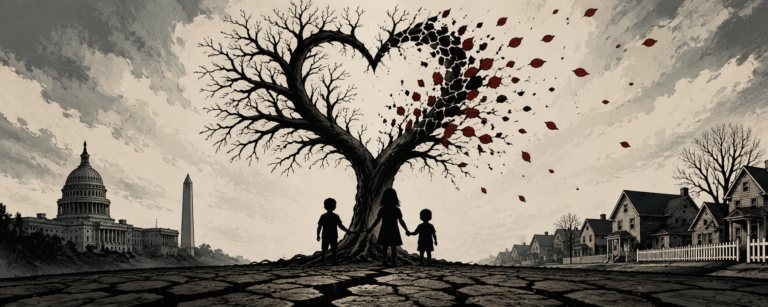
Which brings me to the title of this essay, “Disembodied Autonomy.” For “bodily autonomy” is one of the latest anti-thoughts to plague the world. It appears that people can be cheerfully socialist when it comes to confiscation of property that does not belong to them, but the most radical of individualists when it comes to their bodies, denying the duties they bear toward them and in them, duties that are powerfully social. I have no moral right to take my own life, because my life is not simply my own: I am, as John Donne says, “a piece of the continent, a part of the main,” for “no man is an island.” I have no moral right to consent to a duel, or to play Russian roulette. I have no moral right to cripple myself on purpose. I have no moral right to indulge in orgies, or to parade naked down the street. The body is not something I own, to dispose of as I please, as if I were a disembodied will floating somewhere above it or beside it. Everything I do in this life, I do through the body, and even those things I do to the body, I do by and to my embodied self, in accord with or in opposition to social responsibilities, and with social consequences. We see the point most starkly in the matter of abortion, whereby the woman insisting on her own supposed bodily autonomy acts to destroy someone else’s body, her own child’s body, while violating the nature of her female body itself, made as it is for motherhood, just as she and the father violated the end of reproductive action by engaging in the child-making thing while admitting no responsibility for the child they might make.
And just as the last place to go to if you love literature for its own sake, or for the perennial truths it reveals about human nature, is a college English department — for great literature resists the force of un-thought — so too, if you admire the human body, male and female, and if you are struck with wonder at each kind, and if you ask the most obvious questions about how male and female behavior is reflected in, and springs naturally from, the natures of those bodies, the last person you want to ask about it is someone with the phrase “bodily autonomy” on the lips. For we might instead call it “disembodied antagonism against the body.” I cannot otherwise explain the rage to mutilate children. Spaying and gelding are for cats and dogs, not for girls and boys. Where is the sense that the Psalmist expresses, when he says that he is “fearfully and wonderfully made”?
But the point here might be applied to other objects besides the body. “Clear your mind of cant,” said Dr. Johnson to Boswell. Read old books. Resist the simultaneously centripetal and antisocial pull of mass media. Build a barn. Play cards with your children. Let the mind heal.
Read more You Must Not Question Gloria Steinem. But I Do Have Questions.
READ MORE from Anthony Esolen:
The Man Was Not Deceived
A Letter to Boys
The Dustbin of Relevance
About the Author