Being Spanish is one of the best things that has ever happened to me. I am from a country that loves wine, beautiful women, and sunbathing. I am from a country that tends toward laughter, that safeguards the treasure of the Spanish language, and that forever changed the history of the West by taking to the seas. I am from a country that fought a painful civil war to prevent the genocide of Catholics and to avoid becoming a satellite of Soviet Russia. I am from a country, in short, that is indestructible because it has survived more than a century of enormous efforts to destroy itself.
Read more The Mothers Who Regret Their Children
This article is from The American Spectator’s summer 2026 print magazine. Subscribe to The American Spectator to receive the magazine.
Unfortunately, our current political leaders are not worthy of Spain’s greatness. Pedro Sánchez, with his affected ideological bravado, is proving that Nicolás Gómez Dávila was right when he asserted that “man does not do the worst things unless he claims that his conscience compels him to do them.” Lately, he speaks softly, almost whispering, and pretends that he acts as he does because his heart or his conscience dictates it.
Not even the Black Legend, that crude lie claiming that Spaniards made history by eating the Indians alive, has done as much damage to Spain as the current left. Our two main problems are Pedro Sánchez, because of his megalomania and irresponsibility, and then socialism. Current socialism. Because the socialism of the ’80s and ’90s, led by Felipe González, despite the corruption and state crimes, sounds like a small social-democratic joke compared to what came after.
Everything changed on March 11, 2004. Two days before elections that, according to all the polls, would have reelected the People’s Party — center-right — to the government, the mysterious 11-M attack achieved its objective: changing the balance of power in Spain. The cost was 193 dead and 1,900 wounded.
The government initially attributed the attack to the terrorist group ETA. And it was the most reasonable conclusion: ETA had attempted two major massacres in Madrid a couple of weeks earlier. Later, it became known that Islamists were involved and countless rumors circulated, all aimed at blaming the attack on Spain’s support for the Iraq War and at branding José María Aznar’s government as liars. The Socialist opposition, led by the infamous José Luis Rodríguez Zapatero, ordered its supporters to demonstrate in the streets in the hours prior to the elections and to surround the People’s Party headquarters, shouting “murderers, murderers,” in one of the most shameful actions remembered in the entire twenty-first century, while dozens of victims of the March 11 attacks still lay unidentified among the rubble.
Under this suffocating atmosphere, the elections were held on March 14, 2004, and, against all expectations, the Socialist Zapatero won. The history of Spain in this century would never be the same, and nothing that is happening today in Spanish socialism, as well as in the European left, can be understood without that.
Even without being the sharpest pencil in the pencil case, Zapatero was a precursor of the postmodern left. He crossed all the red lines that the Spanish Socialist Workers’ Party had refused to cross for decades: he allied himself with the far left and the separatists, and he negotiated in secret with ETA terrorists, making humiliating concessions to the victims.
Among the many idiotic things he did, one stands out: sitting down in protest during the annual military parade as the American flag passed by. He is so imbecilic that he does not know that that flag does not represent Bush, but rather each and every American, past, present, and future.
Zapatero fueled separatist movements in those Spanish regions where secessionism is entrenched and steeped in corruption — Catalonia, the Basque Country, and Galicia. Zapatero activated all the ideological laws designed to divide society: from same-sex marriage to the so-called “historical memory” law, a rewriting of Spanish history according to which all the blame for the civil war falls on the winning side, while the left-wing side is rendered spotless. This law changed school curricula, demolished dozens of statues and monuments (does all this sound familiar?), and stripped streets and squares of the names of numerous figures whom he accused — rightly or wrongly — of having been Francoists, removing their names from the public space. Suddenly, Spain once again began to talk constantly about a civil war that had ended more than sixty years earlier and that nobody remembered anymore.
Subscribe to The American Spectator to receive our summer 2026 print magazine.
The current president, Pedro Sánchez, is the political heir of that sectarian, treacherous Zapatero, and he is now under investigation for countless scandals. It is important to understand that Sánchez, who displays far-left policies, believes in nothing. He is not a politician with ideas; he is a politician with ambitions, and with a pathological narcissism that many consider a mental illness that should be urgently treated. Sánchez would sell his own mother just to stay in power for three more days.
Read more The UN, NGOs, and the Business of Perpetuating the Israeli-Palestinian Conflict
He became prime minister without elections through a motion of no confidence, a legal instrument designed to remove unpopular governments in extreme cases and which had never before been successfully used. This is how he ousted Mariano Rajoy’s People’s Party government, accusing it of corruption, in an operation designed with the support of left-wing media, a corrupt judge, and a secret pact with all the political leaders who are enemies of Spain: communists, separatists, terrorists, and a bunch of oddballs who nobody really knows what the hell they are doing in the Congress of Deputies. He won the motion and became president without elections because, had he run, he would undoubtedly have lost. I know this because at that time I was, in a way, in Rajoy’s government, as I was an advisor to the Ministry of Education, Culture, and Sports.
Sánchez brought into the government the Podemos communists, a group of university agitators who admired Lenin and had achieved some popularity on social media thanks to the support of Iranian ayatollahs and Maduro. Coincidence or not, Iran, China, and Venezuela have ended up being the government’s only friends.
Europe should pay more attention to the case of Spain: the three major events in Spanish political life in recent decades have been foreign interferences. The 2017 Catalan coup attempt, when they foolishly tried to become independent from Spain against the wishes of half of Catalans, was supported by Putin’s Russia; the 11-M attacks, although never fully investigated, seem impossible without the cooperation of some intelligence services of neighboring countries; and the arrival of the communists into government, although driven by Sánchez, was only possible because of the support and funding of Iran and Venezuela to destabilize Europe.
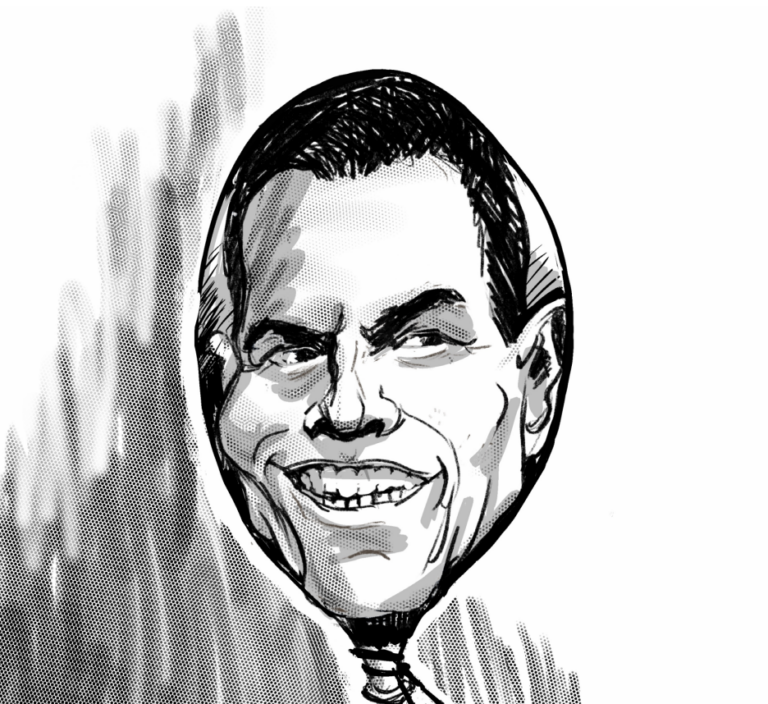
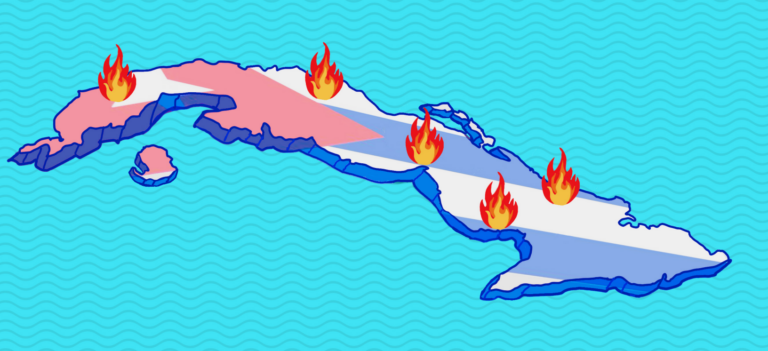
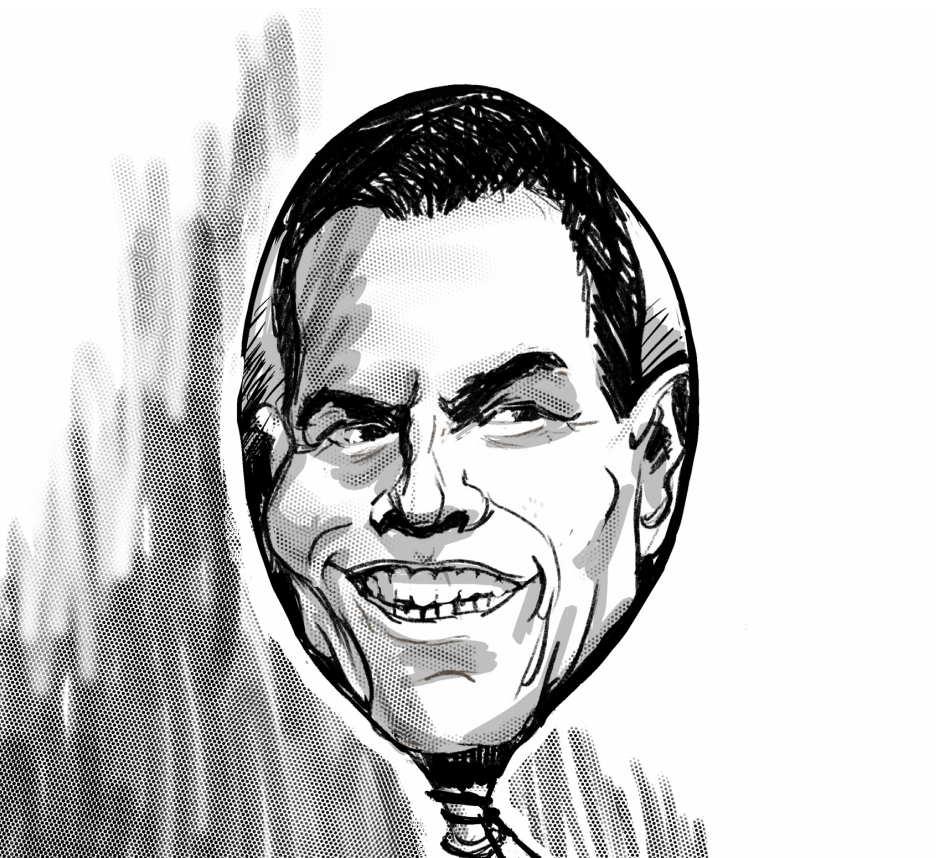
Art by Bill Wilson for The American Spectator
Sánchez is tremendously unpopular in Spain. I do not remember any other president who could not go out in public without his security team first securing a perimeter of dozens of meters. He is insulted everywhere, nobody likes him, and yet, mysteriously, he still seems to maintain a certain level of support at the polls. There are numerous suspicions that the 2027 elections will not be clean, and there is concern that Sánchez may be laying the groundwork to alter the electoral register through measures such as the recent mass regularization of illegal immigrants.
Upon realizing his unpopularity, Sánchez took two steps: one, taking revenge on the Spanish people for not supporting him, and two, building an international profile. Sánchez has tried three times to promote himself as a leading politician abroad. First, he led the Socialist International, which is now under judicial scrutiny for consistent suspicions of illegal financing. Then he tried to sell himself to the EU as a leader of moderate socialism. One could say that Sánchez was clever in winning Ursula von der Leyen’s favor, but the truth is that all the credit belongs to von der Leyen’s innate stupidity. And now he is trying to gather around himself Iranian, Palestinian, Chinese, and Latin American far-left forces.
When his popularity was at its lowest and he was most besieged by judicial investigations in his circle — with his wife, his brother, the leaders he appointed in the Spanish Socialist Workers’ Party, several ministers, and numerous collaborators under scrutiny — he found in the Iran war the excuse to resurrect himself, which is his specialty. Before all this, Sánchez was humiliated by Donald Trump, and as the narcissist he is, he has never forgotten it. That is why turning Iran into a twenty-first–century Vietnam, with his “Imagine” slogan and banners, was a gamble as cynical as it was effective: on the one hand, it would mobilize the far left around him despite the corruption cases; on the other, it could present him to the world as the great opponent of Trump, despite the fact that his relevance to U.S. interests is null.
The relationship between the United States and Spain is surprising. When Spain does things right, it receives enormous benefits and both countries gain a great deal from the agreement; when Spain does things wrong with the United States, only Spanish interests suffer. There is no way in which Spain could harm the United States. Sánchez knows this, but he enjoys appearing in all the newspapers saying that he has denied Trump the use of American bases in Spain.
We often criticize Trump’s lack of subtlety; however, with Spain he was particularly precise when he told ABC correspondent David Alandete that it was a beautiful country and that Spaniards are extraordinary people, and that the problem is that we are governed by idiots. It was a great consolation for decent Spaniards to see that even Trump is capable of understanding that Spaniards are held hostage by a stupid and authoritarian government that does not represent us.
Is Spain’s slide toward totalitarianism a real risk to the entire European Union? Of course it is — but Brussels is not concerned in the slightest. They are far too busy with issues like plastic in the oceans, paper straws, and mandatory remote work to save energy. As for our future, I always remember the brilliant and amusing words of the count and writer Agustín de Foxá: “The Spanish are willing to die for the lady of their thoughts or for a point of honor, but dying for democracy seems to them as foolish as dying for the metric system.”
Read more Lake America
Subscribe to The American Spectator to receive our summer 2026 print magazine.
About the Author