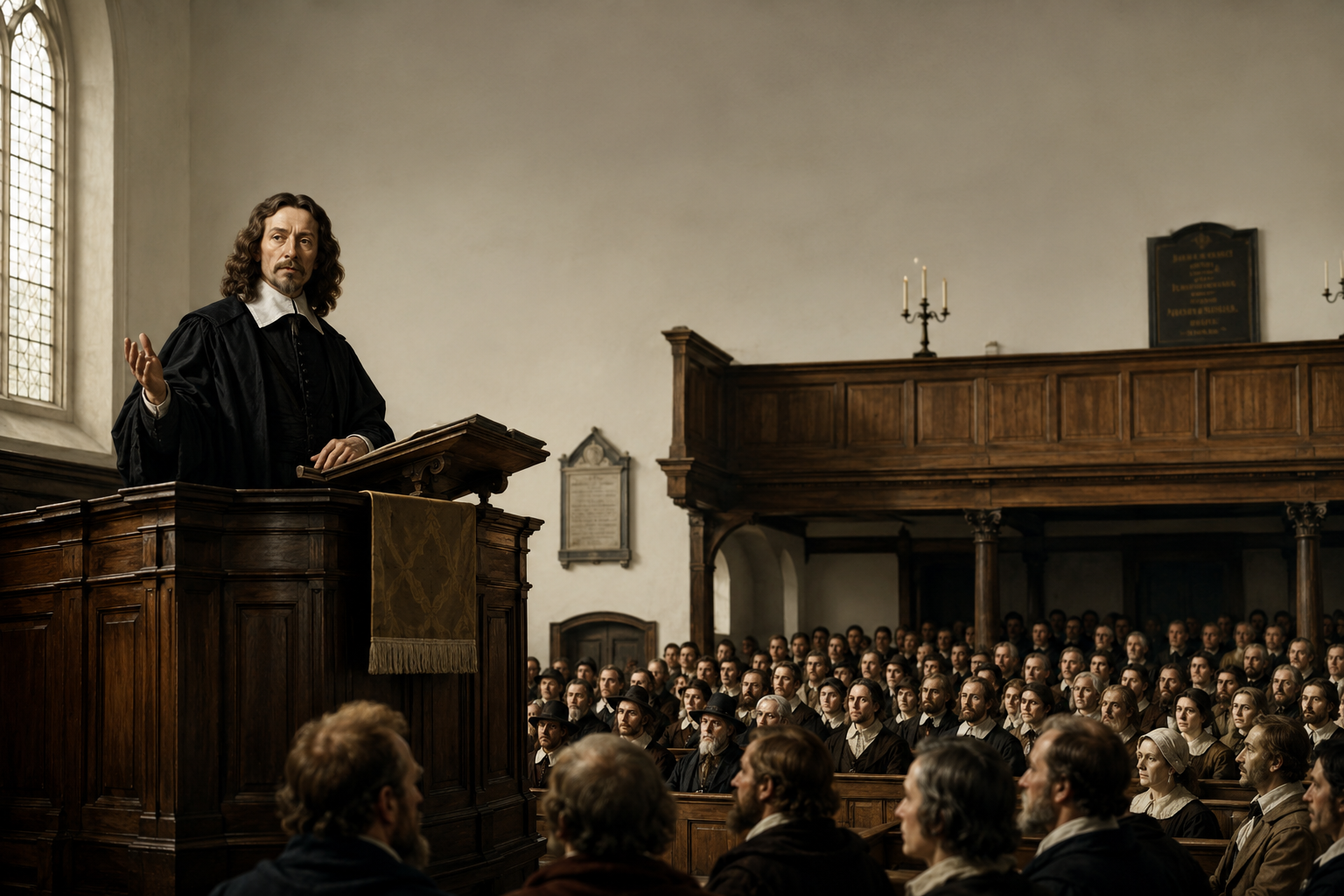
One evening around 1650, John Selden reflected to his dinner guests on humility:
Read more Trump’s Canada Tariffs Aren’t the Betrayal Ottawa Claims
Humility is a Virtue all preach, none practise, and yet every body is content to hear. The Master thinks it good Doctrine for his Servant, the Laity for the Clergy, and the Clergy for the Laity.
Selden was England’s supreme legal scholar and a fierce advocate of the liberties of England’s constitution and its Common Law traditions. He also had a mordant sense of humor and knew by experience the hypocrisy of the powerful.
Political liberty requires that we achieve real humility in our desire for power. Selden might say to us that that is why political liberty is, like humility, preached by, if not all, then by so many, and why its practice is wanting when means of coercion are at hand. Whether it was Jackon’s “to the victor go the spoils” or Obama’s “elections have consequences,” we can see the truth of Madison’s realistic humility in asserting that because we humans are not angels and therefore, we need constitutional limits on political power.
The One who created us all and the world which sustains us requires our attention.
But a constitution by itself, even America’s magnificent one, can be gamed. To paraphrase Franklin, we may have been given a republic, but it all depends on if we can keep it. As John Adams wrote, “Our Constitution was made only for a moral and religious people. It is wholly inadequate to the government of any other.”
But religion, too, can be gamed. Selden did not spare the religious from his wit. As we would apply the strictures of civil law to others while zealously reserving its freedoms for ourselves, so too do we tend to apply the restraint of religious teaching to others while invoking its mercy and forgiveness for ourselves.
The best of our modern critics point out the same thing. Stephen Carter has made the point that the elite in American politics have made a grand project over the years of expelling religion from the conversations that matter. Simultaneously, that same elite invokes for itself and the culture a kind of freedom that amounts to an exemption from moral obligation to others.
These two stances are related. The common thread of the West, conveyed in the Bible, is that there is a oneness underlying all, so that even the most disparate things are held in relation and are never entirely isolated. When we expel that from the conversation, it is inevitable that a less comprehensive relationship takes its place, a relationship from which some will be excluded entirely.
This may manifest itself in politics by what the Founders called faction, which they saw as the greatest danger to the republic. It manifests itself today in the frenzied worldwide attempt to make all politics about exclusion. There are others whose fault it is that you feel a lack of freedom. Exclude those others and you will have your paradise. We free you from restraint against those excluded others, and no longer do you have to control your aggression or serve the hated taskmaster, Impartial Truth.
Quite reasonably, the politics of exclusion inevitably focuses on the people whose book brought to our civilization the imperative to put that Oneness at the center of our lives. Since oneness is real, it must pop up anyway, and in the politics of exclusion, it appears as an all-encompassing narrative of blame that will stretch to infinite lengths to link every evil, real or imagined, to the excluded others. Inevitably, at the center of it all will be those people and the teachings they transmitted, transformed now in their minds from an actual people like themselves into a unified field of evil. This all-consuming thought collapses the soul of those who surrender to it and spreads its evil to all they have the power to reach.
There can be nothing more poisonous to democracy.
Democracy rests on the idea that we all have a voice and by listening to the other voices, we can then be part of an intelligence better and fuller than our own isolated insights. But that requires civility, a sense of responsibility and relation to our fellow participants in this kind of nation. Carter puts it beautifully:
Civility … is the set of sacrifices we make for the sake of our common journey with others, and out of love and respect for the very idea that there are others…
Read more Peace in Ukraine? What Nazi Germany Can Teach Us About Defeating Putin’s Russia
Democracy demands dialogue, and dialogue flows from disagreement. But we can, and maybe must, be relentlessly partisan without being uncivil. Indeed, the more passionate our certainty that we are right, the more urgent our need to practice the art of civility, otherwise we make dialogue impossible, and the possibility of dialogue is the reason democracy values disagreement in the first place.
Some hold up incivility as evidence of their new version of True Religion. Disciples of Danton embody Danton’s motto for the Jacobins: “L’audace, encore l’audace, toujours l’audace!” That audacity eats its own, as Danton found on the guillotine and as his murderer, Robespierre, found out in his turn. America’s nouveau Jacobins hurtle down that same path, at work to warp our civilization equally towards blame and murder in the name of their similar version of politics-as-religion.
One can see why Selden skewered both the laity and the clergy. As long as the moral imperative to do the difficult thing can be outsourced at will to others, then people will exchange the practice of humility for the practice of humiliation. Such a religion needs skewering.
When in Exodus God reveals Himself and His law at Sinai, He begins with identifying Himself: “I am the Lord your God.” We long ago stopped using the second person singular in English — we say “you” whether we are talking to one person or many.
But Hebrew preserves that distinction. Even though God was speaking to everyone, all two million or so, God uses the singular — as King James got it correctly, “I am the Lord thy God.” What follows quite simply is that the law is not something primarily addressed to an abstract construct, the people or nation, but it is addressed individually. The same Source that gave us our freedom (“Who took thee out of the land of Egypt from the house of bondage”) is the One who calls us to join together in bonds of responsibility to our fellows, to our nation, and to its laws.
Selden knew humiliation. But though he had suffered imprisonment several times for angering the king, he was not among those who later tried the king and put him to death. In an age when England had its fill of religious conflict, Selden used his influence to see that political power should be devoted to the civil order. The religion of the nation would practice humility and would not use the civil power to enforce religious uniformity — save on the most basic of issues, those expressed in the succinct seven Noahide commands.
That recognition of God, Selden knew, is the first item in the Seven Noahide Laws as well. The One who created us all and the world which sustains us requires our attention. Without attention to the oneness that underlies us all, morality is just the sham that Selden saw in the misuse of humility.
Selden put it this way:
Morality must not be without Religion; for if so, it may change, as I see convenience. Religion must govern it. He that has not Religion to govern his Morality, is not a dram better than my Mastiff-Dog; so long as you stroke him, and please him, and do not pinch him, he will play with you as finely as may be, he is a very good moral Mastiff, but if you hurt him, he will fly in your Face, and tear out your Throat.
For a last word on the ever-present tendency to blame a certain people, Selden had characteristic humble insight, for all that he lived in a land that had expelled its Jews centuries before:
Talk what you will of the Jews, that they are cursed, they thrive wherever they come; they are able to oblige the prince of their country by lending him money; none of them beg; they keep together; and for their being hated, my life for yours, Christians hate one another as much.
This is what one would expect from the man whose beliefs let him to defend Catholics as well before a very hostile Convention in Westminster and who turned English law towards the freedom of religion we would give first place in our Bill of Rights.
Read more Palantir’s Mission: Peter Thiel, AI, and the Defense of the West
READ MORE from Shmuel Klatzkin:
The Religious Roots of Religious Freedom
Did Religion Create Religious Freedom? Rethinking the Origins of Western Liberty
Does Biden’s Pardon Mean Anthony Fauci Must Testify?
About the Author