Welcome back to the world of Mike Holman.
If this is your first stop, here’s what you need to know: Mike Holman is the independent journalist, podcaster, and inveterate maker-of-enemies at the center of Scott McKay’s bitingly satirical thriller series — four novels (so far) chronicling one man’s habit of ending up in the middle of the very stories the rest of the media is too scared, too compromised, or too incurious to tell. Catch up on the whole series, read past episodes, and find links to every book at “The Mike Holman Novels at The American Spectator.” Soon, see the video-novel version of this and the previous books at MikeHolman.com.
Read more From DSA to Fishback: Why Young Voters Feel Disenfranchised
Where we left off: The plot to free Cuba is taking shape and looks promising with a major backer with a surprising background, but problems on the home front have developed. Mike prepares to take a silent lead on the ground in Cuba, starting with a very key piece to the puzzle.
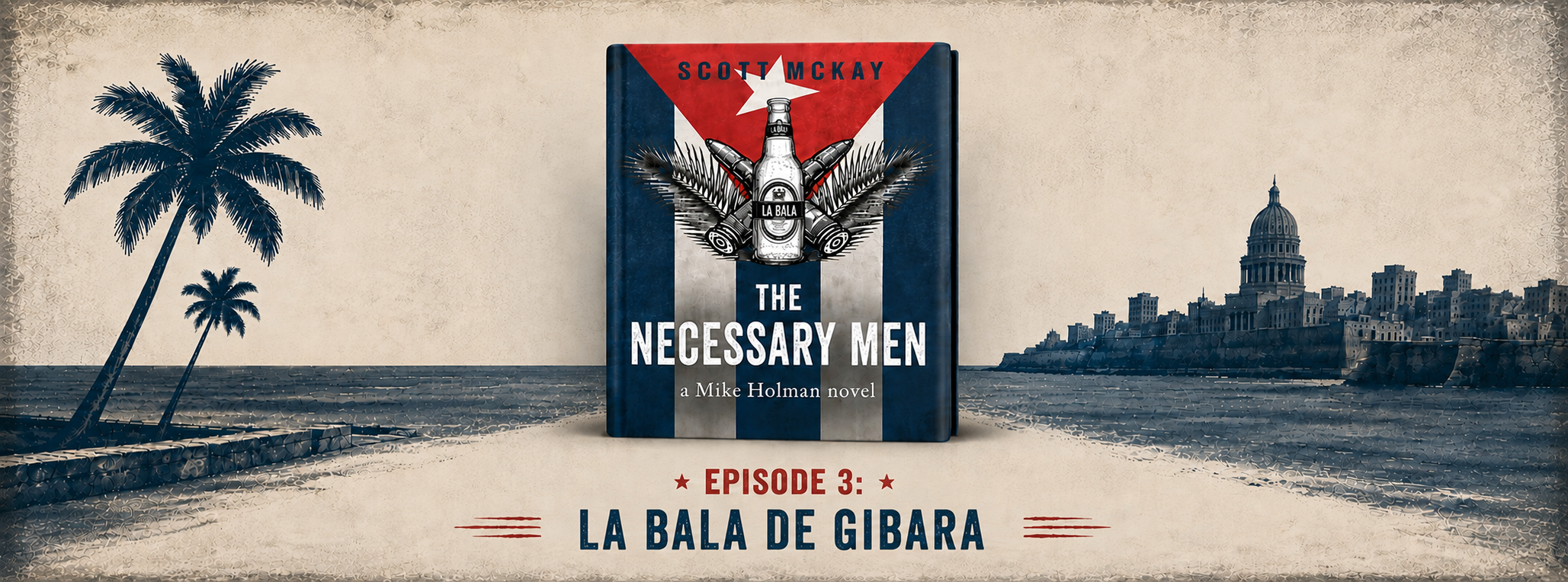
Here are Chapters Five and Six of The Necessary Men.

Chapter Five
Coral Gables, Florida — March 18, 2026
Stan had known Diego Maceo for probably 20 years, and how they got to know each other was a pretty funny story.
Before he sold it to RedGuard, Stan had a hedge fund called Valkyrie Capital. He got out in late 2020 amid all of the COVID hysteria, when he and Trina, his wife, decided they couldn’t stand living in Manhattan for one more minute, and Stan was just done with the Wall Street grind. But prior to that, for a while, Valkyrie had done some TV advertising as they were growing their client base and before they started refining it to filter out the ordinary Joes and hold onto the real high-end clients.
The best ads Valkyrie did starred Diego. And they were hilarious.
There were five or six of them, and they all revolved around a central theme, which was that Diego was the poor black immigrant ballplayer in the dugout with all the snooty rich guys – think Corbin Bernsen’s character in Major League – who are sitting there griping about their portfolios. Then one of them asks Diego how his portfolio is doing, as a snooty joke at his expense, and that’s when Diego says his money is with Valkyrie and it’s outperforming all of theirs.
What made the ads work was that everybody knew Diego was a superstar businessman who had car dealerships, a bunch of real estate in Orlando, a couple of fast-food restaurants that he was a massive franchisee with, and then later that brewpub in Hialeah which ended up being the launchpad for La Bala beer. His playing the poor immigrant was almost a three-way joke – yes, he’d been that at one point, but he clearly wasn’t anymore, so he was clowning on himself. And the ads were clowning on the snooty rich guys, which positioned Valkyrie as the hedge fund for the regular guy while they were really chasing the snooty rich guys after all.
But more than that, and what really made the ads great, was that they were clowning on the people who treated the poor black immigrants as victims of an unjust system. La Bala didn’t need their help, and he had a big smile on his face while he showed it.
When those ads popped in the middle of the Omobba administration, and this was at the peak of Diego’s baseball career, there was sort of a controversy about them. I did a whole podcast on how Diego and Valkyrie were shredding the politically correct weenies for fun and profit and how awesome it was, and I said those ads were the most conservative thing on TV.
Stan told me later that while everybody at Valkyrie loved the podcast – he and I didn’t know each other at the time; we met after PJ and I had moved to Jupiter – the fact that I’d said those ads were conservative had spooked Diego a bit.
Because Diego didn’t want his name associated with politics. Diego was a radical adherent to Jordan’s old line about how “Republicans buy sneakers, too.”
I was pretty sure Diego was a Republican. But he went out of his way not to come off as political. He went to the White House when Omobba was president and shook his hand, and he went and shook Trumbull’s hand. Diego wanted to be known as an all-around good guy. So when I essentially called him a conservative, he just about had a heart attack.
And it was too bad, because as a result we couldn’t get him on the podcast.
A few weeks earlier, there was a charity fundraiser at Diego’s brewpub and Stan and Trina had brought PJ and me, and that’s when I’d met Diego.
And he remembered the thing about the podcast, and he’d said that he loved it but he couldn’t really endorse it because of his public face where politics was concerned.
Then I met Essie – Esmerelda was the name she went by when she was a telenovela actress, but among friends she insisted on being called Essie – and she said they were religious consumers of the podcast and everything Holman Media.
“I really like Colby,” she said. “But he’s not you.”
“I’ll tell him you said so,” I said with an evil smile. And she laughed.
So when Stan and I went to see Diego and Essie at their very lavish, impeccably decorated and utterly South Florida mansion on a tree-lined street in Coral Gables, with the fairway of the 8th hole at the Biltmore golf club practically in their backyard, it was not a cold call. In fact, it was a good 20 minutes before we finally got around to the topic of Cuba.

Diego was an absolutely delightful guy to talk to. He was known as the Shaquille O’Neal of baseball, and he earned that; Diego stood 6’6”, which wasn’t quite Shaq’s height, but he was still one of the tallest guys on any baseball diamond, and he had the deep voice and jovial laugh and blue-collar wit which made him a media darling both before and after his retirement. Plus, he was in the argument for one of the best pitchers of all time; Diego was 25 when he defected from Cuba’s Olympic gold medal baseball team, and then for almost two decades he’d been the ace of the Red Sox staff. Even when his fastball withered from the 100-mph nightmare down to more like 88-90 mph, he could still locate it expertly and mix in some off-speed stuff enough to survive.
And when the Marlins signed him after the Red Sox couldn’t justify La Bala’s contract at past 40 years old, he was still at least an average Major League starter for that last year.
Including the utterly incredible moment in an interleague game back at Fenway when a nearly-washed-up Diego “La Bala” Maceo, his fastball topping out at 89, managed a perfect game against the Red Sox.
He struck out the last 11 batters he faced, and the home fans were standing and cheering for him from the seventh inning on.
That was one of the greatest moments in sports history. And Grant Paxton, our guy who ran Surge Vision Studios, had been trying to get to La Bala so that we could make a biopic of him.
“Tell him I’ll think about it,” said Diego, in that deep voice of his, only a faint trace of the Cuban accent left. He turned that accent on and off depending on who he was talking to. “Essie is the one who makes movies, though, not me.”
“I made TV shows, not movies,” she corrected him, smiling. “But Diego’s story would make an excellent movie.”
“Sounds like I should have Grant call you,” I teased her.
She just smiled at me, saying yes without saying it.
“Can we talk about Cuba for a little while?” asked Stan. “We’ve got some concerns about the regime down there and maybe some thoughts you might be interested in, but we want to get your take first.”
Essie jumped into that conversation like a lightning bolt.
“The thing to understand,” she said, “is that the regime is bankrupt. You know all about this supposed oil embargo, but of course what you know is mostly lies if you watch it on TV.”
“How so?” I asked.
“They say Trumbull is blockading the oil from getting to Cuba. He’s not. Now that they can’t get free oil from Venezuela, what’s blockading the oil is the fact that Candela has no money to pay for oil. They burned through all their currency, they have nothing to sell, and they’ve exhausted all their credit around the world. They have to pay cash for everything and they don’t have any.”
“I think that’s mostly true,” I said.
“And they have their useful idiots here who want to make us prop up that regime, but the answer has to be no. Not until they pay what they owe to families like mine.”
Essie’s family had been big shots and massive landowners in Cuba under the Batista regime, and when they were run off the island during the Castro takeover, they transferred their sugar empire from Cuba to Florida and, of course, became wealthier than ever. There were lots of people like them, and estimates had it that the Cuban government’s expropriation debt, which under U.S. law had to be settled before any normalization of relations could be had, was more than $300 billion – a figure that government was never, ever going to be able to pay back.
We’d talked about that issue as we were formulating the plan for The Everything Company, or LCTC, and though ideas were still being floated, it was a problem we’d yet to resolve. Pierce had a team of economists and other academics kicking it around still.
“I know this,” said Diego, “and I know it because I know Burro…”
“He’s an impressive guy,” I said.
“Yes, he is. And he wants to turn Cuba around and make it free. But he can’t do it. Not now. There is too much… vientos en contra.”
“Headwinds,” Essie translated. Diego nodded.
“The one thing Candela seems to do well is collect shills in the political class in this country and elsewhere in the West,” I said.
“He cannot send the Marines,” said Diego, “though if he did it would be over quickly. The regime would fall.”
“We think it’s going to fall soon anyway,” said Stan.
Diego nodded.
“It should,” said Essie. “But it should have years ago. The only reason it doesn’t fall is that Cuba is such a ruin nobody wants to be responsible for it anymore.”
“What if that weren’t true?” I asked.
“What you mean?” That was Diego.
So I told him.
And he and Essie listened, and then they had a quick conversation in very rapid Spanish before both turned back to Stan and me.
“Okay,” said Diego. “I’ll do this, but I have conditions.”
“Go for it,” said Stan. “What have you got?”
“First, I’ll do… ten years. That’s it. I’m not retiring there. I’ll help, put the place back in order, make it free, and then that’s it.”
Stan and I looked at each other, neither of us understanding what he was saying.
“Diego,” said Stan. “All we need is for you to front The Everything Company when the mask comes off, so that the regime can’t kick us out.”
“No,” said Diego. “You need me to run the country. But like I said, I’m not doing that for the rest of my life. I’ll do it for 10 years and then I’m coming back here.”
“Oh,” I said. “That’s…”
“When the regime falls,” said Essie, “it’s going to be chaos. The only thing that can overcome that is a brand everyone can rally behind. Diego is that brand.”
“This is more than we expected,” I said.
“You have someone else in mind?” asked Diego.
“No, I do not. If you’re willing to take this that far, we’re in business.”
“Good,” said Diego. “And I have some other things that we can get to in time, but the one you’ll need to be ready for immediately is where your headquarters needs to be.”
“In Cuba, you mean,” said Stan.
“I think the initial plan was to set up in a town called Moa, on the eastern side of the island,” I said, “but that wasn’t set in stone the last I heard.”
“No. Not Moa. What you want is Gibara.”
“Where is that?” said Stan.
“Also on the eastern side, on the north coast. It has a large bay and should have an excellent port, but doesn’t. Yet.”
I pulled out my phone and looked up the town on Google Maps, and I showed it to Stan. He opened the Everything Company document on his phone and looked at the list of towns that LCTC operatives had already made contacts in.
Gibara wasn’t on it.
I looked at Diego and shrugged.
“I don’t know,” I said. “We didn’t do the site selection.”
“Trust me. I’m your site selector. You want Gibara.”
“OK, but Diego,” said Stan, “Cuba’s full of little towns that ought to have nice ports but don’t. What’s so cool about this place?”
“How about that it’s where Columbus landed?” said Diego.
“He’s right,” I said, scrolling through Wikipedia. “Or close enough. Plus they have a film festival in July. I imagine we could do something with that. Can’t imagine they’ve got a lot of tentpole features at the Cine Pobre Film Festival just yet, but Blockbusters could fix that.”
And then I looked at Essie.
“I’m thinking of one specific film in particular,” I said.
Essie smiled at me. She knew I was hard-selling her. Game recognizes game, and so on.
“Seriously, Mike?” said Stan, not impressed with the showbiz angle. “Diego, you need to give me a little more than this.”
“Okay, fine,” said La Bala. “It’s my hometown.”
“We’ll make it happen,” I said.
Stan and Trina’s housemaid was a girl named Marisol de la Villa. She was 19 or 20, cute more than pretty, dedicated, very responsible and reliable… they loved her to death. Marisol had come to them after her aunt, who’d been the housemaid at their place, broke her ankle and decided she was done working on her feet all day. Aunt Gisela had Marisol fill in for her at the Lynchs’ place, and a year later they absolutely depended on her to keep their house running. Stan even bought her a car… or, more to the point, when Rich and Caden, the twins, turned 17 and they each got new Cooper Minis for their birthdays, Stan gave Marisol the old Jeep Wagoneer that the twins had shared.
She was happy with that. It was a tank, and Stan made sure it was in perfect working order.
And Stan insisted, a couple of days after we’d finally run through all the details of Diego’s involvement – details which continued to pile up thanks to a steady stream of text messages from Essie – that we get Marisol involved.
“I thought you said she’s Puerto Rican,” I said when he brought Marisol up.
“I said she grew up in Puerto Rico. But she isn’t Puerto Rican; she’s Cuban. Her daddy got thrown in jail for speaking out against the revolution, and her uncle got the whole family out. It was a terrible story. They ended up going from Cuba to Haiti…”
“That’s the wrong direction,” I said. “Definitely the wrong direction.”
“Yeah, well, they walked the length of Hispaniola, got on a boat from the Dominican Republic and made it to Puerto Rico.”
“Yeesh,” I said. “You talk about wanting to get out of Cuba in the worst way; that’s the worst way.”
“That was when Marisol was eight. They came to Florida when she was 13. But you wouldn’t know it. Her English is perfect.”
“Where does she go to school?”
“She doesn’t. She got her GED and now she’s just working. She’s the housemaid for us and like four other families in the neighborhood. But mostly us.”
“OK,” I said, “but what is it that you want us to use her for?”
“As an interpreter, mostly,” said Stan. “But also as, like, a fixer. Marisol is one of those people who just hustles. She finds a way. That’s just her thing. You need people like that for an organization like this, and she’s ready to do something other than cleaning houses. Trina’s gonna kill me for sending her off to do this, but whatever.”
“Seems like we’re both gonna trash our marriages over this project,” I said.
I had more or less moved into a guest room at the Club at Admiral’s Cove, which, as places to go into exile went, wasn’t terrible. But it had been almost a week and I hadn’t even talked to PJ, much less made it back home. In fact, Melissa had come back from lunch at the PGFI offices with two suitcases and told me I needed to put them in my car.
“You went to lunch with my wife?” I asked her. “Is that what this is?”
“OK, you should be glad that I did,” she said. “Because I have intel. And you should be grateful that I do.”
“Speak, then.”
“Oh my God, Mike. Really?”
“Look, I don’t need a buildup, and I don’t need a lecture from you about how I screwed up and I need to go and grovel. I just want to know what the situation is and I’d appreciate a direct answer. OK?”
“I’m… not gonna tell you any of that. From what PJ told me about your fight, you were right. And she knows you were right.”
“Oh?”
“But she was, too.”
“OK, what am I right about, and what is she right about?”
“Well, the way she said it, you said that we work for Pierce, and Pierce made these decisions, so, like, you don’t get to pick and choose the things you’re willing to do if you’re gonna enjoy the rides on the Gulfstream, or the house, or the money. Those are all perks you get from doing big things with him. I mean, that’s correct. And she knows it is.”
“Well, Hallelujah,” I said.
“And she doesn’t like it, but she did agree that our project is worth the sacrifice. Like, in theory. But she really doesn’t want it to be your sacrifice.”
“I’m sacrificing my time,” I said. “That’s it.”
“OK, that’s the part where she’s right.”
“Oh yeah?”
“Yeah. What has her absolutely furious with you is that you just blew off the fact that this is dangerous. OK? And I still don’t think you appreciate how terrified she is of losing you. You’re her everything. God, I wish I had somebody I could love the way this woman loves you.”
“She has a rather unconventional way of showing it,” I deadpanned.
“I mean, that’s really not funny. OK? I think that’s what drives her nuts. You’re just so flippant about all this, and she’s over there with a new baby and another…”
She stopped herself, and I had a vision, briefly, of Melissa covering her mouth with her hands.
“What was that?” I said.
“Nothing! Anyway, you’re just acting like, oh, I’m moving on to this new project, and PJ is like, his family is his new project! And from her perspective it’s not really fair.”
“Well, yeah, but like you said, you don’t get to pick and choose.”
“Yeah, but Mike… I think she feels like Pierce steamrolled you and you let it happen, and then you tried to steamroll her on Pierce’s orders, and she hates that.”
I took a deep breath and dragged the bags out to the car.
And when I came back inside the building, Marisol was waiting by the elevator. She had a tan business suit on that looked like it had arrived in a bag from Amazon and a pair of shoes that… didn’t quite match it. She was humming some song I hadn’t heard, and it was sort of a reggaeton tune, I guess. Boom-badaba-boom-badaba, that kind of thing.
Then she saw me come in the door.
“Mr. Mike!” she said. “It’s so good to see you!”
“Hey Marisol, looks like you’re early for your job interview.”
“Stan told me 1:30. I’m here at 1:25. My uncle says always be 15 minutes early. But I got held up.”
“I think we can forgive that,” I said as I held the elevator door open for her.
I gave her the nickel tour of PGFI’s offices and introduced her to the staff, and then we settled into the conference room. Stan and Trent and Melissa made their way in, and Melissa had coffee for everybody.
“OK,” said Stan, “first of all, Marisol, you’re going to have to do something for me.”
“Sure, Mr. Stan.”
“Well, OK, two things. First, no more Mr. Stan. I’m just Stan from now on. And second, you’re going to have to find somebody to replace you as our housekeeper or else Trina is gonna kill me.”
“I can do that,” she said, “but does that mean I get the job?”
Trent slid a folder over to her. It had a contract offer, a waiver of liability and a non-disclosure agreement.
“You’ve got to sign all of those,” he said. “The sticky notes mark the spots to sign and initial.”
“OK,” she said, grabbing a pen from the little cup in the center of the table and signing. “But this is a… waiver for what?”
So I explained the project to her.
“Essentially, you’re gonna become a Canadian, like me, and you’re gonna drop into Cuba, like me, and you’re going to be my interpreter and personal assistant.”
“How do I become a Canadian?” she asked.
“You remember the name on your Canadian passport,” said Trent, “and you occasionally call somebody a hoser.”
Marisol just looked at him. She didn’t get the joke.
“The cover here is that we’re working for a company called Sino Solutions, and they’re out of Vancouver,” I said. “My name is Douglas Thibaud, and I’m actually from Winnipeg. But I’m a project manager working for these people, and they’re a subcontractor hired by La Compañía Todo de Cuba to…”
“That’s bad grammar,” she said. “It should be La Compañía de Todo Cuba.”
“Tell that to Pierce,” said Stan with a laugh.
Marisol shrugged. “I guess it doesn’t matter.”
“Anyway, you know that there are all kinds of restrictions involved in American companies getting involved in Cuba, plus the nature of what we’re doing has to stay as quiet as possible. A Chinese state capitalist thing such as this is supposed to be wouldn’t use Americans. But Canadians are a different story; there’s a ton of interaction between Canada and Cuba.”
“Including the guy that used to be the prime minister,” joked Trent. “We’re talkin’ serious interaction.”
“Trent!” said Melissa. She knew he was talking about the rumors that Justin Trudeau was actually Fidel Castro’s son, rumors which were almost certainly true.
“So we go in by boat, and we’re gonna set up in this town called Gibara, on the eastern side of the island, and for the next couple of months we’re going to be Canadian project managers and we’ll supervise LCTC’s stuff, and you’re gonna double as a research assistant for the book I’m going to write about this whole project.”
“And you’re not even going to interview me first?”
“Honestly, Marisol,” said Stan, “this isn’t exactly a job we’re going to put on Indeed. The amount of trust we need for somebody embedded this deep is such that we can’t just hire off the street.”
“Stan here vouched for you,” I said, “and when I called Trina and asked if I could have you, and she threw a fit over the prospect of losing you, I knew you were it.”
She smiled. And then she looked at the contract she’d just signed.
“Ay, dios mio!” she said. “So much money!”
“Think of it as hazard pay,” said Stan. “There is a small element of danger if things go awry, so…”
“We will get out of there lickety split at the first sign of trouble,” I said. “But in case it gets ugly, the pay is extra.”
If that dampened Marisol’s enthusiasm, she didn’t let on. She was beaming from ear to ear.
Read more What Is a True Friend?
“All right, then, honey,” said Melissa, sliding another envelope over to Marisol, “this is for you, but you can’t use it here.”
It was a Visa card under the name Selena Jimenez, with Sino Solutions on the company line.
“I’ve… never had a credit card,” she said.
“When we get to Vancouver you’ve got to use it,” I said. “I’ll fill you in when we get there.”
“We’re going to Vancouver?”
“On Friday, yeah. Staying the weekend in a Sino Solutions apartment, then on Monday we catch a flight to Toronto, then one to Nassau, then a puddle jumper to a place called Duncan Town, on Ragged Island, where we have a staging area for the equipment and humanitarian aid stuff we’re bringing in…”
“I actually know where that is,” she said.
“…and then we go into Gibara by boat.”
“And then I do all the translations for you and tell you everything you aren’t seeing,” she said.
“That’s basically it.”
“Okay,” she said, her face lighting up in an adorable smile.
I instantly liked Marisol. I understood why Trina was so pissed off at losing her.

My beard had finally stopped itching, largely thanks to this beard oil Melissa had found. She was dating a guy who was a chef at a fancy seafood place in West Palm Beach who she’d found on Bumble, and the guy had suggested it. It smelled like hipster, but two days’ worth of using the stuff and I was good.
And that beard had filled out nicely.
Around the office they were calling me Fidel, which I took as the insult it was. My beard was much, much nicer than Fidel’s had ever been. I was starting to be proud of it.
Then the AI-generated photo that was going into Douglas Thibaud’s Canadian passport showed up on Melissa’s email, and she threw a fit.
“No, no, no, NO,” I heard her say. “This isn’t going to work at all.”
“What’s the problem?” I said, poking my head into her office.
She got up and looked me over, very closely, and she scowled at me.
“What?” I said.
“It doesn’t match,” she said.
“What doesn’t?”
“This beard. Your hair. It’s just… wrong.”
“What? A passport photo? Nobody cares about that.”
“Nobody cares because nobody is impersonating somebody else,” she said. “Stay here. Don’t go anywhere.”
And she grabbed her purse and started to leave.
“Melissa, I’ve got to get out of here in two hours,” I said.
“I’ll be back!” she hollered as she made for the elevator.
Forty minutes later I was in my office chair, a towel wrapped around my neck and another one draped on the top of the chair behind me. Melissa had slathered my beard and hair with a nearly-black Just For Men dye gel mixture and I was letting it sit.
And in came PJ.
“What on earth?” she said.
“Hey,” I said.
“What are you doing? Is that dye? In your hair?”
“Douglas Thibaud has black hair,” I said. “I’m Douglas Thibaud. Nice to meet you.”
“Who is Douglas Thibaud?”
“Project manager. Sino Solutions out of Vancouver, Canada, eh?”
“You’re going to Cuba. In disguise. Oh my God.”
I gave her a defiant smile. I figured that was as much of a risk as I was willing to take.
I knew she was coming. Mary told me she was coming. Mary had called me because PJ had called her, and Mary had done what she does.
Conflict resolution. She’s literally the best there is at it. It’s one reason she does so well making those international trade deals. But this was at least the second time she’d had to step in pro bono to fix her daughter’s marriage, and both times involved me doing these PGFI projects. I told her I needed to file that away for further thought.
“For the record,” Mary said, “I don’t think I’ve ever been more entertained in my life than when PJ told me about Peter’s role in all this. He deserves every second of what’s coming.”
“I don’t think that was really what made PJ mad,” I said. “In fact, I actually get it now.”
“Get what?” asked Mary. She already knew, but she asked anyway.
“Melissa let it slip that PJ is pregnant again. And here I am going to a hostile foreign country to do cloak and dagger things. I didn’t realize what I was getting into having that fight with her.”
“So the way through this is for you to acknowledge that there is some danger here, and to ask her to accept the risk involved in it when the potential reward is making a better world for your children,” said Mary.
“And she’s going to react well to that and not bite my head clean off?” I asked.
“It probably depends on your definition of ‘react well,’ but I can confidently state that you and your marriage will survive the exchange.”
So with PJ standing in front of my desk, a judgy look on her face, I started to say my appointed line.
“PJ, I…”
“OK,” said Melissa, bursting in. “You’ve had that goop setting for 12 minutes, which should be enough. Go shampoo it and… oh, hi PJ!”
“So you’re responsible for this?” PJ asked her.
“His Canadian passport photo has really dark hair, so…”
“Oh my God.”
“I’ll be right back,” I said, heading for the bathroom and grabbing the bottle of color-preserving shampoo Melissa held out for me.
And when I got back, PJ was waiting in my office.
“Where’s your luggage?” she asked.
“Can’t check a bag. I’m flying as Mike Holman, no luggage, then Mike Holman disappears. I’m Douglas Thibaud when I buy all my gear for Cuba in Vancouver, and then I’m Douglas Thibaud when I fly to Toronto, Nassau and Duncan Town, and then I’m Douglas Thibaud when I get off the boat in Gibara.”
“Gibara?”
“Diego’s hometown where we’re going to headquarters this thing.”
“So this is actually, really happening.”
“I was wrong just dismissing the risks of all this,” I said. “It wasn’t my plan to approach it that way. I just got mad when you sort of called me Pierce’s stooge because that’s a pain point, and then it all just came out wrong. I’m sorry.”
“I’m sorry,” said PJ. “I knew I was wrong when I was arguing with you. You’re right. We owe everything to Pierce, and this is a good thing you’re doing. You will help a lot of people. Even if it goes wrong, you’ll help a lot of people.”
“Still. I don’t think this is super-dangerous, but like you said, this is a heavier lift than the Blockbusters thing was. Instead of trying to give you assurances, I should have asked you to accept the risk. And I know that’s a lot.”
“So you talked to Mom, too, huh?”
“You know I did.”
“Oh, God. Mike, I love you so much I can’t stand it. And I’m gonna worry myself sick while you’re gone.”
“I won’t be gone the whole time. And besides, you can come and see me.”
“In Cuba? Yeah, I’ll pass.”
“Not in Cuba. In the Bahamas. Hopefully, Ragged Island is a little nicer than it sounds.”
“Yeah, we’ll see.”
“I love you too, you know.”
“I accept that I lost the argument about this project of yours,” she said. “But I’m gonna reserve the right to bitch and complain incessantly until it’s over.”
“Your terms are acceptable.”
“And can I tell you how much I hate this beard and this dye job? Mike, seriously.”
“Oh, come on. I’m going to Cuba. I’ll fit right in.”
“Honey, you have never looked less Cuban in your life.”
Just then, Melissa poked her head in.
“I hate to say it, but Marisol is here and you do need to go,” she said.
I sighed. So did PJ.
“We’ll be waiting for you,” she said.
So I hugged her, and she hugged me back, hard enough that my ribs hurt a little.
And I whispered in her ear as I put my hand on her still-flat belly.
“I know about the baby,” I said. “I feel terrible that I’m leaving. Can you forgive me?”
“Only if you come back,” she said.
Chapter Six
Gibara, Cuba — March 20, 2026
“No,” he said. “This will not do.”
“Secretary Pupo,” said Cabrillo, “this is a very good deal. It is a deal which will help your people. All across the country I have concluded arrangements like this one with our Chinese partners in La Compañía Todo de Cuba, and the money has begun flowing.”
“They don’t even have the name correct. It should be La Compañía de Todo Cuba.”
“As you say. It is a foreign enterprise. But our Chinese friends are sincere in their desire to assist their Cuban brothers, and this offer that I have for you is proof.”
Pupo scowled, and Cabrillo leaned back in his chair.
He didn’t want to be here, in this rotted-out little town. And to have Aldo Pupo, a pathetic little man in a dirty white seersucker suit with a blue t-shirt and espadrilles, who looked like an aspirational Sonny Crockett of the American Miami Vice TV show but for the bad combover, stomp his feet and reject the same arrangement two dozen other local Communist Party bosses in cities and towns across Cuba had scrambled to sign off on, was far past the point of irritation for him.
This was supposed to be an easy job; it paid even better than his work for the cartels had, and he now had Chinese protection for when the regime collapsed – which he was more confident than ever would happen. Cuba’s power grid had continued to deteriorate for lack of fuel and the predation of scavengers of various sorts, and shortages of everything were multiplying. Rioting was commonplace, though the world outside saw little evidence of it, and law and order had broken down. Cabrillo’s arrival in the towns and small cities away from the capital had been greeted with celebration; he was bringing the only source of hope any of these people had seen in years.
And yet nothing much had come.
He’d been told by the American, Peter Chang, who was the CEO of LCTC – Chang operated out of Hong Kong, but he had set up shop in one of the obscene five-star hotels for foreigners in Havana, and Cabrillo found it peculiar that a Chinese humanitarian effort would be fronted by an American.
But Chang said that it was an inspired move, and Cabrillo would come to understand this in time. He also promised that the infrastructure of the effort was coming together. LCTC had hired a Chinese-owned company out of Canada, a firm called Sino Solutions, to serve as the project manager; Sino Solutions had at the last minute asked Cabrillo to negotiate terms with the local leadership in Gibara, for some reason.
So he was doing it. As a favor to Chang, more than anything else, but also because Chang had noted that Beijing was losing confidence in Candela. There would be an opportunity for someone else to stand up as the next leader of the country, and as Chang told him, “every place in Cuba that you stand up an operation in, that’s a political machine you’re building for what comes next, if something does come next.”
Cabrillo didn’t find Chang trustworthy. He came off as desperate, and he seemed to see his job as that of a front man and carnival barker more than to run anything. Chang’s office in Havana was staffed mostly with Chinese who spoke no Spanish; Chang’s Spanish was largely unintelligible and Cabrillo’s communications with him were almost completely in English.
It was a fly-by-night operation.
But Cabrillo fulfilled his contract anyway, because the money which landed in his Cayman Islands account on the 1st and 15th of each month was real, and there was a large amount of it, and the work was easy. All he had to do was to build out the network, and then he would sit at a desk and collect wire transfers as a liaison between LCTC and his clients in the boondocks.
And as Chang said, and he wasn’t wrong, build a machine by keeping those people happy.
Cabrillo was waiting for word from Chang on the second round of local hubs for the network. Clearly there had to be one; if they were adding Gibara they would be adding others. He’d asked Chang about that and received a noncommittal answer.
Again, it was a fly-by-night operation.
But the more he saw of Candela’s Cuba – Cabrillo had mostly been away from his country over the past two decades, serving in Venezuela for the bulk of that time and all over Latin America with his most recent job until signing on with LCTC – the more he realized that fly-by-night was the best this benighted country was going to get.
Everything was falling apart. The cars, the roads, the water infrastructure, the power grid, the once-vaunted healthcare system, particularly as the regime was now farming out its doctors to “medical missions” abroad, paying them slave wages and policing them with party apparatchiks while billing their foreign hosts handsomely in order to generate hard currency.
The telecommunications system was holding up rather well; that was somewhat recently built by a consortium of Chinese companies, and it would have been a bright spot but for the fact that there was no power to run most of it and, naturally, it was built more for surveillance of the population than actual telecommunications. Cabrillo had seen the Chinese spy station at Bejucal, south of Havana; it was impressive. But he knew the Americans had far more impressive facilities which were aimed at delivering entertainment to the masses, and he tried not to think about what judgment that comparison offered between capitalism and communism.
He’d spent most of his career in Venezuela. Venezuela was a disaster in and of itself. Venezuela was nevertheless far better off than was Cuba. Mexico and Panama looked like paradise in comparison.
This Pupo, though, somehow had higher standards than did the two dozen party bosses who had enthusiastically agreed to go on the payroll for the one potential bit of salvation Cuba had available.
Cabrillo had some indication of why.
He’d been told by his friends in Colombia that the party secretary had a side hustle. It involved a go-fast boat, and it was in keeping with his regrettable Miami Vice persona. Pupo was transporting loads of cocaine to Exuma in that boat once a week; his nephew was flying those loads in from Sincelejo, landing them at the airport in Holguin a half-hour away.
And Pupo and his nephew owed the Colombians a very large sum of money thanks to his having panicked and dumped a shipment before the Coast Guard could stop the boat. But that was the point of a go-fast boat – it would outrun the Coast Guard.
As drug-runners went, Pupo was below average. But as a negotiator, he was better. And this irritated Cabrillo.
“Perhaps we are going about this wrong,” he said. “It seems that you require… special considerations.”
“I am not some hillbilly, as los Yanquis call them,” said Pupo. “Others may take this pittance you offer. In Gibara we operate differently.”
“You have power two hours a day,” said Cabrillo. “I checked at the hotel; there are two guests. Two! If you operate differently, I would say that means you are even more desperate than the others. Perhaps you should think of more than just yourself.”
Pupo held up his hand and opened and closed it vigorously.
“All I hear is talking,” he said. “What I do not hear is an offer.”
“Ahhh,” said Cabrillo. “You would like me to square things for you and your nephew with your Colombian friends, yes? How much do you owe them?”
Pupo just looked at Cabrillo, his mouth agape.
“Or perhaps you would like me to call Havana and let them know you are trading off-the-books? You’d like to be Ochoa’ed?”
General Arnaldo Ochoa had been a Cuban military hero who was tried and executed in 1989 for trafficking cocaine with the Medellín cartel. Everyone knew the Castro regime was involved in drug trafficking; Ochoa was made a scapegoat just before the U.S. invasion of Panama because he was acting independently of Havana. Ever since then it was known, but increasingly ignored, that if one was to deal in contraband pharmaceutical products it paid to have connections up the chain.
Pupo didn’t have them.
He shifted his attention to the television in his little office, which may have been the only room in Gibara with constant air conditioning thanks to the propane generator humming away in the little courtyard just outside the window. Most of the local party bosses had no televisions; the ones who did had ancient boxes sitting atop cinder blocks.
Pupo had a 70-inch screen mounted on his wall. And somehow he was watching an American channel. MS NOW, the chyron said. Cabrillo recognized the speaker on the television. It was a congresswoman – Dolores Gramsci-Ramos, the woman from New York, and she was castigating the American President Trumbull for his intransigence toward Cuba.
“Hands off Cuba!” she was shouting. “Hands off, Donny!”
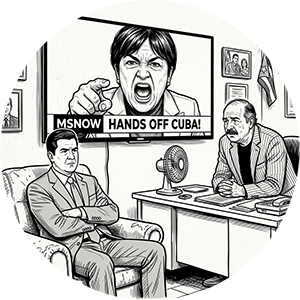
“She is very spirited,” Cabrillo said.
“It is too bad that she is a lesbian,” said Pupo. “She comes to Havana often through the Nuestra America programs, you know. I admire her very much. Perhaps someday I will meet her.”
“Perhaps,” said Cabrillo, making an extra effort to control his irritation.
“I am not so easily intimidated,” Pupo said, turning his attention back to their negotiation. “You may have hand-fed Lopez-Magara in Guardalavaca, that simplon. He runs product out of the little airstrip there; he fools no one. Not me. One phone call to Havana and there goes one of your stooges. You’ll see.”
Just then, a man burst in, soaking wet – the sky was cloudless that afternoon – and coated in mud from his shoulders to his rubber boots. He was holding a handful of moldy rubber sheeting, and he reeked of sweat and… something else.
“Pupo!” he said, waving the rubber sheeting at the commissar. “I told you the repair on the water main break wouldn’t hold without a proper repair clamp. And I was right! Will you do your fucking job and requisition one like I asked you to do two weeks ago?”
Pupo looked at Cabrillo and back at the man, who Cabrillo assumed was el jefe de obras, the public works boss – no one else would talk to the party secretary this way – and stood up at his desk, drawing the hairs back across his scalp to restore his meager combover. Pupo drew in his breath, almost like the ocean undertow pulling back the surf in preparation for a wave.
Then it came.
“¡Coño! ¡No me rompas los cojones ahora mismo! ¡Vete pa’l carajo, singao! ¡Resuelve!”
El jefe de obras drew back his own breath, and for a moment Cabrillo expected a real show. But instead the man simply turned away, muttering under his breath.
“Shut the fucking door on your way out!” said Pupo. And the man did.
“Now,” said Pupo, smoothing his combover again as he sat back down, “Where were we?”
For a moment, Cabrillo considered whether to press the advantage the interruption gave him. In a less dysfunctional place, he knew, he could shame a functionary like Pupo into signing on, because a repair clamp for a water main was a promise he would have no difficulty delivering on.
But Pupo knew this as well. He also knew that item was a crucial need. And yet he still made demands beyond the standard compensation two dozen of his colleagues were happy to accept.
What Cabrillo knew was that it was as likely as not that Pupo had requisitioned the repair clamp. It wouldn’t have mattered if he had. El jefe de obras also knew this, and yet he interrupted the boss’s meeting with an important-looking stranger to dress him down about the water main.
This man was hated by the people of the town, Cabrillo judged, and it was mutual. And of all the places he’d been on this recruitment campaign, Gibara might have been the one most in need of LCTC’s arrangement.
They had entered the phase of the negotiations he had been hoping to avoid, and, miraculously, had managed to, so far.
Namely, the paying of bribes.
It should have infuriated Cabrillo, and it did, but for a moment he considered that, so long as the price was within limits, he might actually be doing some good paying off this silly pendejo.
There was a sizable fund in place for just this purpose, but Cabrillo had installed himself as a recipient of its resources. Why shouldn’t he? Other than a few trinkets and baubles to smooth his way, he’d left that fund untouched – at least, as to its intended use. That Cabrillo was taking a commission, admittedly a very large one, was only fair, he thought.
Peter Chang didn’t strike him as the kind of boss who would lose his composure because of a skim. Or even bother to notice.
But if this soft little man in front of him was greedy enough, his demands might just cut into Cabrillo’s rake. And while he’d decided to be magnanimous in the face of obvious need, the idea of coming out of pocket in Gibara wasn’t acceptable to Manuel Cabrillo at all.
But first, some theater.
Cabrillo stood. “It appears you have bigger issues to handle,” he said. “Perhaps I will come again some other time.”
Pupo’s demeanor changed instantly, and Cabrillo knew the posturing was over. For better or worse, he was about to conclude his 25th acquisition for La Compañía de Todo Cuba.
So long as the cost of the acquisition was borne by LCTC and not Manuel Cabrillo.
“No, no,” said Pupo. “Please, sit down. Would you like some rum? I have an icemaker. It’s in the back.”
Cabrillo took his seat again.
“What is your price, Pupo? I have a long road trip ahead and I tire of this pérdida de tiempo.”
“One hundred thousand. U.S.”
“Fifty. And for that, I get your Exuma run.”
“Eighty.”
“Sixty, and not a dollar more. Give me the keys to your boat.”
Pupo smiled.
“Let me get you that rum,” he said, pushing the wisps of his hair back across his balding scalp yet again.
And Cabrillo waited until the apparatchik left the room before rolling his eyes and giving a satisfied sigh. He wouldn’t reach Havana until very late that night, but he would do so with his skim intact.
If barely.
Coming Saturday, August 22: Episode 4 of Scott McKay’s The Necessary Men.
Catch up and follow along at “The Mike Holman Novels at The American Spectator.” Signed copies are available for pre-order at MikeHolman.com!
Read more Who Is the Mother? Surrogacy Battle Erupts After Woman Refuses Abortion
About the Author