Cool Hand Luke came out a bit before my time, and while I’ve watched it a handful of times, I can’t say I really understood it. Maybe there wasn’t much to understand. Paul Newman’s character was sold as something of an iconoclastic Everyman, a guy who’d decided he’d had enough of society and wasn’t going to take any more. To me, he just came off as a stupid criminal.
Read more Cambridge Professor Commits Suicide After DEI Scandal
The sin which put the movie’s protagonist in prison was that he was cutting the heads off parking meters. That’s kind of a funny thing to go to jail for, even if it’s a small rebellion. There’s little pecuniary benefit to be had in the proceeds from such capers — though yes, dealing with the exorbitant sums cities and their mobbed-up agents charge to park in downtown areas across the country does occasionally spark a desire to brutalize the meters.
I’m reminded of Cool Hand Luke when I see some of the reaction nationally to Flock cameras.
That we’ve moved from forcing people to pay for parking to installing cameras to watch you everywhere you go gives you a bit of an explanation for this explosion of Cool Hand Lukery going on. We’ve all heard, moreover, of the errors we’ve seen made by law enforcement based on the use of license-plate readers, whether Flock cameras or something else.
And it’s completely understandable for folks to object to the idea of a full-surveillance, secretless society. There is something horrific about the idea that you’d live in a Panopticon world with no privacy and no escape from Big Brother’s view. There is no surprise in this pattern of people fighting back against Flock cameras with various sorts of vandalism.
One theme which continues to surface over at The Spectacle Podcast time and again is Melissa railing against the AI surveillance state, and while I don’t disagree with her about the undesirability of the Panopticon, I’m always hitting the brakes by saying that omnipotence is an awfully difficult thing to achieve. (RELATED: The Spectacle Ep. 404: Data Centers (Robots) v. Humans: Who Will Win?)
The disconnect here is that while resistance to the Panopticon is rational and normal, what’s eroding is the society which makes the Panopticon unnecessary.
A Waymo is an amazing technological feat. It’s also exceptionally easy to neutralize a Waymo. All you have to do is open a car door, and that vehicle is disabled. At least until a DoorDash driver summoned by Waymo arrives to shut the door. This is a real thing, by the way.
In that world, it’s questionable whether the full coverage of the Panopticon, which the Flock cameras are only one facet of, can be achieved. Can cities and counties put up Flock cameras at the same rate the vandals can tear them down?
It depends on how many vandals there are.
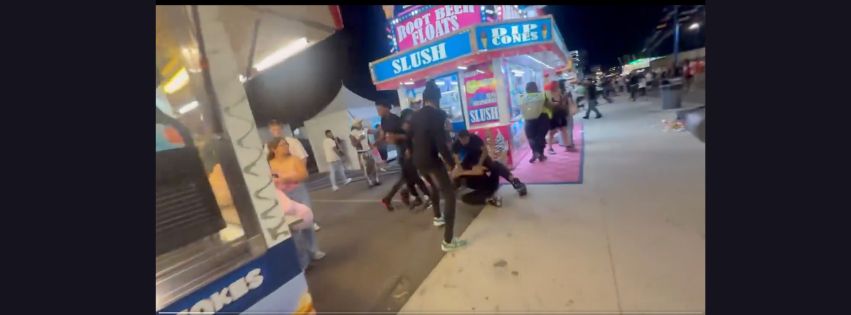
The disconnect here is that while resistance to the Panopticon is rational and normal, what’s eroding is the society which makes the Panopticon unnecessary. For example, the people who run the fairgrounds at which the Wisconsin State Fair is held, just outside of Milwaukee, might want to invest in a whole flock of Flock cameras. Especially after this…
🚨#BREAKING: Absolute CHAOS broke out at the Wisconsin State Fair as “teens” began BEATING ANYONE IN SIGHT.
MULTIPLE police officers were badly beaten, as families with kids were seen RUNNING FOR THEIR LIVES as teens began brawling.
WE DON’T HAVE TO LIVE LIKE THIS!!! pic.twitter.com/gBbE73ph3f
— Matt Van Swol (@mattvanswol) August 17, 2026
They’ve had these problems there on a constant basis going back more than a decade. It does seem worse now. But we’re continuously told that crime is down, and I can believe that’s generally true.
One reason I think it’s true is that normal people are being driven out of public spaces.
I don’t know anybody who goes to things like state fairs, or even public parks, much anymore. The public space is now the lowest common denominator space. That was always true, but the lowest common denominator is lower now than it used to be. Standards are through the floor. And practically every city now has hooligans spending Friday nights shutting down busy intersections while doing donuts and street racing, or terrorizing people with ATVs (where do they even get those things?), or playing the Knockout Game. (RELATED: The Spectator P.M. Ep. 216: Beware of the ‘Teen Takeovers’)
The streets aren’t safe.
Last week, Madelynn and Grace sat in for Melissa on the podcast and we did a segment on this $20 burrito debate which flared up online earlier this month, and our angle, which came from a very good article by Skye Graham at The Federalist noting that the young folks are all getting DoorDash not because they’re lazy or entitled but because it isn’t safe to go out alone in pursuit of dinner if you live in a D.C. or Chicago or New York. Even going to the supermarket, if you live in a big city, can be a harrowing experience. (RELATED: The Spectacle Ep. 453: Burritogate Exposes Gen Z’s Affordability Crisis)
Is crime down? Well, if street traffic is down and the brick-and-mortar retailers have all closed up shop, the bars and restaurants are mostly empty (and the nightlife has gone down the tubes as a result), and things like concerts, festivals, fairs and other public gatherings are withering away because our society doesn’t behave well enough to support those things, then I’m not sure it matters what the crime rate is.
Read more John Hinckley Jr., Assassination Chic, and the Troubling Legacy of the Insanity Defense
When you lose the high-trust society, you’re going to get last weekend at the Wisconsin State Fair. Or you’ll get no Wisconsin State Fair.
Or you get the Panopticon, which is the only way to regulate the kind of crappy behavior put on display in Milwaukee.
And yes, there is the racial element that I’m sure somebody will note in the comments. Rather than go there, I would suggest that the feral youths on display in that state fair video — and lots and lots of others I could put in front of you — are products of public schools.
And what’s the number one reason the public schools are such disasters? Nobody disciplines those kids.
I’d love to see — in Milwaukee, let’s say — the percentage of kids in the public schools from the bad parts of town, as we’ll assume the hooligans who went berserk at the state fair mostly come from the bad parts of town, who had a father in the home. And further, I’d like to see how many male faculty worked in those schools. (RELATED: How Schools Made Gen Z Weaker)
Undisciplined societies are low-trust societies. Low-trust societies are either chaotic or they aren’t free.
My theory, and I’m pretty sure it’s true, based on research I’ve seen elsewhere, is that the dearth of male disciplinary figures in those kids at that fair would be mind-blowing. That creates a culture which can affect even kids who do have a dad in the house.
Undisciplined societies are low-trust societies. Low-trust societies are either chaotic or they aren’t free.
You can hate the Flock cameras. I don’t blame you if you do. But they’re a symptom. The real disease is the low behavioral standard which creates a need, be it perceived or otherwise, for electronic surveillance to provide some hope of accountability and justice.
In a perfect world, every one of those rioters in Milwaukee would be dragged off not just to prison, which wouldn’t alter any behavior at all, but to some sort of corrective institution where the programming that says it’s fine to show up in a public space and turn it into a jungle full of predators can be overwritten.
Either that or they’re banished. The British and the French built prison colonies to dispose of their undesirables, and maybe that wasn’t such a terrible idea after all.
We shouldn’t have to be debating the Panopticon, and we definitely shouldn’t be watching videos of morons beating each other’s brains out or shooting each other in what should be fun, happy public spaces. But we’re doing both because we’re getting both.
And we don’t have nice things as a community because we don’t deserve them. Because of a small section of society, regardless of race, which insists on ruining things for everybody and isn’t afraid of the wrath of the rest of society.
Figuring out how to change that is one of the best questions we ought to be asking ourselves.
Experience high-stakes political intrigue in Scott McKay’s latest Mike Holman novel, The Necessary Men, now serializing exclusively at The American Spectator. A new installment drops twice a week — catch up and follow along at “The Mike Holman Novels at The American Spectator.” Signed copies are available for pre-order at MikeHolman.com!
About the Author