Welcome back to the world of Mike Holman.
If this is your first stop, here’s what you need to know: Mike Holman is the independent journalist, podcaster, and inveterate maker-of-enemies at the center of Scott McKay’s bitingly satirical thriller series — four novels (so far) chronicling one man’s habit of ending up in the middle of the very stories the rest of the media is too scared, too compromised, or too incurious to tell. Catch up on the whole series, read past episodes, and find links to every book at “The Mike Holman Novels at The American Spectator” and soon, see the video-novel version of this and the previous books at MikeHolman.com.
Read more Hollywood Won’t Show Radical Islam. Run Hide Fight: Infidels Will
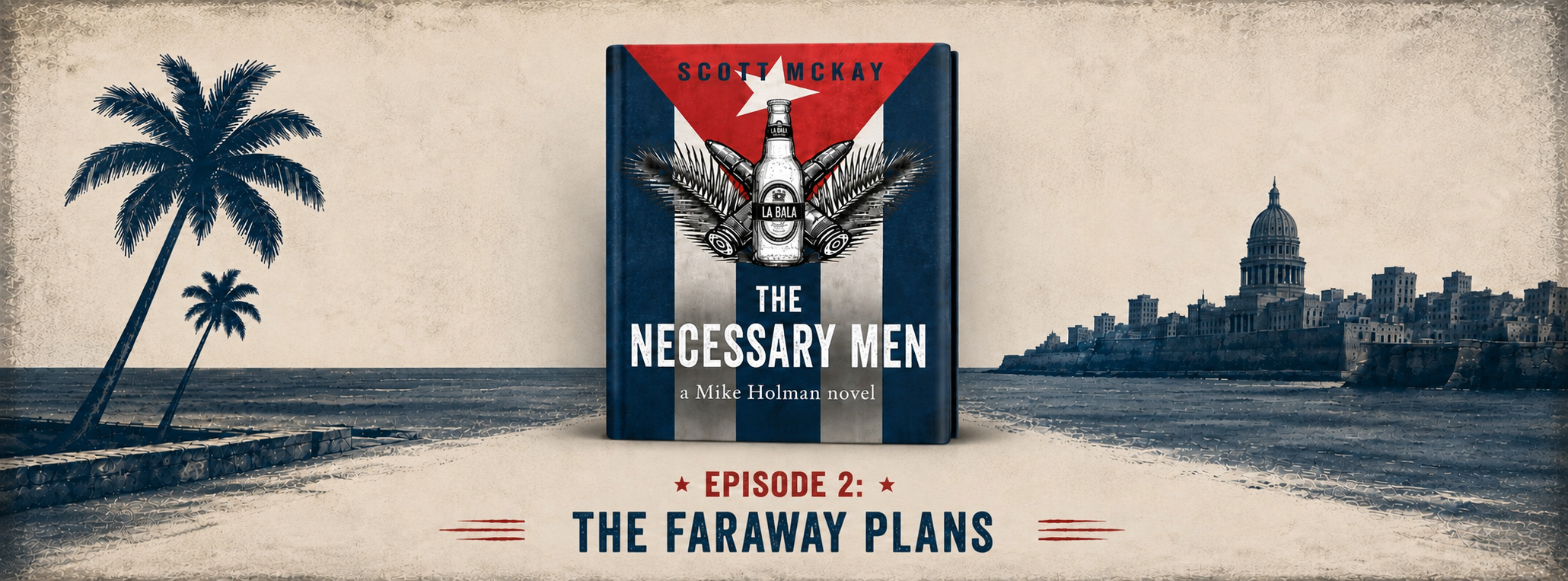
We’re now serializing the fourth Mike Holman novel, The Necessary Men, right here at The American Spectator — new episodes dropping every Thursday and Saturday. The full book goes on sale September 26th at Amazon and the new MikeHolman.com site, and you can pre-order a signed copy right now.
Where we left off: Mike’s post-Blockbusters ennui is broken by a massive new challenge from his best friend, mega-billionaire industrialist Pierce Polk, who enlists him in a plan for a friendly invasion of Cuba, destroying a communist dictatorship without firing a shot. He’s flying across the world to hear the specifics of this uber-ambitious plan.
Here are Chapters Three and Four of The Necessary Men.
Chapter Three
Lazarus Island, Singapore — March 5, 2026
It is not an easy thing to see Simon Lim in person. The four of us – Stan, Trent, Melissa and I – were joking that we were on an odyssey, like from Greek times.
Our flight on Pierce’s Gulfstream left Palm Beach International Airport at just after 9:00 a.m. At a little after 10 p.m. Eastern Time, we touched down in Dubai for refueling. An hour later, the four of us had stretched our legs a bit, eaten a quick meal in the FBO lounge at the airport, and we were waiting for clearance to take off.
And when we were in the air at around 9:30 a.m. local time, which was about 11:30 p.m. by our clocks, Melissa got the bed in the stateroom, Stan called dibs on the divan that converted to a little bed, and Trent and I rode it out on the red-eye plane for the seven-hour haul to Singapore.
That was an interesting conversation.
“Seriously, Mike,” Trent asked me. “What do you think about this idea? A week ago we were basically resting on our laurels, with what we built with Blockbusters and Movie King. Our conversations were about giving grants to churches for community outreach and trash pickup, and now we’re talking about taking down a government. It’s…”
“Well, let me ask it to you,” I said. “You tell me. Is this nuts?”
“Dude, nuts is OK by me. We took out Hollywood a year ago. Kicking communists out of power seems like child’s play. I’m all in. But I notice that Stan is nervous.”
I tilted my head in the direction of the divan where Stan was lightly snoring.
“I dunno. He doesn’t seem nervous right this second.”
“You aren’t answering my question,” said Trent. “I’m on board with this thing, but I’m gonna feel a lot better if I know that you’re fully committed.”
“I’m on a 20-hour flight to Singapore,” I said. “If I’m not committed, I’m a freakin’ moron.”
“Very funny.”
“Fine, I’ll be honest with you,” I said. “I have a couple of big concerns I’m working through. First, you and Stan are finance guys. I’m a talking head. None of us are intel, none of us are logistics. We aren’t operators. How are we qualified to take this on?”
“We weren’t qualified to run Big Five media companies, either,” said Trent, “or at least Stan and I weren’t. But we just figured it out.”
“That’s how I resolve this, too,” I said. “Plus, I know Pierce, and Pierce isn’t going to put us in a situation where we’re doomed to fail.”
“Right.”
“But the other thing is, not whether we’re qualified to run an op like this but who in the hell do we think we are conducting U.S. foreign policy? We ain’t the government.”
“It’s the governments who fucked it all up in the first place, though,” said Trent.
“That’s not much of a defense when you get indicted under the Logan Act.”
“Except nobody ever has been indicted under the Logan Act,” said Trent.
I shrugged.
“So tell Pierce no, then. We’ll do the homeschooling, or we’ll put up monuments to Thomas Edison and Blackjack Pershing and William McKinley and Booker T. Washington all over the country. We don’t have to do this.”
“Yes we do,” I sighed.
“Why?”
“I’ll tell you. My people came from Cincinnati, because my grandfather worked 30 years for Procter & Gamble. But before he caught on with them, he worked for United Fruit in the 50s, out of Miami. The job took him around Latin America, but the place he’d go again and again was Havana.”
“Yeah? I bet he said it was cool.”
“He never stopped talking about that city. How lavish and high-energy it was. The architecture, the Malecón, the beaches, the nightlife. He talked about it like it was Las Vegas, before Las Vegas.”
“Because it was,” said Trent.
“And I know Batista was a shithead and a dictator, and outside of Havana the place was terrible. I get all of that. It’s not like Cuba didn’t have problems; if they didn’t, the Castros wouldn’t have gotten it.”
“But it’s immeasurably worse now.”
“What if Cuba could actually be a well-run, free country?” I said. “You’re a finance guy, you tell me.”
“Well, the agriculture alone should make them middle-class. Bring modern tech to that farmland and you’re gonna generate some wealth. There’s nickel and cobalt, though they’ve done a shit job of exploiting it. Havana’s port ought to be a Hong Kong or Singapore as a gateway between North and South America, and that should be a big driver. There’s a lot to work with. It just depends on the people. The infrastructure is shit, but you can build infrastructure. And nobody’s better at that than Pierce’s people.”
I nodded.
“I mean, the opportunity is huge. The question is, is it so corrupt there that the first investors get robbed blind and that just dries up the next round of money.”
“Well, I guess that’s Pierce’s problem,” I said.
“OPM, baby,” said Trent, downing the last of his coffee.
Other People’s Money, he meant.
By the time we landed at Changi Airport in Singapore, it was around 8:00 p.m. local time on Wednesday. Back home it was… seven in the morning? I was dead on my feet.
But we got off the plane in a hangar, watched the attendants fish our bags out of the cargo hold and put them in the back of a limo bus, and twenty minutes later we were in an executive helicopter flying over the Singapore Strait.
Twenty minutes after that, we landed on what looked like a deserted island until we were over the top of Simon Lim’s compound.
The chopper put us down on a well-manicured lawn in front of what looked like an old British fortress. Pierce was there waiting for us. A team of guys in white seersucker uniforms rushed out to grab our bags and put them onto golf carts.
“How’s it going, buddy?” he said, shaking my hand.
“I need eight hours of absolutely uninterrupted sleep,” I said. “In fact, I absolutely insist on it.”
Pierce laughed.
“You’re on. Everything is all set for tomorrow at eight anyway, and Simon had to go into town tonight on some business. So you and the gang are good to go. I’ll see y’all in the morning.”
Just then, a little guy showed up and, in passable English, told me he would be delighted to take Stan and me to our cottage. So we hopped in the golf cart, and he gave us a ride down the little hill from the fortress to a very fetching set of bungalows lined up along the water. He stopped the cart and carried our bags in, and then without so much as a word, I stumbled into one of the bedrooms – Stan, who’d had a full night of sleep on that divan, was checking out the fridge and the bar – and I barely got my clothes off before I crashed on the bed.
The next morning, though, I was all right. I expected to be jet-lagged even with having had my eight hours – nine hours, actually – but nope. And Stan and I shared a great pot of coffee looking out over the Singapore Strait from the deck of that cottage.
Then Trent and Melissa showed up, bright-eyed and bushy-tailed.
Then the two golf carts showed up to bring us to the great house.

Simon Lim’s British fortress-inspired mansion on Lazarus Island, Singapore
Pierce made the introductions, and we sat around a large oval table in a third-story room with a pair of giant plate-glass windows covering two of its walls, which together offered a panoramic view of Singapore from across the strait. Stan, Trent, Melissa, and I were joined by Pierce, Hal Gibson, who had shown up after I’d gone to sleep, Rebecca Hilton, who was Pierce’s new-ish personal assistant, Simon, and a Mr. Wang, who was introduced as Simon’s head of security.
Wang said one word the entire time we were there. He merely nodded politely. Wang wasn’t all that physically imposing, but I nevertheless got the impression that if those nods ever ceased, there would be dead bodies everywhere.
I gave Simon a firm handshake, which he returned. That was a little surprising. The file on him that I’d read on the plane said he was 74, and he looked it, though not in a sickly or decrepit way. He clearly took care of himself. But he was no taller than 5’7” or 5’8”, if he was more than 150 pounds, I’d be surprised, and he carried himself in a way which suggested his was far more a life of the mind than of physical activity. I could see a deep intelligence behind his eyes and a gravitas which didn’t register in a way I could immediately mark.
The image that filled my head was that this guy was the personification of an old dragon. He was polite, but at the slightest provocation he would cover you in flames from his breath. Together with the Bond-villain compound providing our lodgings and the fact that from the time we’d gotten off the plane in Singapore we’d been under the control of this man, I found him unnerving.
And I sensed that he clocked my discomfort. He held that handshake a bit longer than normal and gave me a grandfatherly smile, which made it even worse.
The tea was served and the meeting began.
“Listen, I appreciate that most of you have come a very long way to be here,” said Pierce, as he got things started, “and I’m not just talking about geographical distance. Let me start off by saying that what we’re proposing to do might seem radical and destructive but it’s actually the opposite.
“What we want to achieve in Cuba is a transformation of its politics, culture and economics by 100 percent peaceful means. We want to set the Cuban people free without unleashing chaos, we want to topple Cuba’s government without killing or maiming anybody, and we want to rebuild their economy and infrastructure without creating an oligarchy. Cuba needs a middle class, and the aim here is to stand one up and have it drive the country’s future going forward.”
“Speaking for the skeptics in the room,” said Stan, quickly interrupting Pierce, “what you’re talking about doing is amazingly laudable. But you recognize this can and will go wrong in about 11 million ways, right?”
I gathered that by mentioning the number of 11 million, Stan was talking about the estimated population of Cuba.
“More like nine and a half million,” said Pierce. “They don’t have 11 million people living there anymore.”
“All right,” said Stan. “Fair enough.”
“So the plan we’ve built is flexible enough to handle most of the likely items of adversity,” said Pierce. “Should we perhaps start by asking whether everybody here is on board philosophically with the idea that Cuba should flip over and become a free country and that it’s worth doing to create that result?”
There were nods around the table, including from Simon and Mr. Wang. Although Mr. Wang was always nodding, so I didn’t take that as dispositive.
“I take that to mean you’re a skeptic as to method, rather than mission,” Pierce was saying to Stan.
“I’m just saying we shouldn’t go into this thinking it’s something that’s going to happen without a mess,” Stan said. “The plan document we read on the plane is a little… storybook-y, if that’s a word.”
“Do we have the people to pull this off?” asked Trent, probably as more of a defense of Stan than as a reflection of his own concerns. After all, I was the one who’d raised that one on the plane.
“We do,” said Simon, in a voice which was polite but seemed final.
“So the theory here,” said Pierce, “and I’m thinking y’all have not bought into it, is that if we simply drop into Cuba and say ‘hey, folks, we’re here to turn the power back on, build houses and factories and shopping malls, hire everybody to do real work for real pay and rebuild the civil society,’ what it’ll do is just make the government irrelevant. We won’t need a revolution in the classic sense, and we won’t need guns. And because we’re doing these things, which the Castro and now Candela regimes have been complaining that nobody is helping them do, which is their never-ending bitching about the U.S. trade embargo, they won’t act to stop it until it’s simply too late.”
“Can we process that for a while?” I asked Pierce. “Because I think this is the fundamental piece that some of us aren’t fully convinced of.”
“Sure. We’ve got all day. Let’s game it out.”
“What makes you think that the Cubans are just going to lie on their backs and let a bunch of Americans – I’m assuming this is a bunch of Americans – come in and take over their country?” said Stan. “That flies in the face of like 70 years of their rhetoric, doesn’t it?”
“The temptation,” I said, echoing Stan, “is to believe that we get shot as soon as we get off the boat. The document we read on the plane is a little thin on how we’re addressing this.”
Pierce smiled.
“Simon?” he said.
“It won’t be an American takeover of Cuba. It’ll be a Chinese takeover of Cuba. With lots of Canadian subcontractors. And some Americans.”
“Baizuo,” said Mr. Wang. That was his one word.
I knew that word. It was a Chinese word for Useful Idiots, as in stupid white leftists who gave away the store. That kind of thing.
Wang was talking about something that was in the plan document, which was that the enterprise we were forming would stand up a non-profit that would recruit leftist kids on college campuses to form work brigades to protect the revolution. I initially thought it was a joke – to recruit commie kids from the universities to dig ditches in Cuba and build, ultimately, capitalist infrastructure, was a classic Pierce Polk prank, or at least the kind of thing he’d theorize about and we’d have a good laugh.
But the Cubans had been bringing Useful Idiot, American leftists in for decades, through the Venceremos Brigades and the Nuestra America pilgrimage trips, along with a number of other organized asset-recruitment efforts.
And apparently we were going to do a fresh version of this. For our own purposes, potentially as a cover for the main objective.
That was a distraction, though, and I quickly stopped Simon.
“Hang on,” I said. “A Chinese takeover? Pierce, why would we want that?”
“It isn’t really a Chinese takeover,” said Simon. “It’s a Chinese front for your Polk Global Freedom Initiative to operate within Cuban space.”
“Well, that wasn’t in the plan document,” said Trent.
“Operational security,” said Hal. “The real structure of this thing is going to be off the books until we control the ground.”
“So,” I said, looking at Simon, “this is going to be your operation, and then it’s going to be mine?”
“I am the face of this to Beijing.”
“And why?”
“Because I am a face Beijing trusts.”
“But apparently they shouldn’t, based on what we’re discussing.”
“Trust, Mr. Holman, is earned. Which I have done with them.”
I nodded, after a beat. Then I did my best to sum up the premise of the operation.
“So this gets presented to Beijing and Havana as a Chinese state-capitalist enterprise, the Cubans believe it’s their salvation protecting them from the Cuban exiles in Miami and the U.S. Marines sweeping out from Guantanamo Bay to invade the country, and the ChiComs believe this is a way to get Cuba without triggering an American response? Is that it?”
“Fundamentally, yes.”
“And because Burro gave you that cryptic statement about how it would be great if somebody other than the U.S. government would take down Candela, we’re going to have carte blanche to essentially run covert American foreign policy in Cuba.”
That just earned me a smile from Pierce.
“It’s… fundamentally more optimistic than I thought it was before,” said Stan.
“The best part of this is we’ll stage it as something the Left in the States will be all for,” said Pierce. “That’s the point of the Omobba Brigades.”
“You are NOT calling them that,” said Melissa.
“If that dude puts his name on this program, it would be the funniest thing ever to happen in world politics,” I said.
“He doesn’t have to. It won’t be a formal name. But yeah – we’re going to get the DSA kids and the Dolores Gramsci-Ramoses and all the rest of the loons to throw in behind this deal while it’s officially a Chinese operation with Canadian sub-contractors.”
“I have a construction firm based in Vancouver,” Simon offered. “There is the corporate infrastructure we will use.”
“So we form an American non-profit and staff it up to go on college campuses and hire these kids to come down, sleep on cots in warehouses and gyms and so on, and do the grunt work while we hire Cubans to put an economy together,” said Trent, “and the whole thing is your operation, Simon?”
“I’m the silent partner,” Simon said. “I have someone who is uncommonly well-suited to be the American face of the venture.”
“This is Peter Chang,” I said. “You’ve already locked him in, haven’t you?”
Simon nodded.
“And he knows nothing about the true nature of this?”
“He does not,” said Pierce.
“Holy shit,” Stan laughed. “That’s perfect.”
“OK,” I said, “so Candela’s people are going to accept this because they think it’s China fully coming in and taking over the patronage that the Soviets used to. The Trumbull administration is going to let it happen because they’re going to understand that this is the long game they’ve asked for. Beijing is going to accept it because they think you and Peter are a cutout, which insulates them from blowback and the U.S. Marines showing up, plus it’s your money being put at risk rather than theirs. Is that all correct?”
“That’s the structure,” Pierce said. “The fact that we’re going to present this in the hinterlands first, to local honchos not well served by Havana in the first place and likely to think more independently, is going to give us an easier way in.”
“And getting the Left to buy in makes for a massive smokescreen that pushes away any suspicious media coverage,” said Stan. “This becomes the new activist meme they all pay homage to and anybody who criticizes it gets canceled.”
Nobody said anything. All the Americans were smiling, though.
“What we haven’t really run through,” I said, “is the most important part. Namely, how does this play among the Cuban people? It seems like there might be a specific danger here, which is that these are going to be pretty cynical folks by now, and when they hear the Chinese are coming it might not be well-received. As in, here’s one more set of foreign colonizers.”
“Like I said, we’re going to start this in out-of-the-way places first,” said Pierce. “Initially this is going to go in front of people who are desperate to be colonized.”
That was when Simon took over the conversation. And that was when I understood why Pierce had hooked him into the operation.
And Simon had a way of talking about suffering that made it sound like a weather report.
“The average Cuban worker,” he said, setting his tea down carefully – I got the impression that everything he did was done carefully – “earns the equivalent of sixteen American dollars per month. This is after the regime’s most recent salary increase, which they announced with considerable fanfare.” He paused. “Sixteen dollars.”
He let that sit there for a moment. Nobody said anything.
“La Compañía Todo de Cuba will pay its workers — entry-level, unskilled labor — the equivalent of four hundred dollars per month, in Canadian currency. Because our contractors are Canadian, naturally.”
“Naturally,” I said.
“At that wage,” Simon continued, “LCTC will be paying its workers twenty-five times the prevailing rate. In a currency that is actually worth something. In a country where the national currency has lost ninety-five percent of its value in six years.”
He looked at me with an expression that was almost, but not quite, a smile. “Mr. Holman, do you know what happens when you offer a man twenty-five times his current wage in a currency he can actually spend?”
“He shows up on time,” I said.
“He shows up early,” said Simon. “And he brings his brother.”
Pierce, who had been watching this exchange from his end of the table the way a tennis fan watches a rally he already knows the outcome of, smiled into his tea.
“The peso situation also means,” Simon went on, “that Mr. Polk’s capital investment goes considerably further in Cuba than it would anywhere else on earth. Infrastructure that would cost three hundred million dollars to build in, say, Brazil, can be built in Cuba for a fraction of that, because Cuban labor costs, even at twenty-five times the prevailing rate, remain extraordinarily low by any regional standard.”
He picked up his tea again.
“Communist regimes are very efficient at one thing, Mr. Holman. They are very efficient at making labor cheap.”
I looked at Pierce.
“He’s been saying things like that since Tuesday,” Pierce said.
“It’s a gift,” I said.
Simon didn’t react to that. Which in itself told me something.
“The Canadian dollar denomination serves two purposes,” he said. “It is consistent with the contractor cover – Canadian firms pay in Canadian dollars, this is unremarkable – and it avoids the technical complications of American currency under the embargo, which would create paper problems we don’t need.”
“OK, this is better than I thought,” said Stan. Trent nodded in agreement.
Simon set his tea down again.
“The MLC we use for retail and smaller transactions. The locals know MLC. They have a relationship with it. Canadian dollars they will take to the informal exchange market and convert, which is fine. The point is that they are holding something worth holding.”
MLC was Cuba’s quasi-foreign-facing currency that replaced the worthless peso in exchanges between Cubans and the government stores. It was one more way that the Candela regime was screwing over the Cuban people.
“And the regime?” I said. “What happens when Candela’s people figure out that the Canadian contractors are paying forty times the government wage?”
“Fifty-two times, at current rates,” said Simon.
“Fine. Fifty-two.”
“The regime’s local officials will be among the first to notice,” said Simon. “Which is why they will also be among the first to be – compensated – for their discretion.”
He said the word “compensated” the way a surgeon says “incision” — precise, clinical, no particular feeling about it either way.
“This has already been arranged in a few localities.”
“So we’re not talking about something which has been proposed. We’re talking about a current project we’re going to take ownership of at some point in the future.”
“Not really,” said Pierce.
“Should you reject this plan altogether,” said Simon, “the work that has already been done will simply melt away as one more project in Cuba which is proposed but doesn’t actually come true. Bribes have been paid, confederates have been identified, but in the end, nothing happens.”
“Which is Cuba for the last 60 years for the most part,” said Pierce.
“OK, and once this thing reaches critical mass,” said Stan, “then what? We flip a light switch and tell everybody, ‘Haha, this was us all along?’”
“I imagine it’ll have to be more elegant than that,” said Pierce.
“We’ll need a Cuban face for it,” I said. “I have an idea I can explore on that front.”
“I really only have one question at this point,” said Trent. “Mr. Lim, what are you doing here with this? It’s, if you’ll permit me, a bit off-brand for you to be participating in a scheme which essentially defrauds China out of having Cuba within its sphere of influence.”
“I have my reasons,” said Simon.
I gave him a look which said that I wasn’t buying that, but it was obvious Simon didn’t have a further explanation on offer.
From there the conversation devolved into finances, details, geography, division of labor among the various entities involved. And finally, we were hustled into the dining room for a feast of… chili crab.
It’s the signature dish they eat in Singapore — mud crab in a rich, slightly spicy tomato and egg-based sauce. You eat it with mantou, which are fried buns, for soaking up the sauce. It was messy, communal and completely delicious. Chili crab is the kind of dish that requires you to use your hands and get involved with it. And Simon, who came off as so careful he was almost robotic, dropped his guard and dug in right along with the rest of us.
There was more planning and scheming in the afternoon. And in the evening the helicopter took us into the city.
Singapore’s nightlife is, if anything, underrated. Particularly when you have a key to unlock the city the way Simon does.
Still, I wasn’t convinced it was wise to depend on him for his part in this.
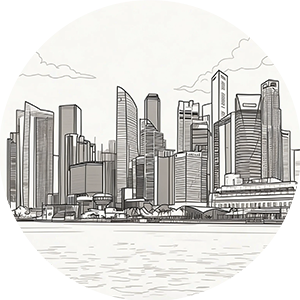
A minimalist line art sketch capturing the iconic modern skyline of Singapore’s Marina Bay.
Read more Camping as a Voluntary Renunciation of Civilization
The next morning, there was a knock on the door of the cottage. I was up; Stan was still in bed nursing a hangover he earned putting away too many Singapore Slings at the long bar in the Raffles Hotel.
And when I answered the knock, it was Simon.
“I am of the impression that you and I should spend some time alone,” he said. “I have something I’d like to show you.”
“All right,” I said, and I let Simon lead me to the golf cart he’d parked in front of the cottage.
He drove us to the north tip of the island, to a structure which had been mostly obscured from that panoramic view afforded by the conference-room windows by the tall trees between the great house and the shore.
It was a pagoda, built in a Chinese style, open to the air. I fully expected to see a bronze or stone buddha placed in the middle.
Instead, it was a cross. About four feet high, installed on a marble pedestal.
“This is beautiful,” I said, as Simon and I approached it. “That metalwork is really ornate. How old is this thing?”
“About 500 years,” he said. “This sat atop the first Portuguese Catholic mission in Malaysia in the 16th century. It was destroyed by Japanese invaders during the Second World War; I bought the pieces and had it restored.”
“But why a Catholic cross?” I asked him.
“I come here every morning,” said Simon, “and I pray the rosary.”
“You’re Catholic?”
He nodded. I stood there dumbfounded.
“I converted to Catholicism four decades ago, when I was still deeply embedded within the Communist Party,” he said. “My faith saved me from the utter emptiness the regime inflicts on the Chinese people.”
“And here I thought you were part of the regime.”
“I do the things the regime needs done.”
“The shadow fleet,” I said. “You’re the guy facilitating the Iranians and the other bad guys selling oil to China. If you’re a dissident, why would you do that?”
“Because there is no prospect of there being a revolution in China in my lifetime,” he said. “Because China has very little oil of its own. And because the Chinese people would suffer, while the regime would not, if there was no fuel.”
“Hmmmph,” I said, not really buying that.
“And because in performing that task for the regime I have made myself indispensable. You are talking to the man who can cut off China’s oil supply with a stroke of a pen. Why do I do this? That’s why.”
“So you’ve been a silent dissident for 40 years? Inside the tent, so to speak?”
“Longer.”
“That has to be maddening. I don’t know how you could stand it.”
“I made one mistake. I spoke out against the waste of the ghost cities the regime was building in the hinterlands. For that I was sent to… re-education.”
“This is the six-month psychiatric treatment thing they do? It’s like a time-out for people who say things the Powers That Be don’t like?”
“It’s a bit more than that, but yes.”
“Well, you were certainly right about the ghost cities and the real estate market in China as a whole, I imagine.”
“I learned the value of silence of words. And loudness of action. I’ve profited from the regime’s losses.”
“And you live in Singapore now rather than China.”
“I am out of the sight of my enemies within the regime, but available to my friends. And when I ask, I am granted my requests. In return, when I am asked, I deliver.”
“That probably comes to a screeching halt when the true nature of our plan becomes known,” I said.
“If the plan succeeds, that will be a small price to pay.”
I looked past the cross toward the gleaming Singapore skyline in the distance and stopped to appreciate the understated, serene beauty of what Simon had built on this island, and it struck me that my initial impression, that this was a Bond-villain lair, was shallow. Insulting.
This man was a titan. I assumed because he was Chinese that his views on power and morality would be reflective of the Chinese Communist Party’s views. But the house and the grounds were nothing like a CCP apparatchik would choose. And the cross, well..
“Last night, I told Pierce that I’m going to write a book about what we’re going to do,” I said. “If I do that and it’s truthful, that book won’t be good for you.”
“No,” he said. “It will not.”
I paused. Simon was looking at me dispassionately.
“What did Pierce say when you told him you were writing a book?” he asked me.
“His exact words were, ‘Fuck yeah, you are.’”
Simon smiled and looked at the water.
“You say it’ll be bad for you, and yet I don’t hear you objecting to my writing the book,” I said
“You should write the book,” he said.
“You aren’t worried about the consequences?”
He just put his hand gently on my arm, and then he reached in his shirt pocket and produced his rosary beads.
Then Simon knelt in front of the cross and began to pray.
I’m a Catholic. All the Holmans have been Catholics as far back as any of us can remember. But I stink at it.
Simon, who had no background as a Catholic and nothing to gain – with an awful lot to lose – did not stink at Catholicism.
And my objections and misgivings about the man we were depending on for this project just melted away on that beautiful morning amid that magnificent view.

This beautifully crafted ornate cross stood over the first Portuguese Catholic mission in Malaysia; now the property of Simon Lim.
Chapter Four
Jupiter, Florida – March 8, 2026
I was home, and I had struggled through jet lag so terrible that I wondered when I’d come back to life, and I’d put Pierce off for a day and a half despite his text messages becoming more and more urgent.
And finally, I began to regain something like full consciousness.
So PJ made us that amazing Trumbull family meatloaf that she’d wrangled the recipe for out of Melanie Trumbull, the president’s wife, and I ate like a pig.
PJ noticed that, because it wasn’t my usual manner. But the jet lag had made me absolutely ravenous. Normal Mike went out the window, and he still wasn’t fully back.
The other thing she noticed was that I was in the 10-day itching phase with the beard I was growing. I couldn’t stop scratching my face, even at the table.
“What’s up with that thing?” she asked. “I mean, it looks terrible. Makes you look homeless. And old. You’ve got this big, handsome, famous face and you want to look like some guy who lives on a desert island or something? Why?”
“Oh, I don’t know,” I said, trying not to scratch at it again. “I think it suits me. I mean, it’ll look a lot different when it completely comes in. And I’ve had a beard before.”
“Yeah, right,” she said. “When was that?”
“Right out of college. Before I got the job at ANN.”
That had been my first big break in media. I got hired by that cable news network as a reporter – before that I’d worked for newspapers and magazines – and then I anchored my own show for them for a few years until I got fired for getting into an ugly confrontation with the dickhead son of the network’s owner. But you probably know that story.
PJ was giving me a suspicious look. She could tell that I was bullshitting her.
Then the phone rang and it was Pierce and there was just no way I could say no to the call. I was grateful for that, and I think PJ could tell that, too.
“Go ahead,” she smiled. “But do it on the deck, OK? I’m gonna go walk the dogs after I clean up here.”
“Yeah, Pierce,” I said, answering the phone and kissing PJ – who gave me an “Oooh. Scratchy!” objection – as I got up to take the call out by the pool.
I looked back at her and she gave me a smile.
I don’t know. That was a smile I think I’m going to remember. It was sort of a late-summer smile, even though it was early spring.
And it was almost three hours later, and I could see from the deck that PJ had cleaned the table, done the dishes, changed Little Mike’s diapers, walked the dogs, gone to the bedroom, drawn the curtains, turned out the bedroom light and left only the light on the nightstand to light the room. The dogs whined to come outside, and I let them hang out on the deck with me, and then they demanded I let them go inside so they could go to sleep.
And Pierce was still talking about the plan.
“And forget about this Logan Act shit, will you?” he was saying. “Nobody’s ever been prosecuted under the Logan Act. You aren’t gonna be the first.”
“OK, look,” I said. “Come up for air for a minute, because I have two things.”
“Oh, yeah,” he said. “If it’s about the book, you don’t even need to tell me. Whatever you need, I’m in. The book is gonna be so freakin’ amazing.”
“I’m not talking about the book. When I need your help with the book, I’ll ask you.”
“Jeez. OK. What, then?”
“First, stop with all this about the Cubans. These people you’re talking about, these politicians and wannabe Batistas comin’ home to Havana, I don’t care about them. I already have an appointment with the guy we need, and Stan and I are going to see him tomorrow.”
“You said you had a guy,” said Pierce, “but you didn’t say who it is.”
“Well, I don’t have him yet; we’ll find that out tomorrow. But it’s Diego Maceo.”
“Maceo? He’s political?”
“Not publicly, which is one reason he works for this.”
“I mean… sure, he’s probably the most famous Cuban there is, but he’s…”
“Perfect. The word you’re looking for is perfect. To front this The Everything Company of yours…”
“La Compañía Todo de Cuba, you mean,” said Pierce, even though my limited Spanish told me it probably should have been La Compañía de Todo Cuba instead. “LCTC.”
“Right. LCTC. When we flip that over and it’s not a Chinese thing anymore, we need the most powerful, dominant brand there is. And Diego is basically the Shaquille O’Neal of baseball. He’s a media star, he’s got a business empire with tens of thousands of employees, he’s got charisma, he’s basically a god among the Cubans.”
“I’m not gonna lie,” said Pierce. “Him going back to Fenway where he’d made his career, pitching for the Marlins when he was all but washed up in his last year, and then throwing a perfect game against his old team with the Boston crowd cheering him on, La Bala, La Bala, I mean that was just an incredible moment. One of the best.”
“That’s the kind of social power you need. It will sweep away all these problems you’re trying to solve on the phone with me.”
“So what? You’re just going to ask him to be a pitch man for this?”
“I dunno, Pierce. I’m going to tell him what we’re doing, I’m going to ask him what he thinks we need to properly brand it so the Cuban government doesn’t roll in the armored vehicles to arrest us and steal all our stuff, and then I’m going to see what his reaction is. And we’ll go as far with him as he wants to go.”
“What if he says no?”
“Won’t happen.”
“Mike, he could very easily say no. When he defected, Castro put his dad in prison for 12 years.”
“And that was almost 25 years ago, Pierce. The guy lives in Coral Gables, his businesses are all based in Hialeah, he leans into his Cuban heritage, his wife is as Cuban as you can be without having been born there…”
“Yeah, what’s her name?”
“Esmerelda Fernandez. Or I guess she’s Esmerelda Fernandez Maceo. When I met her, she told me to call her Essie.”
“She’d help this too. She’s an… actress?”
“She was. She’s got like a lifestyle brand now. Cosmetics and whatnot.”
“Well, that’s a hell of a life he’s built. You think he’s gonna throw it all away to go back to Cuba and play politician for us?”
“I don’t know what he’s gonna agree to, Pierce. All I know is he’s not going to turn us down totally. It’s just a question of how big the yes is, and the bigger it is, the more problems it solves.”
“OK,” I could hear him sigh. “Fine. Go see La Bala tomorrow and then we’ll plan around what he wants to do. It is a good idea; I’m not gonna fight you on that.”
“All right, good.”
“What’s the second thing, Mike?”
“The second thing? Oh, yeah. The second thing is this business with Peter Chang. I have a very bad feeling all around where that’s concerned.”
“Oh, come on. The Peter Chang thing is awesome. It’s a masterstroke. You know that.”
“As a cosmic-level ‘Fuck You, I Win,’ catfishing Peter Chang into thinking he’s shilling for China on MS NOW and the Jennifer Welch podcast when he’s actually working to install a market economy backed by Pierce Polk is one of the all-time greatest long cons in the history of the world,” I said. “After all the shit he’s pulled, he deserves every stitch he’ll get. But that isn’t the whole story, and you know it.”
“What are you worried about?”
“You’re building that comms app with his son, Pierce.”
“So?”
“And I’m married to his daughter.”
“Who he has fucked over more than once, by the way.”
“Nevertheless, Pierce, she is not going to be pleased that you’re using her dad like this.”
“Have you talked to her? She said something?”
“I haven’t told her anything. I don’t think I can hold out on her much longer, though.”
“I mean, you might want to try. If you think PJ is going to lose her shit and call her dad to warn him, we’re pretty much dead in the water before we get started.”
“I’m not gonna lie to my wife. This affects her; she’s gotta know about it. And besides, she’s onto this. The beard I’m growing, the Singapore trip, the sudden nonstop phone calls… she isn’t stupid.”
“Well, do you want me to call her?”
“That,” I said, “is the worst possible idea.”
“Fine. You need to take care of it.”
“I intend to. I’m just saying, this was problematic and it should have been addressed.”
“And I would have won the argument anyway, because there is literally nobody on earth who’s a better and more deserving shill and mark for this than Peter Chang. Don’t even try to argue that point with me.”
“I’m not arguing that point with you.”
“Then Mike, and you’re gonna get all fussy with me and act like a little bitch when I say this, but it’s your job to control your household, get your wife on board with the plan so she doesn’t blow it up, and put us in alignment.”
“Oh, yes SIR then.”
“Hey, don’t give me that shit. What we’re doing here? It’s fuckin’ important. This could make millions of people get to live exponentially better lives. It’s a game-changer for America’s place in the world. It puts the whole Western Hemisphere in a position to thrive like never before, and it discredits the fuckin’ commies maybe once and for all. Pardon me for saying it, but I’m not all that concerned if the price for it is a little domestic turbulence at Mike Holman’s idyllic mansion on the water.”
“Oh, fuck you,” I said, knowing he was right and hating him for it. “This is the shit that got you divorced twice.”
“Yeah, and thank God for that. Hey Mike?”
“What?”
“Best of luck to ya!”
And then he hung up.
It was all I could do not to throw my phone into Lake Worth Creek.
I looked at the master bedroom through the plate-glass window. I couldn’t see much with the curtains drawn, but I could tell she’d left one of the nightstand lights on.
She was waiting up for me.
PJ didn’t watch a lot of TV in bed. Though interestingly enough, she had started streaming the subtitled version of Corazón de Caña, the old telenovela series Essie was in before she married Diego. She denied she was addicted but I’d caught her watching it while she was pedaling away on her Peloton.
I knew the nightstand light being on meant she was neither watching TV nor sleeping. PJ wanted to have a conversation, and the extreme length of the call with Pierce had assuredly ramped the pressure gauge up into the red.
So I took a deep breath and made my way into the bedroom.
Where I found PJ sitting up in bed, wearing an absolutely stunning pink babydoll negligee. With an enticing smile on her face that I read as a very good sign.
“Oh my God,” I said.
“I’m finally back to the weight I was before I got pregnant,” she said. “I look good.”
“Yes, you do.”
“You, on the other hand? Not so much.”
“I know you don’t like the beard,” I said. “And I need to talk to you about that, because…”
“Yeah, I think you should. Because something is going on and it’s big, and usually you’re trying to tell me about what you’re doing and I’m like ‘Mike, leave me alone about that.’ But this time, mum’s the word.”
“I did invite you to go on the Singapore trip,” I said, sitting down at the foot of the bed and latching on to one of her ankles to give it a massage. “Had you come with us, you’d know everything.”
“And I didn’t want to, but now it’s worse, so yeah – you should probably tell me because I can tell it’s going to affect me. And probably in larger ways than the Blockbusters stuff did. I’m right, aren’t I?”
“You are,” I said, “and I guess I should tell you.”
So I did.
And she was dead silent the entire time. She had this blank, inscrutable look on her face.
And finally, I was done.
The room fell quiet.
“PJ?” I said. “Now is when you say something.”
“Ummm, I have a really hard time with the idea that my dad is just gonna up and go work for Pierce,” she said. “That’s not really…”
“He’s not,” I said. “At least, not so far as he knows.”
“So what? He’s getting conned? You guys are catfishing him?”
“Pretty much, yeah.”
“Oh my God.”
“This was not my idea,” I said. “It was already in place before I even got brought into it.”
“Michael!” she said, getting out of bed and standing over me. “You’re just gonna go along with this?”
“It isn’t my preference, and I voiced a concern, but on the other hand…”
“Mike, it’s not safe for him to be in that position. You put him…”
“Wait,” I said. “Stop. I didn’t do anything where he’s concerned. Nobody forced him into this. In fact, what he thinks he’s doing is actually a whole lot worse than what he’s actually doing. What he volunteered for was essentially to help China colonize Cuba.”
“Oh, and instead he’s helping America do it.”
“Which, even if I agreed was the correct way to characterize this plan, is still a hell of a lot better than subjecting the Cubans to another kind of tyranny.”
“OK, let’s get something straight,” she said. “I have nothing against the Cubans, but I’ll be damned if I’m gonna sacrifice my family for them.”
“We’re not…”
“No, Mike, it’s my turn to talk. Those people down there, they had 60-something years to get out. Or to fix their country. Have they done it? No. And now you and Pierce think you’re gonna be the Great White Hope, or whatever, and go fix their problems for them – and in doing that you’re gonna defraud the Chinese, and the Cuban commies, and screw over a bunch of killers and gangsters in the process? How’s that gonna work out? For us, I mean. Your wife. Your infant son.”
“It’s gonna work out pretty freakin’ well, I think. Big picture…”
“No. I’m done caring about the big picture. My picture is in this house. It’s my family. It’s the people I love. It’s my husband. And what you’re telling me is you care about this big picture of yours more than you care about us.”
“That is absolutely unfair,” I said. “You should 100 percent take that back.”
“And yet, I will not,” said PJ. “Because it’s the truth.”
“OK, fine,” I said. “You want the truth? The truth is that this picture you want to protect so much, and it pisses me off that now you think I don’t want to protect it, came from a very specific place. You know where it came from?”
“You’re gonna say Pierce, aren’t you?” she said.
“Yes! Pierce! My whole adult life I resisted, I said no, I don’t want to be in Pierce’s orbit because I won’t have independence if I do. Right or wrong, I gave that up. And when I did, I didn’t have the ability to just tell him ‘No, Pierce, I don’t like this.’ Not for important shit. It’s the golden rule – he has the gold, so he makes the rules. And I made my peace with that.”
“I see,” she said sarcastically. “Just following orders.”
“Oh, and somehow you’re completely separate from all this, huh? It wasn’t your idea to have our wedding in Liberty Point? You sure weren’t shitting on Pierce when he sent Roman and the guys to bust me out of Belmarsh Prison, you know.”
“Ohhhho,” she said, with a pissed-off laugh. “Now I know what you spent all that time out there on. Pierce coached you up and sent you in here to sing his praises.”
“That’s a cheap shot,” I said.
“Is it?”
“What I also resent,” I said, “is the idea that after all the bullshit he’s pulled, on each of us individually and both of us together, you would blow up about this over your father willingly getting himself into it. You remember what that man did. Hell, he had something to do with putting me in Belmarsh. And you told me what he told you when you asked him for help. What did he say? Come on, PJ, you remember. He said you should get an annulment. Now you’re worried about him?”
“I’m not worried about him, you knucklehead. I’m worried about YOU!”
“And I’m telling you that it’s going to be fine.”
“Well, I don’t believe you. How about that?”
I took a deep breath.
“No, PJ, it’s not that you don’t believe me, it’s that you don’t trust me.”
“OK, now it’s your turn to take something back.”
“Why? It’s true.”
I shouldn’t have said it. I instantly regretted it. But it was too late, and that was too much.
She was shaking her head at me the way she does when she’s too angry to speak.
“OK, let’s turn this down,” I said. “I’m sorry this has…”
“No,” she said. “No, we’re not gonna just paper this over. You’re gonna call Pierce and you’re gonna shut this down. Let somebody else do it.”
“I’m way too far in for that, PJ.”
“Well, this stupid plan of yours puts my household in danger. So if you’re gonna do this shit, then you can do it from someplace else.”
“What the…”
“Ohhh, you heard me, Mike. Pack a bag and go. Come back when you haven’t lost your goddamned mind.”
I looked at her, and I realized the fight was either going to resolve itself on her terms as stated, or it was going to escalate into something neither of us could control.
So I did it. I packed a bag, went to the nursery and kissed Little Mike, grabbed my laptop and a phone charger, hopped in the car and drove to the club where I got a room for the night.
Read more Five Quick Things: Yes, Enes Kanter and Royce White, That Is the Way
Mike packed his life into one bag, the domestic price of the Cuban adventure.
Coming Wednesday, August 19: Episode 3 of Scott McKay’s The Necessary Men.
About the Author